UPSC PYQs

Prelims, Mains & Optional PYQs

UPSC Notes

Comprehensive & Short Notes

Right to Protest in India: Jantar Mantar, Constitutional Rights and Restrictions

13 Oct 2026

Right to Protest in India: Jantar Mantar, Constitutional Rights and Restrictions

Subject: GS 02: Polity & Governance

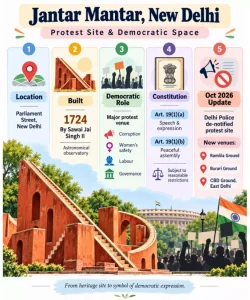
Context: The Delhi Police has de-notified Jantar Mantar as a designated protest site and designated three alternative venues for demonstrations. The decision has renewed debate over balancing the Right to Peaceful Protest, public order, and the rights of local residents.
IAS coaching

About Right to Protest

Right to Protest

  • The Right to Protest is not explicitly mentioned as a standalone Fundamental Right but is protected under Article 19(1)(a) (freedom of speech and expression) and Article 19(1)(b) (right to assemble peaceably and without arms).
  • Reasonable Restrictions: These freedoms are subject to reasonable restrictions under Articles 19(2) and 19(3), respectively, on constitutionally specified grounds, including public order.
  • Not an Absolute Right: Protests must be peaceful and comply with lawful restrictions; the right does not include an unrestricted entitlement to occupy public roads or spaces indefinitely.
  • Judicial Interpretation: In Amit Sahni v. Commissioner of Police (2020), the Supreme Court held that public ways cannot be occupied indefinitely for protests, while recognising the importance of peaceful dissent in a democracy.

Constitutional and Legal Framework

  • Article 19(1)(a): Guarantees freedom of speech and expression, enabling citizens to criticise government policies and communicate grievances.
  • Article 19(1)(b): Guarantees the right to assemble peaceably and without arms, providing the constitutional basis for peaceful demonstrations.
  • Reasonable Restrictions: Articles 19(2) and 19(3) permit constitutionally specified reasonable restrictions on freedom of expression and peaceful assembly, respectively, including restrictions in the interest of public order.
  • Article 21: Protects life and personal liberty. The regulation of demonstrations must also account for the safety, dignity, and lawful interests of residents and commuters.
  • Bharatiya Nagarik Suraksha Sanhita (BNSS), 2023: Section 163 empowers the competent Executive Magistrate to issue orders to prevent specified forms of obstruction, annoyance, injury, or danger in urgent cases, subject to statutory conditions.
  • Doctrine of Proportionality: Restrictions on fundamental rights must pursue a legitimate objective and maintain a reasonable balance between the public interest and the rights affected. The assessment includes rational connection, necessity, the availability of less restrictive alternatives, and balancing of competing interests.

Judicial Position on the Right to Protest

  • Babulal Parate v. State of Maharashtra (1961): Recognised the right of affected persons to challenge a magistrate’s prohibitory order.
  • Ramlila Maidan Incident (2012): Emphasised that preventive restrictions must be based on a genuine threat to public order and exercised cautiously, without arbitrariness.
  • Mazdoor Kisan Shakti Sangathan v. Union of India (2018): Recognised peaceful demonstrations as a fundamental right and held that protests should be regulated through reasonable measures rather than prohibited altogether.
  • Amit Sahni v. Commissioner of Police (2020) — Shaheen Bagh case: The Supreme Court held that public ways and public spaces cannot be occupied indefinitely in a manner that obstructs others. 
    • The judgment emphasised that peaceful dissent must be accommodated without allowing prolonged blockades to deprive other citizens of their rights.

UPSC Coaching Classes

Significance of the Right to Peaceful Protest

  • Democratic Accountability: Protests enable citizens to question government decisions, demand transparency, and hold public authorities accountable.
  • Representation of Marginalised Groups: Demonstrations provide farmers, workers, and disadvantaged communities with a platform to raise grievances that may otherwise receive limited attention.
  • Participatory Democracy: Peaceful assembly complements electoral participation by allowing citizens to engage in public affairs between elections.
  • Policy Responsiveness: Collective mobilisation can bring neglected issues into national debate and encourage legislative or administrative action.
  • Protection of Dissent: The ability to express disagreement peacefully strengthens pluralism, political participation, and the legitimacy of democratic institutions.

Challenges in Regulating Protest

  • Competing Fundamental Rights: Authorities must balance protesters’ freedoms with the rights of residents, commuters, and other users of public spaces without automatically prioritizing one group over another.
  • Proportionality: Police action should correspond to the nature and immediacy of the threat.
  • Public Order and Security: Large gatherings may create traffic congestion, security risks, and difficulties in managing crowds near sensitive government institutions.
  • Residents’ Rights: Noise pollution, sanitation problems, and disruption of daily activities can adversely affect local communities.
  • Restrictions on Dissent: Arbitrary permissions, blanket prohibitions, or inaccessible alternative venues may weaken the practical exercise of constitutional freedoms.
  • Unequal Access: Relocation to distant or poorly connected venues may disproportionately affect groups with limited financial resources.
  • Administrative Discretion: Unclear criteria for granting permissions can create uncertainty and allegations of selective enforcement.

Way Forward

  • Application of Proportionality: Restrictions should satisfy the requirements of legality, legitimate aim, rational connection, and necessity, while adopting the least restrictive effective measure and balancing competing rights.
  • Standard Operating Procedures (SOPs): Develop publicly accessible operational guidelines for Ramlila Ground, Burari Ground, and CBD Ground covering sanitation, crowd capacity, emergency services, security, traffic management, and public transport connectivity.
  • Stakeholder Consultation: Consult protest organisers, civil society groups, local residents, and relevant authorities before changing designated venues or imposing major restrictions.
  • Adequate Infrastructure: Ensure that alternative venues have drinking water, sanitation, accessibility provisions, emergency facilities, and reliable public transport so that relocation does not become a de facto barrier to peaceful assembly.
  • Accountable Policing: Establish clear protocols for crowd management, the use of preventive powers, and the handling of peaceful demonstrators, with appropriate oversight and access to legal remedies.
  • Judicial Oversight: Preserve effective judicial review of restrictions that may disproportionately affect fundamental rights, especially where repeated orders or blanket prohibitions raise concerns about arbitrary state action.

Click to Know UPSC Offline Courses

Conclusion

A democratic state shows its strength in tolerating the dissent it hears, and a democratic citizenry in keeping that dissent peaceful. Our Constitution asks both to remember that order and liberty are not rivals but co-tenants of one republic, and that each is safest when the other is respected.

News Source: Indian Express

Check Out UPSC CSE Books

Visit PW Store

online store 1

Right to Protest in India: Jantar Mantar, Constitutional Rights and Restrictions

Need help preparing for UPSC or State PSCs?

Connect with our experts to get free counselling & start preparing

Free Counselling for UPSC Aspirants

Connect with our experts and take the right next step.

Expert Guidance
Personalized Strategy
100% Free

Book Your Free Session

NEED ASSISTANCE?

Request a Callback

Our counsellor will connect with you and help you choose the right course and centre.

  • Expert Guidance
  • Course & Fee Information
  • Quick Callback Support

Request a Callback

Books
UPSC PYQs
UPSC Notes
Current Affairs
Quick Revise Now !
AVAILABLE FOR DOWNLOAD SOON
UDAAN PRELIMS WALLAH
Comprehensive coverage with a concise format
Integration of PYQ within the booklet
Designed as per recent trends of Prelims questions
हिंदी में भी उपलब्ध
Quick Revise Now !
UDAAN PRELIMS WALLAH
Comprehensive coverage with a concise format
Integration of PYQ within the booklet
Designed as per recent trends of Prelims questions
हिंदी में भी उपलब्ध

<div class="new-fform">


    </div>

    Subscribe our Newsletter
    Sign up now for our exclusive newsletter and be the first to know about our latest Initiatives, Quality Content, and much more.
    *Promise! We won't spam you.
    Yes! I want to Subscribe.