GS Paper 3: Economy
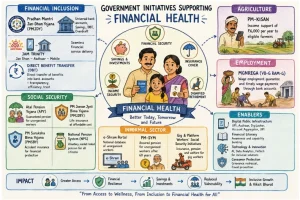
Context: The UN Secretary-General’s Special Advocate for Financial Health highlighted India’s remarkable progress in financial inclusion and argued that the next phase of reforms should focus on financial health—ensuring that citizens can save, invest, manage risks, and build long-term financial resilience.
- According to the World Bank Global Findex Report, the proportion of Indian adults with bank accounts increased from 56% about a decade ago to nearly 89% by 2026.
- This transformation has been driven by the JAM Trinity (Jan Dhan–Aadhaar–Mobile), which has expanded access to banking, digital payments, and government welfare schemes.
IAS coaching
What is Financial Health?
- Financial health refers to an individual’s ability to manage day-to-day finances, withstand unexpected financial shocks, achieve future financial goals, and feel confident about their financial future.
- It is a qualitative measure of financial well-being rather than simply measuring access to financial services.
- Financial health enables individuals to transition from financial survival to financial resilience and prosperity.
Financial Inclusion vis- i – vis Financial Health
| Aspect |
Financial Inclusion |
Financial Health |
| Meaning |
Access to formal financial services such as bank accounts, credit, insurance, and payments. |
Ability to effectively use financial services to meet present needs, withstand shocks, and achieve long-term financial goals. |
| Focus |
Access |
Outcomes and well-being |
| Key Objective |
Bring people into the formal financial system. |
Improve financial security, resilience, and prosperity. |
| Measures of Success |
Number of bank accounts, digital payment users, access to credit, insurance coverage. |
Savings, investment, pension adequacy, debt management, insurance protection, financial resilience, and confidence about the future. |
| Key Question |
Can people access financial services? |
Are financial services improving people’s lives? |
| Approach |
Supply-side (opening accounts, expanding banking infrastructure). |
Demand- and outcome-oriented (helping people make informed financial decisions and build wealth). |
| Example |
A person opens a Jan Dhan account but rarely uses it. |
The same person regularly saves, has insurance, contributes to a pension, and can manage financial emergencies. |
Difference through Amartya Sen’s Capability Approach: Understanding Financial inclusion & Financial Health
- Amartya Sen’s Capability Approach emphasizes that possessing resources alone does not improve well-being.
- Individuals must also possess the capability to utilize those resources effectively.
- Similarly, opening a bank account does not automatically improve financial well-being unless individuals actively use financial products to enhance their lives.
- Therefore, financial inclusion creates opportunities, whereas financial health enables people to convert those opportunities into meaningful outcomes.
Importance of Financial Health
- Financial Resilience: Enables individuals and households to withstand unexpected shocks such as medical emergencies, job losses, or natural disasters without falling into financial distress.
- Reduced Dependence on Informal Credit: Improves access to affordable and regulated formal credit, reducing reliance on high-interest informal lenders and preventing debt traps.
- Savings and Wealth Creation: Encourages regular savings, investments, and asset creation, helping individuals achieve long-term goals such as education, home ownership, and entrepreneurship.
- Retirement Security: Promotes participation in pension and retirement savings schemes, ensuring financial independence and a dignified life after retirement.
- Improved Financial and Mental Well-being: Reduces financial stress and uncertainty, enhances confidence in managing personal finances, and contributes to better mental health and overall quality of life.
- Higher Household Savings: Mobilizes domestic savings into the formal financial system, increasing the availability of capital for productive investments and economic development.
- Deepening Financial Markets: Expands the use of banking, insurance, pension, and investment products, making financial markets broader, more efficient, and inclusive.
UPSC Course Fees Online
Challenges to Achieving Financial Health in India
- Underutilization of Bank Accounts: A significant number of bank accounts remain inactive or are used only for receiving government benefits, limiting their role in savings, investments, and credit access.
- For Example: Out of roughly 56.04 crore PMJDY accounts, about 13.04 crore (roughly 23%) are classified as inoperative (meaning no customer-initiated transactions for two years).
- Low Household Savings among Vulnerable Groups: Low-income households often lack the financial capacity to save regularly, making them highly vulnerable to income shocks and emergencies.
- Limited Pension Coverage: A large proportion of workers in the informal sector remain outside formal pension systems, leaving them financially insecure in old age.
- Inadequate Insurance Penetration: Despite government-backed insurance schemes, health, life, and crop insurance coverage remains insufficient, exposing households to catastrophic financial losses.
- For Example: India’s overall insurance penetration stands at 3.7% of GDP, roughly half the global average of 7.3%. Broken down, life insurance penetration is 2.7% and non-life (including health and crop) is stuck at 1.0%.
- This structural underinsurance exposes households to severe financial distress when faced with health emergencies or agricultural shocks
- Continued Dependence on Informal Borrowing: Many individuals still rely on moneylenders and informal credit due to limited access to affordable formal credit or lack of financial awareness, increasing the risk of debt traps.
- Growing Digital Fraud and Cyber Risks: Rapid digitization of financial services has been accompanied by rising cyber frauds, phishing attacks, and financial scams, undermining consumer trust.
- For Example: According to the RBI Annual Report, financial institutions reported over 10,000 fraud cases (involving \(₹48,021\) crore). While digital payment/card fraud incidents have dropped in volume due to improved real-time AI and multi-layer authentication, large-ticket advances-related fraud continues to dominate the total monetary value lost
- Low Financial Literacy: Many people lack the knowledge and skills to manage savings, investments, insurance, pensions, and digital financial products effectively, reducing the benefits of financial inclusion.
- For Example: An OECD PISA report found that roughly 20% of 15-year-olds globally lack basic financial literacy, struggling to safely navigate digital finance, mobile payments, and online security risks.
- Persistent Gender and Regional Gaps: Women, migrant workers, and people in remote areas often face barriers in actively using financial services despite owning bank accounts, limiting inclusive economic participation.
Role of FinTech in Improving Financial Health
- AI-based Financial Advisory: Artificial Intelligence can provide personalized financial guidance on budgeting, savings, investments, retirement planning, and debt management, enabling informed financial decision-making.
- Responsible Digital Lending: FinTech platforms leverage alternative data and AI-driven credit assessment to provide quick, affordable, and responsible credit while minimizing the risk of over-indebtedness.
- Financial Health Scores: Digital platforms generate financial health scores based on savings, spending patterns, debt levels, and repayment behaviour, helping individuals monitor and improve their financial well-being.
- Digital Pension and Social Security Enrollment: FinTech simplifies enrollment and contribution to pension and insurance schemes such as NPS and APY through paperless, mobile-based platforms, improving coverage among informal and gig workers.
- Personalized Savings and Investment Solutions: AI-powered applications recommend customized savings goals, automated investments, and wealth management strategies based on an individual’s income, expenditure, and financial objectives.
- Fraud Detection and Cybersecurity: Advanced analytics, machine learning, and real-time transaction monitoring help detect suspicious activities, prevent cyber fraud, and strengthen trust in digital financial services.
Financial Health in Developed Countries
- Universal Financial Inclusion: Countries such as Sweden and Norway have near-universal bank account ownership and cashless payment systems, ensuring easy access to formal financial services.
- Comprehensive Social Security: The Netherlands has one of the world’s strongest multi-pillar pension systems, while Singapore’s Central Provident Fund (CPF) integrates retirement, healthcare, and housing savings.
- Advanced Digital Financial Ecosystem: The United Kingdom’s Open Banking framework and Australia’s Consumer Data Right (CDR) enable secure data sharing, personalized financial products, and improved credit access.
- Financial Literacy and Consumer Protection: Canada’s National Financial Literacy Strategy and the UK’s Money and Pensions Service (MaPS) promote financial awareness, supported by strong consumer protection regulations.
- Focus on Financial Well-being: The United States’ Financial Health Network and Canada’s Financial Well-being Index measure financial health using indicators such as savings, debt, insurance, retirement readiness, and resilience rather than merely bank account ownership.
Way Forward
- Transform PMJDY into Jan Dhan 2.0: Convert Jan Dhan accounts into comprehensive financial wellness platforms by integrating pensions, insurance, savings, credit, and government welfare schemes.
- Universalize Pension and Insurance Coverage: Expand affordable pension and insurance schemes, especially for informal workers, gig workers, and other vulnerable groups, to strengthen social security.
- Strengthen Financial Literacy: Scale up financial education through schools, digital platforms, Self-Help Groups (SHGs), Banking Correspondents, and community outreach programmes to improve financial capability.
- Leverage AI and Digital Public Infrastructure: Use AI-driven financial advisory services and Digital Public Infrastructure (UPI, Account Aggregator, ULI, DigiLocker) to provide personalized, secure, and responsible financial solutions.
- Enhance Consumer Protection: Strengthen regulatory oversight, cyber security, grievance redressal mechanisms, and fraud prevention systems to build trust in the financial ecosystem.
- Improve Convergence of Welfare Schemes: Ensure seamless interoperability between PMJDY, DBT, e-Shram, PM-KISAN, APY, PMJJBY, PMSBY, and other social protection programmes to maximize benefits.
- Develop a National Financial Health Index: Create a comprehensive index to assess household financial resilience using indicators such as savings, debt, insurance, pension coverage, and financial well-being, enabling evidence-based policymaking.
- Promote Public–Private Partnerships: Foster collaboration among the Government, RBI, banks, fintech companies, employers, insurers, and civil society to expand access to affordable and innovative financial products while ensuring consumer welfare.
Click to Know UPSC Offline Courses
Conclusion
India has successfully expanded financial inclusion, but the next stage of development lies in achieving financial health. A resilient financial ecosystem—combining savings, pensions, insurance, responsible credit, and digital public infrastructure—will empower households to withstand shocks, build wealth, and contribute to the vision of Viksit Bharat 2047.
 13 Jul 2026