UPSC PYQs

Prelims, Mains & Optional PYQs

UPSC Notes

Comprehensive & Short Notes

Uniform Civil Code (UCC): Article 44, State Laws & Constitutional Debate

15 Sep 2026

Uniform Civil Code (UCC): Article 44, State Laws & Constitutional Debate

Subject: GS 2: Polity & Governance

Context: The Union Home Minister recently said that the Uniform Civil Code (UCC) will be implemented by 2029 across all 21 BJP/NDA-ruled States, renewing debate over its constitutional basis, legislative competence and State-level implementation.
IAS coaching

About Uniform Civil Code (UCC)

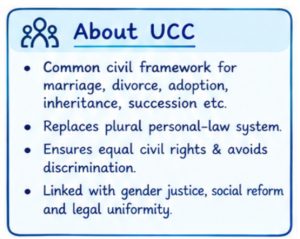
  • Common Civil Framework: Uniform Civil Code (UCC) refers to a common framework of civil laws governing personal matters such as marriage, divorce, adoption, inheritance and succession, irrespective of the religion of the individuals concerned.
  • Uniform Civil CodeExisting Plural Legal System: India presently follows a plural personal-law system, where different religious communities may be governed by different personal laws and customary practices in matters relating to family and personal affairs.

  • Uniformity in Civil Rights: The idea of UCC seeks to establish common civil rules for citizens, particularly where differences in personal laws may result in unequal rights or discriminatory outcomes.
  • Equality and Gender Justice: UCC is primarily associated with equality before law, gender justice, social reform and legal uniformity, rather than uniformity in every aspect of Indian law.
  • Balancing Diversity: Its implementation requires a balance between common civil standards and India’s religious, cultural and customary diversity.

Constitutional Basis of UCC

Uniform Civil Code

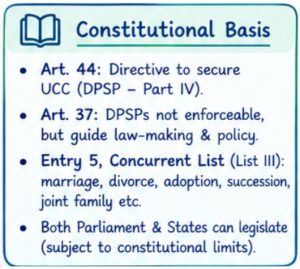
  • Article 44 – Constitutional Directive: Article 44 directs the State to endeavour to secure a Uniform Civil Code for citizens throughout India, making UCC an explicit constitutional objective.
  • Entry 5, Concurrent List – Subject Matter: Entry 5 of the Concurrent List (List III) covers marriage and divorce, infants and minors, adoption, wills, intestacy and succession, joint family and partition, among related matters.
  • Concurrent Legislative Power: Since these subjects fall under the Concurrent List, both Parliament and State Legislatures can legislate on them, subject to constitutional provisions and limitations.

Law Commission and Judicial Perspective

Uniform Civil Code

  • 21st Law Commission (2018): Its Consultation Paper on Reform of Family Law stated that a UCC was “neither necessary nor desirable at this stage”, favouring reform of discriminatory provisions within existing personal laws.
  • 22nd Law Commission (2023): Reopened the issue and invited fresh views from the public and recognised religious organisations, citing developments since the 2018 consultation.
  • Judicial Approach: The Supreme Court has repeatedly dealt with questions concerning personal law, gender equality, secularism and constitutional rights, making the relationship between personal laws and Fundamental Rights an important dimension of the UCC debate.

Need for Uniform Civil Code

Uniform Civil Code

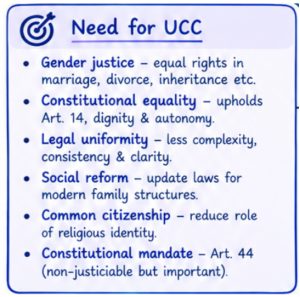
  • Gender Justice: UCC can eliminate discriminatory provisions in personal laws and secure equal rights for women in marriage, divorce, maintenance, inheritance and succession.
    • Example: Uttarakhand’s UCC provides equal inheritance rights to daughters and sons in ancestral property.
  • Constitutional Equality: Different personal laws may create differential rights based on religion. A common framework can strengthen equality before law under Article 14 and uphold liberty, dignity and personal autonomy.
  • Legal Uniformity: Multiple personal-law regimes can create complexity, inconsistencies and legal ambiguity. A common framework can make family and succession laws more consistent, predictable and accessible.
  • Social Reform and Modernisation: UCC can facilitate reform of practices inconsistent with constitutional values, while updating family laws to address changing family structures, women’s economic rights and contemporary social realities.
  • Common Citizenship: A common set of civil rules can promote national integration and common citizenship by reducing the role of religious identity in civil matters, without requiring uniformity in religious beliefs or practices.
  • Constitutional Mandate: Article 44 directs the State to endeavour to secure a UCC. Though non-justiciable, it remains an important constitutional objective and provides a basis for legislative efforts toward uniform civil laws.

UPSC Coaching Classes

State-Level Implementation in India

  • Uttarakhand: Became the first State to bring a comprehensive UCC into force, implementing it in January 2025. It provides common rules on marriage, divorce, inheritance and succession, prohibits polygamy and mandates marriage registration.
    • The Uttarakhand framework also provides for registration of live-in relationships and their termination, making it a distinctive feature of the State’s model.
  • Gujarat: Its Assembly passed a UCC Bill in March 2026, broadly covering marriage, divorce, succession and live-in relationships.
  • Assam: Passed its UCC Bill in May 2026, covering marriage, divorce, succession and live-in relationships and prohibiting polygamy.
  • Madhya Pradesh: Passed its UCC Bill in July 2026, with additional provisions concerning adoption, triple talaq and nikah halala.
  • Scheduled Tribes: State-level UCC frameworks provide exemptions for Scheduled Tribes, recognising their distinct customs and constitutional protections.

Major Issues Associated With UCC

  • Religious Freedom: A UCC must be reconciled with Article 25, which guarantees freedom of conscience and the right to profess, practise and propagate religion, subject to constitutional limitations.
  • Cultural and Customary Diversity: India’s diverse tribal, regional and customary practices, particularly in the Northeast, make complete uniformity legally and socially complex.
  • Tribal Constitutional Protections: A common civil framework must account for constitutional safeguards protecting tribal customs and customary laws.
  • Federalism: The Concurrent List allows both the Union and States to legislate on relevant subjects, making cooperative federalism and coordination important for implementation.
  • Uniformity vs Pluralism: The central challenge is to determine what should be made uniform and what legitimate cultural or customary differences should be retained.

Way Forward

  • Consultative Approach: Build UCC through wide consultations with States, religious communities, tribal groups, women’s organisations, legal experts and civil society.
  • Rights-Based Reform: Prioritise gender equality, individual dignity and constitutional rights rather than uniformity for its own sake.
  • Gradual Harmonisation: Begin by identifying and removing clearly discriminatory provisions across personal laws before moving towards broader common standards.
  • Protection of Diversity: Provide carefully defined safeguards for legitimate tribal and customary practices consistent with constitutional rights.
  • State-Level Learning: Evaluate the experience of States such as Uttarakhand, Gujarat, Assam and Madhya Pradesh and identify provisions that can form the basis of wider national standards.
  • Constitutional Balance: Ensure that any UCC respects the balance between Articles 14, 15, 21, 25 and 44, thereby combining equality and individual rights with religious freedom and constitutional pluralism.

Click to Know UPSC Coaching Centres in India

Conclusion

A UCC can advance the constitutional goals of equality, dignity and gender justice, but its legitimacy will depend on the process through which it is framed. A consensus-based, rights-oriented and diversity-sensitive approach would better reconcile the constitutional aspiration of Article 44 with India’s plural social fabric.

News Source: The Hindu

Check Out UPSC CSE Books

Visit PW Store

online store 1

Uniform Civil Code (UCC): Article 44, State Laws & Constitutional Debate

Need help preparing for UPSC or State PSCs?

Connect with our experts to get free counselling & start preparing

Free Counselling for UPSC Aspirants

Connect with our experts and take the right next step.

Expert Guidance
Personalized Strategy
100% Free

Book Your Free Session

NEED ASSISTANCE?

Request a Callback

Our counsellor will connect with you and help you choose the right course and centre.

  • Expert Guidance
  • Course & Fee Information
  • Quick Callback Support

Request a Callback

Books
UPSC PYQs
UPSC Notes
Current Affairs
Quick Revise Now !
AVAILABLE FOR DOWNLOAD SOON
UDAAN PRELIMS WALLAH
Comprehensive coverage with a concise format
Integration of PYQ within the booklet
Designed as per recent trends of Prelims questions
हिंदी में भी उपलब्ध
Quick Revise Now !
UDAAN PRELIMS WALLAH
Comprehensive coverage with a concise format
Integration of PYQ within the booklet
Designed as per recent trends of Prelims questions
हिंदी में भी उपलब्ध

<div class="new-fform">


    </div>

    Subscribe our Newsletter
    Sign up now for our exclusive newsletter and be the first to know about our latest Initiatives, Quality Content, and much more.
    *Promise! We won't spam you.
    Yes! I want to Subscribe.