Recently, the US official waiver for India to access Iran’s Chabahar Port expired, placing significant pressure on India’s independent foreign policy. India must now navigate its relationship with Iran while managing its partnership with the United States.
Best Online Coaching for UPSC
Strategic Importance of Chabahar
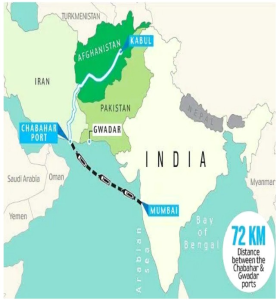
- Located in Iran’s Sistan-Baluchistan province, it allows India to bypass Pakistan to reach Afghanistan and Central Asia.
- India has invested approximately $620 million in the port, specifically developing the Shahid Behesti terminal.
India’s Dilemma
India’s core challenge is balancing its Strategic Autonomy with its economic dependencies.
| PWONLYIAS ExtraEdge
Key Terms:
- Sanctions: These are economic penalties imposed by the U.S. on Iran. The U.S. uses the threat of these sanctions to pressure other nations, including India, to halt trade and investment in Iranian projects like Chabahar.
- Waiver: Previously, the U.S. granted India a specific “waiver” or exemption to continue work at Chabahar.
- This was allowed because a stable Afghanistan (supported by Indian humanitarian aid through the port) served U.S. interests.
- However, this waiver contained a “sunset clause” that expired on April 26, 2026.
|
- Option A: Maintain Engagement with Iran. India has invested $620 million in the Chabahar Port (specifically the Shahid Behesti terminal) to bypass Pakistan and gain access to Afghanistan and Central Asia. Abandoning this would mean losing a critical strategic corridor and wasting significant financial investment.
- Option B: Yield to U.S. Pressure. The U.S. is India’s largest trading partner. Resisting U.S. demands could lead to secondary sanctions, damaging India’s broader economic interests and its primary export market.
Key Points
- US Pressure and Sanctions: The US previously allowed a waiver because a stable Afghanistan was in its interest. However, with the waiver ending and the US-Iran tensions rising, India is under “maximum pressure” to reduce engagement.
- JCPOA Background: The 2015 nuclear deal (JCPOA) initially eased sanctions, but the US withdrawal in 2017 under Donald Trump re-imposed them, derailing India’s progress.
- Multi-Alignment Strategy: India follows a policy of engaging America, managing China, cultivating Europe, and reassuring Russia.
- This “tightrope walk” is essential as the US is India’s biggest trade partner, yet Iran is vital for connectivity.
- Current Status: India has withdrawn its staff and handed the Shahid Behesti terminal back to Iranian authorities, though it remains open for future re-engagement.
Historical Timeline: Start–Stop Engagement (2003–2026)
- 2003 – Vajpayee Era: In 2003, India signed its first Memorandum of Understanding (MoU) for the development of Chabahar Port.
- However, progress was delayed due to pressure from the United States over Iran’s nuclear program.
- 2004–2013 – Manmohan Singh Government: During this period, progress on the Chabahar Port project remained limited.
- Nevertheless, India achieved a major strategic milestone as the Border Roads Organisation (BRO) constructed the Zaranj–Delaram Highway in Afghanistan.
- 2015 – JCPOA Agreement: In 2015, Iran agreed to curb its nuclear program under the Joint Comprehensive Plan of Action (JCPOA).
- As a result, the United States lifted sanctions on Iran.
- This created a favorable environment and opened a window of opportunity for India to advance the Chabahar project.
- 2016 – Modi Era: In 2016, a trilateral agreement was signed between India, Iran, and Afghanistan.
- This agreement operationalized a trade and aid corridor through Chabahar.
- Consequently, the project gained significant momentum.
- 2018–2020 – Trump Administration Pressure: The United States withdrew from the JCPOA and reimposed sanctions on Iran.
- The “maximum pressure” campaign against Iran was resumed.
- As a result, India was compelled to halt oil imports from Iran and cancel related infrastructure plans.
- 2026 – Waiver Expired: In 2026, the sanctions waiver granted to India for Chabahar operations expired.
- India began withdrawing its personnel from the project.
- It is also considering transferring its stake in the Shahid Beheshti terminal to an Iranian entity.
Way Forward
- Continued Diplomatic Engagement: India should continue diplomatic engagement with all key stakeholders, including the United States, Iran, and regional partners, to balance its strategic and economic interests.
- Such engagement will help India manage geopolitical pressures while safeguarding long-term connectivity goals.
- Keeping Strategic Options Open: India must keep its strategic options open for future re-engagement with Iran, especially in projects like Chabahar Port.
- This is important because Chabahar remains a long-term strategic asset for regional connectivity and access to Central Asia.
- Diversification of Trade and Connectivity: India should diversify its trade routes and connectivity corridors to reduce dependence on any single route or geopolitical partner.
- Strengthening alternative corridors and integrating projects like Chabahar with broader networks will enhance resilience and economic security.
Click to Explore UPSC Offline Coaching
Conclusion
Chabahar is not just about Afghanistan; it is a gateway to the International North-South Transport Corridor (INSTC). While India has retreated temporarily under pressure, maintaining strategic autonomy is crucial for its long-term connectivity goals in Central Asia.
 27 Apr 2026