GS II: Indian Constitution-historical underpinnings, evolution, features, amendments, significant provisions, and basic structure.
Context: The Cockroach Janta Party (CJP) protest march towards Parliament and the subsequent police action have revived the debate on the constitutional right to protest, its reasonable restrictions, and the balance between civil liberties and public order.
- Highlights the constitutional balance between Fundamental Rights (Part III) and the State’s duty to maintain public order under Entry 1, State List.
What is the Right to Protest?
- The Right to Protest is a Fundamental Right derived from Article 19 of the Constitution. Though not explicitly mentioned, it flows from:
- Article 19(1)(a): Freedom of speech and expression
- Article 19(1)(b): Right to assemble peacefully without arms
- Article 19(1)(c): Right to form associations
UPSC Course Fees Online
Reasonable Restrictions (Article 19)
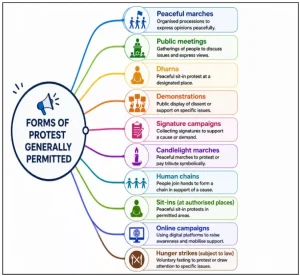
- The State may impose restrictions in the interests of:
- Sovereignty and integrity of India
- Security of the State
- Public order
- Friendly relations with foreign States
- Decency or morality
- Contempt of court
- Defamation
- Incitement to an offence
- Thus, peaceful, non-violent protest is constitutionally protected.
Constitutional Basis
- Article 19(1)(a): Freedom of speech and expression
- Article 19(1)(b): Right to assemble peacefully without arms
- Article 19(1)(c): Right to form associations
- Article 21: Right to life and personal liberty, including dignified democratic participation
Legal Framework Governing Protests
- Bharatiya Nagarik Suraksha Sanhita (BNSS), 2023:
- Section 163 (successor to Section 144 CrPC) empowers Executive Magistrates to prohibit:
- Unlawful assemblies
- Public gatherings
- Processions
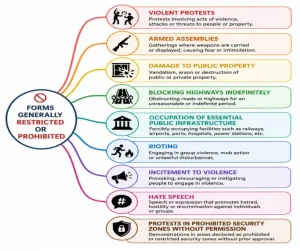 Activities likely to disturb public peace
- Used to prevent:
- Riots
- Violence
- Communal tension
- Threats to public safety
- Police Permission: Most States require prior permission for:
- Public meetings
- Rallies
- Marches
- Demonstrations
- Use of loudspeakers
- Purpose: Traffic management, Security, Emergency services & Public convenience
- Designated Protest Sites:
- Jantar Mantar (Delhi)
- Ramlila Maidan
- Azad Maidan (Mumbai)
- Purpose: Balance democratic rights with public order.
Landmark Judgements
- Himat Lal K. Shah v. Commissioner of Police (1973): Held that peaceful assembly is a Fundamental Right.
- The State may regulate the use of public spaces, but regulation cannot become an arbitrary prohibition.
- Recognised the Right to Protest and established that restrictions must be reasonable, fair, and non-arbitrary.
- Mazdoor Kisan Shakti Sangathan (MKSS) v. Union of India (2018): Held that peaceful protests should be regulated, not prohibited.
- Suggested limiting participants, maintaining distance from sensitive institutions, prohibiting weapons, and continuing designated protest sites.
- Reaffirmed that reasonable regulation is constitutionally valid.
- Amit Sahni v. Commissioner of Police (2020) (Shaheen Bagh Case): Held that public roads cannot be blocked indefinitely.
- Directed that protests should be held at designated places.
- Clarified that Fundamental Rights of protesters cannot extinguish the rights of commuters and other citizens.
UN Position and India’s Stand
- At the 47th Session of the UN Human Rights Council (2021), India stated:
- Peaceful assembly is a cherished democratic tradition.
- Non-violent protests were central to India’s freedom struggle.
- The Constitution guarantees peaceful assembly.
- The State must balance:
- Freedom of protest
- Protection of life
- Public order
Issues in Regulation of Protests
- Frequent Use of Section 163 BNSS: May disproportionately restrict peaceful assembly.
- Excessive Police Action: Allegations involving lathi charges, tear gas, and detentions.
- Permission Delays: Lack of transparency may undermine constitutional freedoms.
- Rights vs Public Order: Balancing civil liberties, security, and essential services.
- No Uniform Framework: Different standards across States.
- Digital Surveillance: Use of CCTV, facial recognition, and digital monitoring raises privacy concerns.
- Security–Freedom Balance: Ensuring national security without unnecessarily restricting democratic dissent.
UPSC Online Preparation
Right to Protest in Other Countries:
- United States: Protected under the First Amendment; subject to time, place, and manner restrictions and permits for large gatherings.
- United Kingdom: Protected under the Human Rights Act, 1998 (Article 11, ECHR); restrictions permitted to prevent serious disruption and maintain public order.
- Germany: Protected under Article 8 of the Basic Law; requires prior notification and prohibits violent or armed assemblies.
- France: Recognised under constitutional principles; prior notification required and restrictions allowed for public security.
- Canada: Protected under Section 2 of the Canadian Charter; subject to reasonable limits for public safety and public order.
- South Africa: Protected under Section 17 of the Constitution; only peaceful protests are protected, while violence and property damage are prohibited.
- Singapore: Protected under Article 14 of the Constitution but generally requires a police permit and is subject to strict public order regulations.
- China: Article 35 of the Constitution recognises the right, but government approval is required and protests are strictly regulated in practice.
|
Way Forward
- Promote Peaceful Protests: Ensure demonstrations remain peaceful, lawful, and respect public property.
- Transparent Permissions: Adopt clear, objective, and time-bound approval procedures.
- Proportionate Restrictions: Ensure restrictions satisfy reasonableness and proportionality.
- Prioritise Dialogue: Encourage consultation before coercive action.
- Strengthen Judicial Oversight: Prevent arbitrary prohibitory orders.
- Develop Protest Spaces: Create well-planned designated protest sites.
- Use Smart Management: Prefer technology-enabled crowd management over blanket bans.
- Protect Democracy: Balance Fundamental Rights with public order in accordance with constitutional principles.
Click to Know UPSC OnlyIAS Coaching Centres
Conclusion
The right to peaceful protest is a cornerstone of India’s constitutional democracy, enabling citizens to participate in governance and hold authorities accountable. While subject to reasonable restrictions, regulation must remain fair, proportionate, and non-arbitrary, ensuring a balance between individual freedoms and public order.
 23 Jul 2026