World AI Cooperation Organisation (WAICO)
Context: China launched the World AI Cooperation Organisation (WAICO) at the World Artificial Intelligence Conference 2026 in Shanghai to promote a Global South-centric AI governance framework.
UPSC Online Courses
About World AI Cooperation Organisation (WAICO)
- WAICO is a China-led intergovernmental organisation established to promote international cooperation in Artificial Intelligence (AI), particularly among developing countries, and to build an alternative framework for global AI governance.
- Establishment: Officially established on 16 July 2026 in Shanghai, China, during the World Artificial Intelligence Conference (WAIC).
- The WAIC 2026 was held in Shanghai, China, under the central theme “Intelligent Partners, Co-Creating the Future”.
- Headquarters: Shanghai, China
- Key Partners
- Founding Members: total 29 including China, Russia, Brazil, South Africa, Indonesia, Malaysia, Pakistan, Kazakhstan and other Global South countries
- India has not signed the agreement
- International Engagement: Supported by the United Nations as an observer and collaborates with regional groupings such as BRICS, ASEAN, the African Union (AU), and the Shanghai Cooperation Organisation (SCO).
- Objectives
- Promote Inclusive AI Development: Bridge the global AI divide by improving AI access, capacity and innovation in developing countries.
- Strengthen Global AI Governance: Develop a multilateral AI governance framework based on cooperation, digital sovereignty and responsible AI use.
- Enhance AI Innovation: Facilitate technology sharing, research collaboration and open-source AI development among member countries.
- Key Initiatives
- AI Capacity Building: China will provide 5,000 AI training opportunities and establish AI cooperation centres across partner countries.
- Open-Source AI Ecosystem: Encourages sharing of open-source AI models, technology transfer and collaborative AI research.
- Global South Cooperation: Expands AI partnerships with BRICS, ASEAN, AU, Latin American countries and the SCO to strengthen digital capabilities.
- Alternative AI Governance Framework: Promotes multilateral AI standards while opposing unilateral technology restrictions and advocating digital sovereignty.
Colobus Congoensis
Context: Scientists have identified Colobus congoensis, a new monkey species from the Democratic Republic of Congo, highlighting the Congo Basin’s rich yet threatened biodiversity.
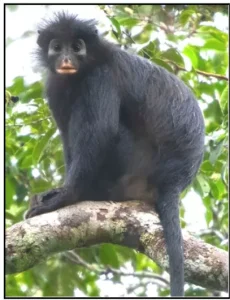
About Colobus congoensis

- Colobus congoensis (locally known as Likweli) is a newly identified Old World monkey endemic to the Democratic Republic of Congo (DRC).
- It is the fifth African monkey species discovered in the last 75 years.
- Discovery: The species was first photographed in 2008 and officially described in 2026 after extensive genetic, morphological and acoustic studies.
- Distribution and Habitat: It is confined to a small range of about 1,700 sq. km between the Lomami and Congo Rivers in the Congo Basin.
- It inhabits closed-canopy upland tropical forests with deep clay soils, making it highly vulnerable to habitat fragmentation.
- Most of its known habitat lies within Lomami National Park.
- Key Features
- The monkey has a glossy black coat, distinctive orange-cream facial markings, large folded ears, a long tail, and a white anal patch.
- Like other colobus monkeys, it lacks a functional thumb, an adaptation that aids efficient movement through forest canopies.
- It is herbivorous, feeding mainly on leaves and shoots using a specialised foregut fermentation digestive system similar to that of ruminants like Cow.
- Genetic studies indicate that its closest living relative is the Black Colobus (Colobus satanas), from which it diverged around 4–5 million years ago.
- Conservation Status: It has not yet been formally evaluated or added to the official IUCN Red List.
- Researchers have recommended listing the species as Endangered on the IUCN Red List because of its restricted distribution, small population, habitat loss and hunting pressure.
New and Old World Monkeys
- Old World Monkeys inhabit Africa and Asia, feature downward-facing nostrils, and lack prehensile tails.
- Examples include Baboons, Mandrills, and Macaques.
- New World Monkeys live in Central and South America, possess wide-spaced, sideways-facing nostrils, and often have prehensile tails for gripping branches.
- Examples include Howler Monkeys, Spider Monkeys, and Capuchins.
Prime Minister’s National Apprenticeship Promotion Scheme (PM-NAPS)
Context: The Ministry of Skill Development and Entrepreneurship extended the PM-NAPS special intervention for the North-Eastern Region (NER) for FY 2026–27 with enhanced targets and funding.
About the Prime Minister’s National Apprenticeship Promotion Scheme (PM-NAPS)
- PM-NAPS is a flagship apprenticeship promotion scheme launched in 2016 and implemented under the Apprentices Act, 1961.
- It promotes structured, paid on-the-job training by integrating classroom learning with workplace experience to improve youth employability under the Skill India Mission.
- Key Objectives
- Develop a highly skilled workforce through industry-oriented apprenticeship training.
- Encourage employers to engage apprentices by providing financial incentives and stipend support.
- Bridge the gap between formal education and industry skill requirements while improving employment opportunities.
- Funding: The Government provides partial stipend reimbursement and financial incentives to employers through Direct Benefit Transfer (DBT).
- For the North-Eastern Region (FY 2026–27), a financial outlay of ₹57.58 crore has been allocated under the NER component of PM-NAPS.
- Nodal Ministry
- The scheme is implemented by the Ministry of Skill Development and Entrepreneurship (MSDE).
- The Indian Institute of Entrepreneurship (IIE), Guwahati, is the implementing agency for the special intervention in the North-Eastern Region.
- Key Targets
- The FY 2026–27 intervention aims to support 30,000 apprentices, including 15,000 placements within the North-East and 15,000 opportunities outside the region, including Government departments and Public Sector Undertakings (PSUs).
- Apprentices engaged within their home States in the North-East are also eligible for the additional incentive of ₹1,500 per month.
- PM-NAPS strengthens the apprenticeship ecosystem through industry partnerships, awareness programmes and institutional collaboration, promoting inclusive growth, regional development and a skilled workforce aligned with India’s economic needs.
Futures & Options (F&O)
Context: India’s rapidly expanding Futures & Options (F&O) market has renewed concerns over rising retail investor losses, prompting calls for stronger regulatory safeguards.
- A July 2025 SEBI study revealed that over 90% of individual traders incurred heavy losses over the four-year period from FY22.
About Futures & Options (F&O)
- Futures and Options (F&O) are derivative contracts whose value is derived from an underlying asset such as equities, indices, commodities or currencies. They are primarily used for hedging, speculation and price discovery.
- Types of F&O
- Futures Contract: A legally binding agreement to buy or sell an underlying asset at a predetermined price on a specified future date.
- Options Contract: Gives the buyer the right, but not the obligation, to buy (Call Option) or sell (Put Option) an underlying asset at a predetermined price before or on expiry.
- Key Features
- Enables risk management through hedging against adverse price movements.
- Provides leverage, allowing investors to take larger market positions with relatively lower capital.
- Facilitates efficient price discovery and enhances market liquidity.
- Trades are standardised and settled through recognised stock exchanges.
- Regulation: The Securities and Exchange Board of India (SEBI) regulates India’s derivatives market.
- Trading takes place on recognised exchanges such as the National Stock Exchange (NSE) and the Bombay Stock Exchange (BSE) under SEBI’s regulatory framework.
Click to Know UPSC Coaching Centres in India
PV Sindhu Wins Japan Open Super 750 Title
Context: PV Sindhu won the Japan Open Super 750 title by defeating Japan’s Akane Yamaguchi 21-17, 21-17 in the final, securing her first BWF (Badminton World Federation) Super 750 title since 2018.

Key Highlights
- Historic Achievement: She became the first Indian shuttler to win a major badminton title in Japan.
- Third Elite BWF World Tour Title: This is Sindhu’s third Super 750/1000-level title, after:
- China Open (2016), BWF World Tour Finals (2018), Japan Open Super 750 (2026)