Breakthrough Prize 2026
Context: Recently, the Breakthrough Prize Foundation has announced the 2026 Breakthrough Prize laureates.
UPSC Online Courses
About the Breakthrough Prize
- Founders of the Award: The Breakthrough Prizes were founded in 2013 by Sergey Brin, Priscilla Chan and Mark Zuckerberg, Yuri and Julia Milner, and Anne Wojcicki.
- Prestige & Recognition: It is often called the “Oscars of Science,” recognising path-breaking work in Life Sciences, Fundamental Physics, and Mathematics.
- Prize Amount: Each Breakthrough Prize carries a monetary award of 3 million dollars, which is significantly higher than the Nobel Prize amount of about 1 million dollars.
- Cumulative Funding: Over $340 million awarded since inception.
- Life Sciences Prizes, 2026:
- Stuart Orkin and Swee Lay Thein: Orkin and Thein’s findings about how the body switches between foetal and adult haemoglobin led to the development of Casgevy, the first CRISPR-based medicinal treatment approved anywhere in the world for any disease.
- Casgevy works by ‘editing’ patients’ own blood stem cells.
- Jean Bennett Katherine High and Albert Maguire: Development of the first FDA-approved gene therapy (Luxturna), which restores vision in patients with Leber Congenital Amaurosis—a rare genetic disorder that often leads to complete blindness by early adulthood.
- Rosa Rademakers and Bryan Traynor: Identification of a major genetic cause of amyotrophic lateral sclerosis (ALS) and frontotemporal dementia.
- Mathematics Prize, 2026:
- Frank Merle: Contributions to nonlinear wave equations and instability in dynamic systems
- Fundamental Physics Prize, 2026:
- Collaborations at CERN Brookhaven National Laboratory and Fermilab: for efforts to measure the magnetic moment of the muon, a subatomic particle, with extraordinary precision.
- David Gross: He was awarded the Special Breakthrough Prize for his lifetime contributions to theoretical physics, particularly for developing the theory of the strong nuclear force.
- Other Awards and Initiatives:
- Vera Rubin New Frontiers Prize: Newly introduced to recognise early-career women physicists (within two years of PhD).
- New Horizons Prizes: Fifteen early-career researchers shared six prizes across physics and mathematics, encouraging emerging talent.
- Maryam Mirzakhani New Frontiers Prize: Awarded to women mathematicians to promote excellence and gender diversity in mathematics.
National Nutrition Fortnight (Poshan Pakhwada)
Context: Ahilyanagar district ranked first nationally in the 8th National Nutrition Fortnight campaign, highlighting grassroots success in nutrition awareness.
About National Nutrition Fortnight (Poshan Pakhwada) Awareness Campaign
- National Nutrition Fortnight is a nationwide awareness campaign aimed at improving nutritional outcomes, especially among women, children, and vulnerable groups.
- Launch: The initiative is part of the broader POSHAN Abhiyaan (National Nutrition Mission), launched by the Government of India on March 8, 2018.
- To accelerate malnutrition reduction efforts, the government designated September as “Poshan Maah” (Nutrition Month) and March/April as “Poshan Pakhwada” (Nutrition Fortnight)
- Implementation: Led by the Ministry of Women and Child Development (MoWCD) under Mission Poshan 2.0, utilizing the Anganwadi network for ground-level activities.
- Key Features
- Thematic Focus: Each year centres on a specific theme.
- 2026 Focus:“Brain Development in the First Six Years of a Child’s Life.”
- Mass Awareness Activities: Includes campaigns such as rallies, workshops, home visits, and community engagement programmes.
- Community Participation: Involves Anganwadi workers, self-help groups, and local institutions for last-mile outreach.
- Data-driven Monitoring: Activities and outcomes are tracked digitally to ensure effective implementation.
- Significance
- Improving Child Development: The campaign promotes early childhood nutrition, crucial for cognitive and physical growth.
- Reducing Malnutrition: It addresses issues like stunting, wasting, and anemia through awareness and behavioural change.
- Strengthening Public Health Systems: It enhances coordination between health, nutrition, and sanitation services.
- Promoting Behavioural Change: It encourages better dietary practices, maternal care, and hygiene at the household level.
Adi Shankaracharya Jayanti
Context: Recently Prime Minister Narendra Modi paid tributes to Adi Shankaracharya on his Jayanti highlighting his role in reviving spiritual unity and Advaita Vedanta.
About Adi Shankaracharya Jayanti (Annual Celebration)
- Adi Shankaracharya Jayanti is observed annually to commemorate the birth anniversary of Adi Shankaracharya, celebrating his contributions to Hindu philosophy and spiritual revival.
- It is celebrated annually on Panchami Tithi of Shukla Paksha in the month of Vaishakha which was celebrated on April 21 in 2026.
- It is marked by prayers, discourses, and remembrance of his teachings on unity, knowledge, and non-dualism across India.
About Adi Shankarach
- Adi Shankaracharya was an 8th-century Indian philosopher and theologian who consolidated Hindu thought through Advaita Vedanta and institutional reforms.
- Early Life: Born in Kalady, Kerala, he became a monk early, studied under Govinda Bhagavatpada, and mastered Vedic scriptures within a short lifespan.
- Key Contributions
- Advaita Vedanta Philosophy: He propounded non-dualism, asserting the unity of Atman and Brahman, and explaining worldly diversity through the concept of Maya.
- Revival of Sanatan Dharma: He revitalised Vedic traditions during a period of ritual rigidity and philosophical fragmentation.
- Establishment of Four Maths: He institutionalised spiritual learning by founding four mutts at Sringeri, Dwarka, Puri, and Jyotirmath to ensure cultural unity.
- Literary Contributions: He authored commentaries on Upanishads, Bhagavad Gita, and Brahma Sutras, along with texts like Vivekachudamani.
- Cultural Integration (Panchayatan Puja): He promoted inclusive worship practices unifying major Hindu deities under a single philosophical framework.
- Disciples
- Padmapada: A devoted disciple who propagated Advaita teachings and established monastic centres.
- Totakacharya: Known for devotion and composing Totakashtakam, reflecting spiritual dedication.
- Hastamalaka: Recognised for innate philosophical clarity and deep understanding of non-dualism.
- Sureshvara: Former scholar Mandana Misra who became a key interpreter of Advaita philosophy.
- Relevance of His Teachings: His philosophy promotes unity, rational spirituality, and inner awakening, offering solutions to modern social divisions, materialism, and ethical challenges through the idea of oneness and knowledge.
UPSC Online Preparation
Odisha Becomes First State to Launch Marine Spatial Plan
Context: Odisha has become India’s first state to implement Marine Spatial Planning.
What is Marine Spatial Planning (MSP)?
- MSP is a scientific approach to organise and manage the use of ocean space for different activities.
- Integrated Planning Tool: It balances economic development (ports, fisheries, energy) with environmental protection.
- Data-Based Decision Making: Uses scientific data like water quality, biodiversity mapping, and seabed (benthic) studies.
- Policy Support Tool: Guides governments in making efficient, conflict-free, and sustainable marine policies.
About Odisha Marine Spatial Planning (MSP)
- Institutional Support: Implemented through collaboration with the National Centre for Coastal Research under the Ministry of Earth Sciences.
- Objective: To ensure sustainable and integrated use of marine resources while balancing economic growth and environmental protection.
- Scientific Approach: Includes benthic mapping, water quality assessment (salinity, temperature) and spatial zoning of coastal activities.
- Sectoral Planning: Identifies suitable areas for fisheries, aquaculture, tourism, ports, industries, and ocean energy.
- Blue Economy: Aims to boost livelihoods, investment, and coastal development under India’s blue economy strategy.
- Climate & Ecosystem Protection: Helps protect mangroves, estuaries, lagoons, and marine biodiversity while improving climate resilience.
- Coastal Advantage: Odisha’s 550+ km coastline makes MSP crucial for managing competing demands on marine space.
- Linked Initiative: Supported by Odisha Marine Biotechnology Research and Innovation Corridor (OMBRIC, 2025) for research and innovation.
Tanzania
Context: India’s medical aid to Tanzania highlights growing India–Africa cooperation and brings focus to Tanzania’s strategic and geographical significance.
About Tanzania
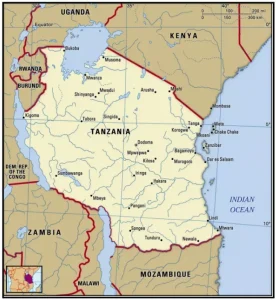
- Tanzania, officially the United Republic of Tanzania, is an East African country with its capital at Dodoma and major commercial hub at Dar es Salaam.
- Location: Tanzania is located on the eastern coast of Africa, just south of the equator, along the Indian Ocean.
- Bordering Countries: Tanzania shares borders with eight countries:
- North: Kenya and Uganda
- West: Rwanda, Burundi, and the Democratic Republic of the Congo
- South: Zambia, Malawi, and Mozambique
- Geographical Features
- Climate: Tropical climate along the coast (hot and humid), while the highlands experience more moderate temperatures.
- Vegetation: Diverse vegetation, including coastal mangroves, savanna grasslands, and dense highland forests.
- Mountain : Mount Kilimanjaro, located in northern Tanzania, is Africa’s highest peak at 5,895 meters.
- Water Bodies: Tanzania hosts major African lakes such as Lake Victoria, Lake Tanganyika, and Lake Nyasa, along with rivers like Rufiji and Ruvuma.
- Other Features: The Great Rift Valley passes through Tanzania, shaping its terrain with plateaus, valleys, and rich biodiversity regions including the Zanzibar Archipelago.
Click to Know UPSC OnlyIAS Coaching Centres
World Earth Day 2026
Context: Earth Day 2026 is being celebrated globally emphasising collective climate action and renewable energy transition.
About World Earth Day
- World Earth Day is an annual global event observed on April 22 to promote environmental protection and sustainability awareness.
- Origin: It was first celebrated in 1970 in the United States, led by Gaylord Nelson, and later evolved into a worldwide environmental movement.
- The United Nations officially recognized April 22 as International Mother Earth Day in 2009, to formally observe the annual, originally grassroots, Earth Day.
- 2026 Theme: “Our Power, Our Planet”
- The theme highlights the role of individuals and communities in driving environmental protection and accelerating the shift to clean energy.
- Significance of World Earth Day
- Promotes Environmental Awareness: It sensitises people about climate change, biodiversity loss, and pollution challenges.
- Encourages Sustainable Practices: It advocates renewable energy, conservation, and responsible consumption patterns.
- Strengthens Global Participation: Over 1 billion people across 190+ countries engage in collective environmental action.
- Drives Policy and Accountability: It pushes governments and institutions to adopt climate-friendly policies and ensure environmental accountability.
- Supports Climate Action Goals: It aligns with global efforts like emission reduction and sustainable development.
- Key Initiatives in India
- Educational Outreach: Institutions like National Science Centre Delhi organise lectures, quizzes, and awareness programmes for students.
- Renewable Energy Promotion: India promotes solar and bioenergy initiatives to reduce fossil fuel dependence.
- Community Participation: Activities such as tree plantation, cleanliness drives, and local campaigns are widely organised.
- Policy Support and Missions: Government programmes focus on sustainability, waste management, and climate resilience.
 22 Apr 2026