The Union government proposed the Constitution (131st Amendment) Bill to raise the maximum strength of the Lok Sabha from 550 to 850 and introduced a separate Bill to establish a Delimitation Commission (2026). However, the Amendment Bill was defeated in the Lok Sabha, leading to the withdrawal of the Delimitation Bill.
Best Online Coaching for UPSC
About the Recent Issue
- Scope and Key Provisions: The proposed Constitution (131st Amendment) Bill, 2026 sought a structural overhaul of parliamentary representation through three major changes:
- Expansion of Lok Sabha Strength: It proposed increasing the maximum strength of the Lok Sabha from 550 to 850, implying a ~50% expansion to accommodate demographic realities and future representation needs.
- Flexibility in Delimitation Basis: It aimed to empower Parliament to decide the Census base for delimitation, thereby introducing discretion in timing and methodology, instead of a fixed constitutional mandate.
- Operationalising Women’s Reservation: It proposed to delink the implementation of 33% reservation for women (under the 106th Constitutional Amendment Act, 2023) from the post-2027 Census condition, allowing earlier implementation using existing Census data (e.g., 2011).
- Design of the Delimitation Framework: The accompanying Delimitation Bill, 2026 proposed:
- Constitution of a Delimitation Commission (2026) to readjust constituencies and allocate seats.
- Use of the latest available Census data, which in the immediate term would likely have been the 2011 Census, given delays in conducting the next Census.
- A framework enabling simultaneous expansion and redistribution, rather than waiting for post-2027 Census-triggered delimitation.
- Government’s Rationale:
- Facilitating Women’s Reservation Without Displacement: Expansion was intended to create additional seats, ensuring men’s constituencies are not reduced, thereby easing political resistance.
- Maintaining Federal Balance (Pro-rata Assurance): The government provided an oral assurance that all states’ seats would increase proportionately, so that no state loses its relative share of representation.
- Addressing Representation Deficit: The move was framed as necessary to correct constituency size imbalances and align representation with population growth.
- Key Concerns and Criticisms:
- Excessive Executive Discretion: Allowing Parliament to choose the Census base raised concerns of political manipulation of delimitation timing and outcomes.
- Federal Imbalance Fears: Despite pro-rata assurances, opposition parties feared implicit advantages to high-population states, potentially altering inter-state political weight.
- Credibility of Interim Delimitation: Using 2011 Census data was criticised as outdated, risking misaligned representation in a rapidly changing demographic landscape.
- Procedural and Constitutional Concerns: Critics argued that decoupling women’s reservation from the next Census may undermine the original constitutional design of the 106th Amendment, which linked it explicitly to fresh delimitation.
- Outcome: The 131st Amendment Bill was defeated in the Lok Sabha, reflecting deep political and federal concerns, and consequently, the Delimitation Bill, 2026 was withdrawn, halting the proposed reform process.
|
Delimitation in India
- Concept: Delimitation refers to the process of allocating seats among states and redrawing constituency boundaries for the Lok Sabha and State Legislative Assemblies.
- Conducted by: It is carried out by an independent Delimitation Commission, constituted by the President through a law enacted by Parliament.
About Delimitation Commission
- An Independent, Quasi-Judicial Body: The Delimitation Commission is constituted as an autonomous, quasi-judicial body to shield the delimitation process from political interference and ensure impartial decision-making.
- Composition and Leadership Structure: It is chaired by a retired Supreme Court judge, with the Chief Election Commissioner and State Election Commissioners serving as ex officio members.
- Finality and Legal Authority of Decisions: The Commission’s orders are final and binding; once notified, they carry the force of law and do not require parliamentary approval.
- Objective of Institutional Design: This framework is designed to ensure neutrality, transparency, and administrative efficiency in the delimitation process.
|
- Objective: Its core objective is to uphold the democratic principle of “One Citizen, One Vote, One Value”, ensuring rough population parity across constituencies.
- Constitutional Framework: The process of delimitation is firmly embedded in the Constitution through multiple provisions that together define its scope, authority, and limitations.
-
- Article 81(2)- Principle of Uniform Representation: Article 81(2) mandates that the ratio between population and the number of seats allotted to each state in the Lok Sabha should, as far as practicable, remain uniform, thereby promoting inter-state equality in representation.
- Article 82- Periodic Readjustment After Census: Article 82 provides that after every Census, Parliament shall enact a law to readjust the allocation of seats and the division of constituencies, ensuring that representation remains aligned with demographic changes.
- Article 170- Application to State Assemblies: Article 170 extends similar principles to State Legislative Assemblies, requiring periodic readjustment of constituencies within states to maintain population balance.
- Article 327- Legislative Competence of Parliament: Article 327 empowers Parliament to make laws concerning all aspects of elections, including the constitution, powers, and procedures of the Delimitation Commission.
- Article 329(a)- Finality of Delimitation Orders: Article 329(a) explicitly bars judicial review of delimitation laws and orders, thereby ensuring finality, certainty, and the uninterrupted conduct of elections.
UPSC Online Classes
Historical Evolution
- Early Phase- Regular Delimitation (1950s–1970s): In the decades following independence, India adhered to the constitutional mandate of periodic readjustment.
- Delimitation exercises were conducted on the basis of the 1951, 1961, and 1971 Censuses, reflecting changes in population and ensuring that electoral representation remained broadly equitable.
- The Critical Shift- Freeze on Inter-State Seat Allocation: A major turning point occurred with the enactment of the 42nd Constitutional Amendment Act, 1976, which introduced a freeze on the allocation of Lok Sabha seats among states based on the 1971 Census.
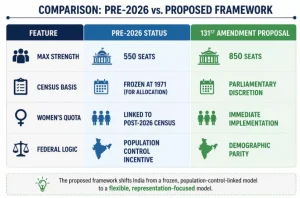 This decision was driven by a policy objective to promote population control, particularly during a period when India was grappling with rapid population growth.
 - The underlying concern was that states which successfully implemented family planning measures—largely in southern and western India—should not be penalised with a reduction in parliamentary representation, while states with higher population growth would otherwise gain seats.
- Continuation and Modification of the Freeze: The 84th Constitutional Amendment Act, 2001 extended this freeze until the first Census conducted after 2026, thereby continuing the use of 1971 population figures for inter-state seat allocation for several more decades.
- Subsequently, the 87th Constitutional Amendment Act, 2003 introduced a limited reform by permitting the redrawing of constituency boundaries on the basis of the 2001 Census, which was implemented through the 2008 delimitation exercise.
- However, this amendment explicitly retained the freeze on the total number of seats allocated to each state, thereby preserving the inter-state balance established in 1976.
- Present Status: As a result of these constitutional provisions, India has continued to operate with inter-state representation based on the 1971 Census for nearly five decades, even though the country has undergone substantial demographic, economic, and social transformations.
- While constituency boundaries within states have been adjusted periodically, the relative share of parliamentary seats across states has remained unchanged, creating increasing disparities in population-to-seat ratios.
- Rationale Behind the Freeze: The freeze on delimitation was intended to achieve a delicate balance between democratic representation and developmental incentives.
- On one hand, it sought to encourage states to adopt population control measures by ensuring that success in reducing fertility rates would not lead to diminished political influence.
- On the other hand, it aimed to preserve national unity and federal stability by preventing sharp shifts in political power across regions.
- Impending Post-2026 Scenario: The constitutional freeze is scheduled to end after the first Census conducted post-2026, which means that India is approaching a critical juncture in its electoral and federal structure. A future delimitation exercise is expected to involve:
- Reallocation of Lok Sabha seats among states based on updated population data, and
- Comprehensive redrawing of constituency boundaries to reflect current demographic realities.
Why Delimitation Matters
- Democratic Legitimacy and Electoral Equity: Delimitation gives concrete effect to the constitutional principle of “one person, one vote, one value” by correcting disparities in constituency sizes.
- At present, there are significant variations, with some Members of Parliament representing over 20 lakh citizens, while others represent far fewer, thereby weakening electoral equality and democratic fairness.
- Federal Balance and Regional Equity: The exercise has direct implications for the distribution of political power among states.
- Based on Census 2011 data, states such as Uttar Pradesh and Bihar together account for nearly one-fourth of India’s population, which could translate into greater parliamentary representation, raising concerns among southern states about relative political marginalisation.
- Gender Justice and Political Inclusion: Delimitation is institutionally linked to the implementation of women’s reservation under the 106th Constitutional Amendment Act.
- Since women currently constitute only about 15% of Lok Sabha members, timely delimitation is critical for achieving substantive political inclusion.
- Institutional Capacity and Parliamentary Functioning: India’s MP-to-population ratio remains among the lowest globally, which places considerable strain on representatives in terms of constituency service and legislative responsibilities.
- A rational delimitation process can contribute to improving governance responsiveness and legislative effectiveness.
- Political Stability and National Cohesion: Expert bodies such as the Second Administrative Reforms Commission have emphasised that imbalances in representation can strain federal relations.
- A poorly designed delimitation exercise may deepen regional divides, particularly between demographically divergent states.
| The Population Arithmetic Approach- Conceptual Limitations:
The central justification for expansion is based on the principle that larger populations require more representatives to maintain democratic equality. While this principle has normative validity, its application in isolation is problematic.
- It reduces representation to a numerical ratio, ignoring qualitative aspects such as accessibility, responsiveness, and governance efficiency.
- It assumes that increasing the number of MPs is the only way to improve representation, without considering institutional alternatives.
- It does not account for the transformation in communication technologies, administrative reach, and citizen engagement mechanisms that have expanded the effective capacity of representatives.
- Therefore, the critical issue is not merely the size of constituencies, but whether institutional capacity and governance structures are adequate to serve citizens effectively.
- Deviation from Global Norms: The “Cube Root Law” suggests a House size of ~1,100 for India’s population; while the 131st Constitutional Amendment Bill proposal of 850 seats moves closer, institutional capacity constraints remain a concern.
|
Click to Know UPSC Coaching Centres in India
Critical Concerns and Constitutional Dilemmas
- Democratic Equality versus Federal Balance: The Constitution, through Articles 81 and 82, promotes population-based representation; however, the freeze introduced by the 42nd Constitutional Amendment (1976) reflects the need to preserve federal equilibrium, creating an enduring structural tension.
- Uneven Demographic Transitions: According to the Registrar General of India, several southern states have achieved replacement-level fertility, whereas some northern states continue to experience higher population growth.
- This divergence raises concerns that delimitation may penalise states that successfully implemented population control policies.
- Excessive Institutional Discretion: The proposal to allow Parliament to determine the Census base for delimitation departs from the traditional rule-based constitutional framework, raising concerns about potential politicisation of the process.
- Irreversibility of Parliamentary Expansion: Any substantial increase in Lok Sabha strength would constitute a permanent structural change.
- For instance, expanding the House to around 850 members would make it one of the largest legislative chambers globally, with implications for efficiency, costs, and decision-making.
- Misplaced Policy Linkages: Linking women’s reservation to delimitation delays the implementation of an important reform.
- Earlier bodies such as the Committee on the Status of Women in India had emphasised the need for timely and independent measures to enhance women’s representation.
- Neglect of Local Democratic Institutions: Reports of the Second Administrative Reforms Commission and the Finance Commission of India have consistently highlighted that effective governance depends significantly on empowered local bodies, rather than solely on increasing parliamentary representation.
- Lack of Political and Federal Consensus: The failure of recent legislative proposals indicates that delimitation remains a politically sensitive issue, requiring broad-based consensus to ensure legitimacy and acceptance.
- Dilution of the Upper House (Federal Imbalance): Increasing Lok Sabha strength to 850 without a corresponding expansion of the Rajya Sabha would alter the ratio from ~2.2:1 to ~3.4:1, significantly weakening the Rajya Sabha’s role in Joint Sittings (Article 108) and undermining its function as the Council of States.
- “Demographic Penalty” Paradox: States like Kerala and Tamil Nadu, which successfully implemented population control policies, risk a loss of political leverage, creating a “success-penalty” where developmental efficiency leads to political marginalisation.
- Threat to the Basic Structure: Since Federalism and Free & Fair Elections are part of the Basic Structure (as held in Kesavananda Bharati v. State of Kerala and Indira Gandhi v. Raj Narain), a regionally biased delimitation could be challenged as unconstitutional, notwithstanding the bar under Article 329(a).
Global Best Practices & Comparative Models
- Degressive Proportionality (EU Model): The European Parliament follows degressive proportionality, where smaller states receive more seats per capita than larger ones.
- For India, this approach can balance the North–South divide by ensuring that high-population states gain seats while population-stabilised states retain meaningful influence beyond their strict numerical share.
- “Grandfather Clause” (Canadian Model): In Canada, constitutional provisions ensure that no province falls below its historical seat share.
- A similar “seat floor” guarantee in India can prevent absolute loss of representation, addressing fears of a demographic penalty.
- Cube Root Law (Theoretical Benchmark): A widely cited political science norm suggests that legislative size should approximate the cube root of population.
- For India (~1.4 billion), this implies about 1,100 members, indicating that the 131st Constitutional Amendment Bill proposal of 850 seats is a moderate, evidence-based expansion, not arbitrary.
- Deviation Limits (Venice Commission Standards): The Venice Commission recommends that constituency populations should not vary by more than 10–15%, except in exceptional cases.
- This reinforces the need to uphold electoral equity and the principle of “one citizen, one vote, one value”.
- Capping vs Reapportionment (US Model): The United States House of Representatives operates with a fixed strength (435 seats), periodically reapportioned based on Census data.
- India is now shifting from a capping model (post-1976 freeze) toward an expansion model to address large constituency sizes.
- Double Majority Principle (Swiss Model): In Switzerland, major constitutional changes require a double majority—both popular support and approval of states (cantons).
- This supports the case for a broad federal consensus mechanism in India, ensuring delimitation reforms are not driven by simple majorities alone.
Way Forward
- Adopting a Calibrated Delimitation Strategy: A balanced approach would involve rationalising constituency boundaries within states to ensure internal equality, while avoiding abrupt changes in the inter-state distribution of seats.
- Safeguarding Federal Balance through Institutional Design: Innovative mechanisms such as proportionate expansion of seats across all states or hybrid allocation models can help reconcile democratic equality with federal fairness, drawing from comparative practices in federal systems.
- Preserving the Constitutional, Rule-Based Framework: Delimitation must remain a mandatory and constitutionally anchored exercise under Articles 82 and 170, rather than being subject to discretionary political decisions.
- Decoupling Women’s Reservation from Delimitation: Women’s reservation should be implemented independently and without delay, using available data if necessary, to ensure timely advancement of gender justice.
- Strengthening Grassroots Democratic Institutions: As recommended by the Finance Commission of India, greater fiscal devolution and administrative empowerment of Panchayats and Municipalities is essential for improving citizen-level governance.
- Undertaking Comprehensive National Consultation: A structured consultation involving states, political parties, and domain experts is necessary to evolve a broad-based and durable consensus on delimitation reforms.
- Aligning Reforms with Long-Term Demographic Trends: Estimates by the United Nations Population Division suggest that India’s population is likely to peak around the 2060s, indicating that reforms should be designed with a long-term institutional perspective.
- Strengthening the Inter-State Council (Article 263): Any revision of the seat-sharing formula must be consensus-driven. The Inter-State Council should serve as the primary forum to negotiate the North–South representation compact before legislative action.
- Exploring Weighted Representation Models: India may consider hybrid allocation or weighted voting mechanisms, partially decoupling seat increases from pure population growth—on the lines of the German Bundestag—to safeguard the interests of population-stabilised states.
Click to Explore UPSC Offline Coaching
Conclusion
The delimitation debate goes beyond seat expansion to the core balance between democratic equality and federalism, as reflected in the defeat of the 131st Constitutional Amendment Bill. A purely population-based approach risks federal imbalance, while rigidity weakens democratic legitimacy; hence, India needs a balanced, forward-looking constitutional framework, not just a larger Parliament.
 21 Apr 2026