The defeat of the Constitution (131st Amendment) Bill, 2026 in the Lok Sabha has reignited debate on women’s reservation in Parliament. While the principle commands broad support, the episode highlights that constitutional reform in India requires consensus, credibility, and careful institutional design.
Need for the Constitution (131st Amendment) Bill, 2026
- Restore Equal Representation: Realign seats with population to uphold “one person, one vote, one value” after decades of freeze.
- Correct Delimitation Distortions: Address unequal constituencies and voter imbalance caused by delayed delimitation since 1971 (extended by 42nd & 84th Amendments).
- Enable Women’s Reservation: Facilitate timely operationalisation of 33% reservation in legislatures.
- Ensure Flexibility in Delimitation: Empower Parliament to decide timing and census base, reducing procedural delays.
- Expand Lok Sabha Capacity: Increase seats to match population growth and improve representational adequacy.
Best Online Coaching for UPSC
About Constitution (131st Amendment) Bill, 2026
- Core Provision: The Bill proposed to reserve one-third (33%) of seats for women in the Lok Sabha and State Legislative Assemblies, marking a significant step toward enhancing gender representation in law-making bodies.
- Importantly, this reservation was to be horizontally applied within the existing SC/ST quota, ensuring inclusivity across social categories.
- Expansion of Lok Sabha Strength: The Bill proposes to increase the strength of the Lok Sabha from the existing 543 members to a maximum of 850 members.
- The objective of enhancing representational capacity and aligning parliamentary structure with population growth.
- Conditional Implementation Framework: The operationalisation of reservation was made contingent upon two key structural processes:
- Conduct of a fresh Census, to reflect updated population data.
- Subsequent delimitation of constituencies, to redraw electoral boundaries based on revised demographic realities.
- This sequencing effectively deferred immediate implementation, linking gender reform to broader electoral restructuring.
- Rotation of Reserved Constituencies: The Bill envisaged a system of rotation for reserved constituencies, ensuring that different constituencies benefit from reservation over time.
- This mechanism aimed to broaden participation and prevent permanent seat fixation, though it also raised concerns regarding continuity and political accountability.
- Integration with Electoral Reforms: A distinctive feature of the Bill was its attempt to integrate gender justice with structural electoral reforms, particularly delimitation and seat expansion.
- While conceptually comprehensive, this coupling became a major point of political contention, as it intertwined a widely supported social reform with more sensitive questions of representation and federal balance.
- Structural Significance: In essence, the Bill represented not just a gender empowerment measure, but a systemic reconfiguration of India’s representative framework, thereby elevating both its transformative potential and the complexity of its acceptance.
Reasons for Defeat of the Constitution (131st Amendment) Bill, 2026
- Failure to Secure Special Majority: The Bill failed to obtain the constitutionally mandated special majority, receiving 298 votes in favour and 230 against out of 528 members present, thereby falling short of the required threshold for passage of a constitutional amendment.
- Controversial Linkage with Delimitation: The decision to link women’s reservation with delimitation—conducted by bodies such as the Delimitation Commission of India—became a central point of contention.
- Delimitation redistributes representation based on population, making it politically sensitive.
- Key Concerns Included:
- Potential North–South representational imbalance,
- Possible reduction in parliamentary strength of southern states,
- Risk of disturbing the federal balance of power.
This linkage transformed a social justice reform into a broader federal and political issue.
- Unresolved Social Justice Concerns: Important issues related to intra-group equity remained unaddressed:
- The demand for an OBC sub-quota within women’s reservation was not incorporated,
- Concerns regarding elite capture of reserved seats weakened support among certain constituencies.
Post-Defeat Scenario
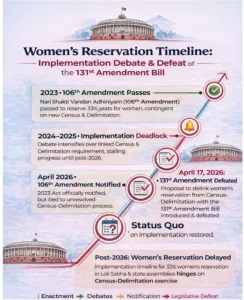
- Temporary Setback, Not Rejection of the Idea: The failure represents a political and procedural setback, not a rejection of women’s reservation, which continues to enjoy broad normative support.
- Need for Rebuilding Political Trust: The episode underscores the importance of:
- Restoring trust between political stakeholders,
- Ensuring inclusive and consultative law-making processes,
- Strengthening institutional credibility.
- Continued Salience in Public Discourse: Women’s reservation is likely to remain a central issue in electoral and policy debates, with competing narratives around ownership, intent, and design of reform.
- Responsibility of the Executive Going Forward: The responsibility now lies with the executive to:
- Reinitiate the reform process through wider consultation,
- Address pending concerns related to social justice and federal balance,
- Adopt a sequenced and consensus-driven approach for future legislative success.
UPSC Coaching Classes
Historical Background & Further Developments of Women’s Reservation
- Early Legislative Attempts (1990s Onwards): The demand for women’s reservation in legislatures dates back to the 1990s, with the introduction of the Women’s Reservation Bill, 1996.
- It sought to reserve one-third of seats in Parliament and State Assemblies for women, but faced strong political resistance from the outset.
 Repeated Failures and Structural Disagreements: Despite multiple reintroductions across successive governments, the Bill failed to secure passage due to the absence of political consensus. Key points of contention included:
- Demand for sub-quotas for OBC women within the overall reservation.
- Concerns regarding the rotation of constituencies, which was seen as affecting electoral continuity and incumbency.
- These disagreements led to a prolonged legislative deadlock.
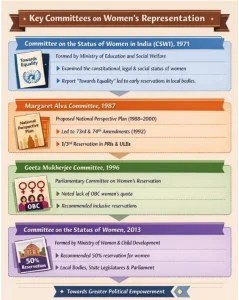
 106th Constitutional Amendment Act, 2023: A major breakthrough came with the enactment of the Nari Shakti Vandan Adhiniyam (2023), which provided constitutional backing for 33% reservation for women in the Lok Sabha and State Assemblies. However, it deferred implementation by linking it to:
-
- A future Census, and
- Delimitation of constituencies thereafter.
- Thus, while the framework was legally recognised, its execution remained contingent.
- The 2026 Bill: The Constitution (131st Amendment) Bill, 2026 was introduced to operationalise the provisions of the 2023 Amendment.
- However, instead of resolving earlier concerns, it inherited and amplified existing political disagreements, particularly around delimitation, seat expansion, and representational balance.
- The trajectory of women’s reservation in India reflects a pattern of broad normative support but persistent political contestation. Each legislative attempt has underscored the challenge of reconciling gender justice with competing demands of social justice, federal balance, and electoral strategy.
Rationale for Women’s Reservation
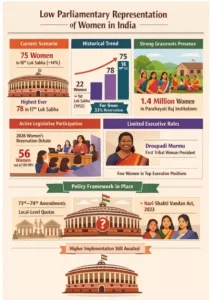
- Democratic Deficit and Representation Gap: Women continue to be significantly underrepresented in Parliament and State Legislatures, which weakens the core democratic principle of inclusive and representative governance.
 A legislature that does not reflect gender diversity risks systemic bias in agenda-setting and law-making.
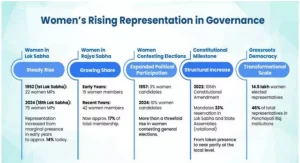
- Women remain significantly underrepresented in Parliament, constituting only about 14–15% of the Lok Sabha (18th Lok Sabha)—far below the global average of around 26%.
- This reflects a persistent democratic deficit and underscores the need for corrective institutional measures.
- Substantive Equality and Constitutional Mandate: While formal equality is guaranteed under Articles 14 and 15 of the Constitution, achieving substantive equality requires affirmative action.
- Women’s reservation is thus a corrective mechanism to address historical and structural barriers that limit women’s political participation.
- Improved Governance Outcomes: Empirical evidence from Panchayati Raj Institutions (PRIs) demonstrates that women leaders often prioritise social sector issues such as health, education, water, and nutrition.
- This indicates that enhanced representation can lead to more inclusive and welfare-oriented governance outcomes.
- International Commitments and Norms: India is a signatory to global frameworks such as the United Nations Convention on the Elimination of All Forms of Discrimination Against Women (CEDAW), which calls for equal political participation.
- Women’s reservation aligns with these international obligations and normative commitments.
- Political Empowerment Multiplier Effect: Representation in legislatures acts as a multiplier for broader empowerment, enabling women to influence policy priorities, institutional culture, and socio-economic opportunities. It also helps break patriarchal barriers, creating role models and normalising women’s leadership in public life.
Global Normative Frameworks for Gender Equality in Politics
- Sustainable Development Commitments: The United Nations Sustainable Development Goal 5 (Gender Equality) emphasises equal participation of women in leadership and decision-making, recognising political inclusion as central to sustainable development.
- International Legal Obligations: The Convention on the Elimination of All Forms of Discrimination Against Women (CEDAW), adopted under the United Nations, mandates the elimination of discrimination in political and public life and encourages affirmative measures, including reservations and quotas, to ensure substantive equality.
- Global Advocacy and Institutional Support: Institutions such as the Inter-Parliamentary Union (Inter-Parliamentary Union) and UN Women (United Nations Entity for Gender Equality and the Empowerment of Women) actively promote:
-
- Gender-sensitive electoral reforms,
- Legislative quotas,
- Capacity-building for women leaders,
- thereby shaping global norms and best practices.
Comparative International Models of Women’s Representation
- Constitutional Quota Model – Rwanda: Rwanda demonstrates the effectiveness of constitutionally mandated quotas, resulting in over 60% women’s representation in Parliament—the highest globally.
- Legislated Candidate Quotas with Enforcement – France: France follows a legislated candidate quota system, where political parties must nominate a minimum proportion of women, with financial penalties imposed for non-compliance.
- Voluntary Party Quotas – Norway & Sweden: These countries have achieved high female representation through voluntary internal party quotas, reflecting strong institutional commitment and societal support for gender equality.
- Constitutional Inclusion Model – Nepal: Nepal ensures significant representation of women through constitutional mandates, complemented by proportional representation mechanisms, leading to broader inclusion across legislative bodies.
- International experience demonstrates that enhancing women’s political representation requires a combination of constitutional backing, electoral design, and political will, supported by sustained institutional and societal commitment.
|
Click to Know UPSC Coaching Centres in India
Advantages of Women’s Representation in Legislatures
The inclusion of women in legislatures is far more than a numerical exercise in “tokenism.” It is a structural necessity that converts formal equality into substantive democracy. By bringing diverse lived experiences to the floor, women legislators fundamentally alter the quality of governance and the integrity of institutional outcomes.
- Strengthening Democratic Legitimacy and Inclusiveness:
- Reflective Representation: A representative democracy must mirror its population. The systemic exclusion of women creates a structural democratic deficit, undermining the core principle of popular sovereignty.
- Institutional Credibility: Greater female participation enhances the legitimacy and responsiveness of democratic institutions, ensuring that the “will of the people” is truly inclusive.
- Enriched Deliberation: Policymaking that incorporates diverse gender perspectives leads to more holistic legislative outcomes, ensuring that laws are not designed through a monolithic lens.
- Improving Quality of Governance and Policy Outcomes:
- Prioritizing Public Goods: Evidence from Panchayati Raj Institutions (PRIs) demonstrates that women leaders tend to prioritize essential public goods such as health, education, water, sanitation, and nutrition.
- Welfare-Oriented Policies: Their participation steers the legislative agenda toward human development-focused policies, which yield superior long-term socio-economic outcomes compared to purely infrastructure-centric models.
- Practical Policymaking: By bringing diverse lived experiences to the table, women contribute to more grounded and practical legislation that addresses the daily realities of citizens.
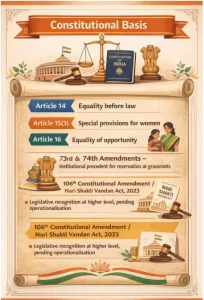
- Evidence from Panchayati Raj Institutions: It shows that over 1.4 million elected women representatives, enabled by the 73rd and 74th Constitutional Amendments, have contributed to improved outcomes in health, education, sanitation, and local governance.
- Advancing Gender Justice and Substantive Equality:
- Core Agenda Shifting: Women legislators move gender concerns from the periphery to the core of the national agenda, advocating for laws on gender-based violence, workplace equality, and maternal health.
- Constitutional Mandate: This representation gives meaningful effect to Articles 14–16 of the Constitution, facilitating the transition from formal equality (equality on paper) to substantive equality (equality in practice).
- Transformational Social Impact and Role Modeling:
- Challenging Patriarchy: Women in positions of power serve as a direct challenge to patriarchal norms and entrenched stereotypes regarding leadership and capability.
- The Multiplier Effect: They act as role models, triggering an aspirational shift that encourages girls to pursue education, leadership, and public life.
- Societal Shift: Over time, their presence fosters a progressive shift in societal attitudes, normalizing the role of women in the highest echelons of decision-making.
- Enhancing Accountability and Institutional Integrity:
- Reduced Corruption: Empirical studies suggest that higher female participation is often associated with greater transparency and reduced corruption, although this varies by context.
- Grassroots Responsiveness: Women leaders often exhibit higher responsiveness to community needs, thereby strengthening accountability mechanisms and ensuring that the “last mile” of the population is heard.
- Promoting Inclusive Economic Development:
- Economic Empowerment: Women legislators are more likely to support policies regarding financial inclusion, Self-Help Groups (SHGs), and microfinance.
- Multiplier Effects: Because women’s empowerment has strong multiplier effects on household welfare, their leadership contributes to broad-based economic growth and better human capital formation.
- Strengthening Peace, Stability, and Social Cohesion:
- Conflict Resolution: Globally, women’s participation is linked to more inclusive peace-building processes and sustainable conflict resolution.
- Consensus-Building: A female leadership style often emphasizes cooperation and consensus, qualities that are critical for maintaining stability in plural and diverse societies like India.
Concerns & Challenges in Women’s Representation
While women’s reservation is normatively compelling, its design raises significant hurdles that must be addressed to ensure substantive—not merely symbolic—outcomes.
- The Challenge of Proxy Representation & Tokenism:
- Symbolic Presence: There is a persistent risk that reservation leads to a “physical presence” in the House without real authority.
- The “Sarpanch-Pati” Phenomenon: Insights from Panchayati Raj Institutions (PRIs) warn of male relatives exercising de facto control over elected women. Without institutional safeguards, representation may not translate into independent decision-making power.
- Elite Capture and Intersectionality:
- Intra-gender Inequality: Without sub-quotas for OBCs and marginalized groups, the benefits of reservation may be monopolized by urban, socially privileged women.
- The Inclusivity Gap: Ensuring intersectional representation across caste, class, and region remains a central point of contention for parties demanding “social justice within gender justice.”
- Institutional & Accountability Issues:
- Rotation of Constituencies: The proposal to rotate reserved seats frequently may weaken the representative–constituency linkage, discouraging long-term political investment and reducing electoral accountability.
- Displacement of Incumbents: Mandatory reservation displaces male incumbents, often leading to internal party resistance and the informal marginalization of women even when they are formally fielded as candidates.
- Federalism and the “Delimitation Trap”:
- Redistribution of Power: Linking the quota to the Delimitation Commission‘s work has ignited fears of a North–South representational imbalance.
- Federal Equity: States that successfully managed population growth perceive the linkage as an erosion of their political weight, complicating the consensus required for a Constitutional Amendment.
- Structural and Social Barriers:
- Capacity Constraints: First-time representatives often face a steep learning curve in a male-dominated legislative culture. Without systematic capacity-building, their performance may be unfairly scrutinized.
- Financial & Social Capital: Electoral politics remains heavily dependent on campaign financing and informal networks, areas where women face deep structural disadvantages due to entrenched patriarchal norms.
- The Risk of a “Standalone” Solution:
- Single-Point Fallacy: Treating reservation as a panacea ignores broader issues like the lack of internal party democracy and unequal candidate selection processes.
- Complementary Reforms: For the 131st Amendment to be truly transformative, it must be accompanied by reforms in campaign finance and a shift in the institutional culture of political parties.
Way Forward
- Restoring the Deliberative Process:
- Build Broad-Based Political Consensus: Constitutional reform of this magnitude must be preceded by structured all-party consultations and rigorous Parliamentary Committee scrutiny.
- The executive must act as a facilitator of consensus rather than a unilateral driver to rebuild institutional trust.
- Decouple Reservation from Delimitation: To reduce federal anxieties, women’s reservation should be implemented independently of delimitation.
- Delimitation—overseen by the Delimitation Commission of India—should follow its own transparent, rule-based timeline, preventing the quota from being held hostage to regional population politics.
- Ensuring Inclusivity and Accountability:
- Address Intersectionality: To ensure equitable representation, the design must incorporate sub-quotas for OBC women and marginalized minorities.
- This strengthens the “social justice within gender justice” argument, ensuring that benefits are not restricted to an urban elite.
- Reform the Rotation Mechanism: To preserve continuity and accountability, the government should avoid excessive or frequent rotation of constituencies.
- Longer reservation cycles or partial rotation models would allow women representatives to build leadership expertise and deep constituency connections.
- Institutional and Party-Level Reforms:
- Internal Party Mandates: Beyond constitutional compulsion, political parties must adopt mandatory internal quotas for candidate selection.
- Strengthening internal party democracy ensures women become genuine decision-makers, not just electoral nominees.
- Capacity Building: Establishing mentorship networks and legislative support systems is critical.
- Providing access to research assistance and policy inputs ensures that women’s participation in debates and law-making is substantive and effective.
- Addressing Structural Barriers:
- Socio-Cultural Transformation: Legal provisions must be complemented by awareness campaigns and gender-sensitization initiatives to transform societal attitudes.
- Improving access to financial resources and political networks is essential to level the playing field.
- Global Alignment: India should draw from global best practices—combining legislative quotas with party reforms—to align with SDG 5 (Gender Equality) while adapting these models to the unique Indian socio-political context.
Click to Explore UPSC Offline Coaching
Conclusion
Women’s reservation remains a critical democratic and constitutional imperative, but its success depends on consensus, inclusive design, and institutional credibility. A calibrated approach—balancing gender justice with federal and social concerns—can transform representation into substantive empowerment and deeper democratic legitimacy.
 20 Apr 2026