Khijadia Bird Sanctuary & Black-necked Stork
Context: A 2026 GEER Foundation study confirmed Khijadia Bird Sanctuary as an important breeding site for the Black-necked Stork.
UPSC Online Courses
About Khijadia Bird Sanctuary
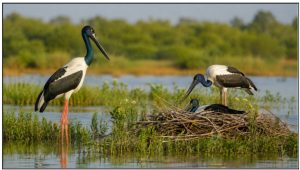
- It is a Ramsar-designated wetland known for its unique combination of freshwater, saline and marine ecosystems.
- It was designated a Ramsar Site in 2022 because of its ecological significance for resident and migratory waterbirds.
- Location: Jamnagar district, Gujarat, on the southern coast of the Gulf of Kutch, about 12 km northeast of Jamnagar city.
- It covers approximately 605 hectares and lies near the confluence of the Ruparel and Kalindri rivers with the sea.
- Key Features
- Freshwater–Marine Mosaic: A reclamation bund/check dam separates freshwater bodies fed by rivers from saline marshes and mangrove habitats.
- This creates a rare ecological mosaic supporting freshwater, brackish-water and marine bird species within a relatively compact area.
- Migratory Bird Habitat: Khijadia lies along the Central Asian Flyway, making it an important stopover and wintering site for migratory waterbirds supporting more than 300 species of resident and migratory birds.
- Breeding Habitat: Shallow wetlands, elevated mounds, nesting trees and relatively undisturbed zones provide favourable conditions for breeding waterbirds.
- The 2026 study recorded four active Black-necked Stork nests, with each nest producing two fledglings.
About Black-necked Stork
- The Black-necked Stork (Ephippiorhynchus asiaticus) is one of India’s largest wetland birds and is recognised by its striking black-and-white plumage and long red legs.
- Habitat: It primarily inhabits freshwater wetlands, floodplains, marshes, shallow pools and oxbow lakes, while also using rice fields, coastal mudflats and mangroves.
- Distribution: The species occurs across parts of the Indian subcontinent and Southeast Asia, with a separate major population occurring in northern and eastern Australia.
- Diet: It is a carnivore that feeds on fish, frogs, snakes, lizards, crustaceans and aquatic invertebrates.
- Conservation Status
-
- IUCN: Near Threatened
- Wildlife Protection Act 1972: Schedule II
Mission Samriddh Gaon
Context: Union Rural Development Minister launched Mission Samriddh Gaon to develop poverty-free and employment-rich villages.
About Mission Samriddh Gaon
- Mission Samriddh Gaon is an integrated rural development initiative aimed at transforming villages into prosperous, self-reliant and poverty-free communities.
- Aim: To establish a comprehensive model of rural development by bringing together different developmental interventions at the village level.
- Nodal Ministry: The Ministry of Rural Development is the nodal ministry responsible for implementing and coordinating the mission.
- Objectives:
- To create poverty-free villages by improving livelihood opportunities, income generation and access to essential services.
- To make villages employment-rich by strengthening local economic activities and creating sustainable livelihood opportunities.
- To ensure assured basic amenities and improve the overall quality of life in rural areas.
- Key Features
- Integrated Rural Development: The mission adopts a comprehensive and integrated approach, seeking convergence among existing government programmes rather than implementing rural development interventions in isolation.
- Poverty Reduction & Employment: The mission places poverty eradication and employment generation at the centre of rural transformation, with emphasis on sustainable livelihoods and economic self-reliance.
- Basic Amenities: The mission seeks to ensure that villages have access to essential basic amenities, thereby improving living standards alongside livelihood opportunities.
- The approach links economic development with social and physical infrastructure to create more sustainable rural communities.
- Pilot Project: The initial pilot projects are planned in Budni block of Sehore district and Khategaon block of Dewas district in Madhya Pradesh.
- Successful models emerging from the pilot phase are intended to be replicated across other parts of the country.
Mission Samriddh Gaon seeks to strengthen the rural foundation of Viksit Bharat by promoting prosperous, self-reliant, employment-rich and poverty-free villages.
Periyar Kullan
Context: The ICAR-NBAGR has recognised Periyar Kullan as Kerala’s second registered indigenous cattle breed, following Vechur cattle.
About Periyar Kullan
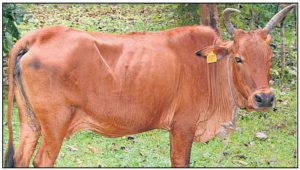
- Periyar Kullan, locally known as Kuttampuzha cattle or Andukanni, is a native cattle population of central Kerala that has adapted to plantation and forest-fringe environments.
- Research: The breed was scientifically studied for three years by Kerala University of Veterinary and Animal Sciences (KVASU) in collaboration with ICAR-NBAGR.
- The ICAR-National Bureau of Animal Genetic Resources (ICAR-NBAGR) is a premier research institute established in 1984 in Karnal, Haryana dedicated to the identification, characterization, and conservation of India’s indigenous livestock and poultry genetic resources.
- Key Features
- Habitat & Adaptation: Periyar Kullan primarily occurs in Ernakulam and Thrissur regions, particularly around Koovappady, Angamaly, Kothamangalam and Chalakudy.
- It thrives under semi-feral and silvopastoral conditions, with cattle commonly grazing in plantation areas and returning to farms later.
- Physical Characteristics: The cattle are small to medium-sized, generally weighing around 150–200 kg, and are characteristically dark brown.
- Production Characteristics: The breed produces approximately 2.5–4 litres of milk per day, with milk containing about 4.5% fat and 9.1% SNF.
- Its first calving generally occurs around 35 months, with a gestation period of approximately 279 days.
- Current Status: The estimated population is around 1,000 animals, mainly maintained by farmers in central Kerala.
- National recognition provides a foundation for scientific conservation, genetic improvement and sustainable dairy development.
About Indigenous Cattle Breeds
- Indigenous cattle are native, locally adapted cattle populations, predominantly belonging to Bos indicus, and possess traits suited to India’s diverse agro-climatic conditions.
- India has 50 recognised indigenous cattle breeds, broadly classified as milch, draught and dual-purpose breeds.
- Key Benefits
- Climate Resilience: Indigenous breeds generally possess strong heat tolerance and adaptation to tropical conditions, enabling them to perform better under thermal stress.
- Disease Resistance: Their long adaptation to local environments provides greater resistance to several region-specific diseases, parasites and climatic stresses.
- Agricultural Utility: Indigenous cattle contribute to milk production, farm operations, manure production and livelihood security, particularly for small and marginal farmers.
- Government Initiatives
- Rashtriya Gokul Mission: The Rashtriya Gokul Mission, implemented by the Department of Animal Husbandry and Dairying, promotes conservation and genetic improvement of indigenous bovine breeds.
- Gokul Grams & Breeding Centres: Gokul Grams serve as integrated centres for indigenous cattle development, while National Kamdhenu Breeding Centres conserve and improve elite indigenous germplasm.
- Advanced Breeding Technologies: Government programmes promote artificial insemination, sex-sorted semen and genomic/genetic technologies to improve the productivity and genetic quality of indigenous cattle
UPSC Online Classes
Lakshadweep Ownership Dispute
Context: The Kerala High Court’s August 2026 verdict clarified ownership rights over certain pandaram lands held by traditional cowledars in Lakshadweep.
Lakshadweep Ownership Dispute Resolution
- Pandaram Land: It refers to land historically treated as government property, while cowledars were persons holding such land under traditional lease arrangements.
- The Laccadive, Minicoy and Amindivi Islands Land Revenue and Tenancy Regulation, 1965 created the statutory framework governing land ownership, tenancy and occupancy rights.
- Kerala High Court Verdict
- The Kerala High Court held that cowledars in possession of pandaram land when the 1965 Regulation came into force qualify as landowners and need not obtain a separate Section 83 occupancy order.
- The Court ruled that the Lakshadweep administration cannot resume such land merely by treating it as government property; acquisition must follow lawful procedure with compensation.
- The Court also declared the 2023 amendment deleting Section 15A unconstitutional, restoring protections introduced through the 2020 amendment for certain transfers involving Scheduled Tribe islanders.
- Significance: The judgment protects the land rights of eligible cowledars, their legal heirs and assigns, while clarifying that not all pandaram land automatically becomes private property.
About Lakshadweep
- Lakshadweep is India’s smallest Union Territory, comprising 36 islands, of which 10 are inhabited, with a total land area of about 32 sq km.
- Kavaratti is the capital and administrative headquarters of the Union Territory.
- Location: Lakshadweep lies approximately between 8°N–12°N latitude and 71°E–74°E longitude, about 220–440 km from Kochi.
- Geographical Features: The islands comprise 12 atolls, 3 reefs and 5 submerged banks, formed over the submerged Chagos–Lakshadweep volcanic ridge.
- The 9° Channel separates Minicoy from the main Lakshadweep group, while the 8° Channel separates Minicoy from the Maldives.
- The islands are low-lying and flat, generally lacking hills, rivers and streams, with shallow lagoons and coral reefs.
- Climate: Lakshadweep experiences a tropical maritime climate, characterised by warm and humid conditions throughout the year.
- The Southwest Monsoon brings substantial rainfall mainly between June and September/October.
- Vegetation & Agriculture: Coconut palms dominate the landscape because of the islands’ sandy, coral-derived and highly permeable soils.
- Other vegetation includes breadfruit, banana, wild almond, tamarind and coastal shrubs.
- The entire territory was declared a 100% organic agricultural area in 2020.
- Marine Biodiversity: Coral reefs support rich marine biodiversity, including numerous species of corals, reef fish and sea turtles.
- Pitti Island is an important bird sanctuary and nesting site for pelagic birds and marine turtles.
Previously Unknown Alloy Found in Hiroshima Blast Debris
Context: Researchers discovered a previously unknown alloy inside glass-like droplets called Hiroshimaites, formed during the Hiroshima atomic bombing in 1945.
About Hiroshimaites
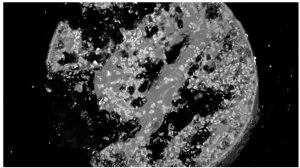
- Hiroshimaites are small glass-like beads recovered from the sands of Hiroshima Bay.
- They formed when the blast’s intense heat vaporised soil, buildings and metals, which later cooled and solidified.
Discovery and Formation of the Alloy
- Discovery: Researchers found a micrometre-sized metallic grain inside a Hiroshimaiite.
- It contained iron, chromium, nickel, manganese, molybdenum, silicon and aluminium.
- Formation: The explosion’s fireball reached temperatures of over 7,000°C, turning urban materials into a mixed metallic vapour.
- As the fireball expanded and rapidly cooled, the elements mixed and stabilised into a complex phase through ultrafast quenching.
- Structure: The alloy developed a unique, highly ordered crystal structure.
- Advanced Materials: It shares characteristics with high-entropy alloys and quasicrystals, which are of interest for their strength and stability.
Click to Know UPSC Coaching Centres in India
Operation Safed Sagar
Context: The Netflix series, Operation Safed Sagar, highlights the photo-reconnaissance missions of IAF’s No. 17 ‘Golden Arrows’ Squadron during the 1999 Kargil War.
About Operation Safed Sagar

- Operation Safed Sagar was the Indian Air Force’s (IAF) air campaign during the 1999 Kargil War, undertaken in support of the Army’s Operation Vijay.
- It involved photo-reconnaissance, intelligence gathering, precision bombing, close air support, air defence and helicopter operations to assist in regaining strategic heights occupied by Pakistani forces along the Line of Control (LoC) in the Kargil sector.
- Operational Area: Mushko Valley, Drass, Kaksar, Batalik and Turtok sectors of the Kargil region, Ladakh, along/near the LoC.
 26 Aug 2026