UPSC PYQs

Prelims, Mains & Optional PYQs

UPSC Notes

Comprehensive & Short Notes

Nobel Prize in Economic Sciences 2026: Laureates and Key Contributions

13 Oct 2026

Nobel Prize in Economic Sciences 2026: Laureates and Key Contributions

Subject: GS 03: Economy

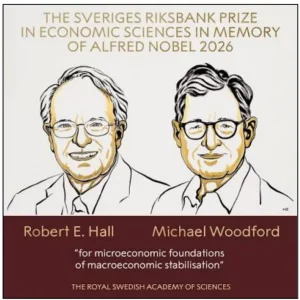
Context: The 2026 Nobel Prize in Economic Sciences is awarded to Robert E. Hall and Michael Woodford for their work on the microeconomic foundations of macroeconomic stabilisation. 
  • In 2025, the economics award went to Joel Mokyr, Philippe Aghion and Peter Howitt for research into how technology drives and affects growth.

UPSC Online Coaching

Key Contributions of the Laureates

Nobel Prize in Economic Sciences 2026

  • Microeconomic Foundations of Macroeconomics: Developed New Keynesian models to demonstrate how well-timed fiscal and monetary policies can reduce economic fluctuations.
  • Household Consumption and Expectations: Robert E. Hall showed that changes in household consumption depend on expectations about future income and new information. 
    • His research also helped identify hand-to-mouth consumers, who depend mainly on current income due to limited savings or borrowing.
  • Interest Rate-Based Monetary Policy: Michael Woodford demonstrated how central banks can influence consumption, output, and inflation by changing policy interest rates. 
    • He also explained the natural (neutral) rate of interest, at which monetary policy neither stimulates nor restrains economic activity.
  • Price Rigidity: Sticky prices refer to the tendency of businesses to delay changing prices when demand or production costs change. 
    • As a result, changes in aggregate demand (total demand for goods and services) can directly affect production and employment, while prices adjust slowly.
  • Output Gap: The laureates explained the output gap, which is the difference between actual output and natural output (the level of output that would prevail if prices adjusted freely and demand matched supply).
    • A positive output gap indicates excess demand and inflationary pressure, while a negative output gap indicates weak demand and downward pressure on inflation.
    • Stabilisation policy aims to bring the output gap towards zero.
  • Policy Communication: Highlighted how credible and transparent central bank communication influences the expectations and decisions of households and businesses.

About the Nobel Prize in Economic Sciences

  • Official Name: Sveriges Riksbank Prize in Economic Sciences in Memory of Alfred Nobel.
  • Established: 1968 by Sweden’s central bank, Sveriges Riksbank, through a donation.
  • First Awarded: 1969.
  • Awarding Institution: Royal Swedish Academy of Sciences.
  • Prize Money: 12 million Swedish kronor (approximately US$1.2 million).
  • Distinction: The Economics Prize was not among the five original Nobel Prizes established under Alfred Nobel’s 1895 will.
  • Award Ceremony: December 10, the anniversary of Alfred Nobel’s death.

Click to Know UPSC Offline Courses

PW OnlyIAS ExtraEdge

Keynesian Model of Economics

  • The Keynesian Model was developed by British economist John Maynard Keynes in his 1936 book, The General Theory of Employment, Interest and Money.
  • It emphasises aggregate demand as the primary determinant of output, income and employment in the short run.
  • Unlike classical economics, it argues that markets may not automatically restore full employment.
  • Key Concepts  of the Model
    • Total output and employment are determined by total spending:
      • Total expenditure: AD = C + I + G + (X − M).
        • Includes consumption(C), investment (I), Government spending(G) and net exports (X-M)
    • Sticky Wages and Prices: Wages and prices adjust slowly, potentially prolonging unemployment and recessions.
    • Multiplier Effect: An initial increase in investment or government spending generates a larger increase in national income.
    • Liquidity Preference: Demand for money arises from transaction, precautionary and speculative motives.
  • Major Branches
    • Traditional Keynesian: Emphasises demand management and countercyclical fiscal policy.
    • Neo-Keynesian: Combines Keynesian ideas with neoclassical theory, including the IS–LM model.
    • New Keynesian: Explains price and wage rigidities through market imperfections and adjustment costs.
    • Post-Keynesian: Focuses on uncertainty, income distribution and institutional factors.

News Source: The Hindu

Check Out UPSC CSE Books

Visit PW Store

online store 1

Nobel Prize in Economic Sciences 2026: Laureates and Key Contributions

Need help preparing for UPSC or State PSCs?

Connect with our experts to get free counselling & start preparing

Free Counselling for UPSC Aspirants

Connect with our experts and take the right next step.

Expert Guidance
Personalized Strategy
100% Free

Book Your Free Session

NEED ASSISTANCE?

Request a Callback

Our counsellor will connect with you and help you choose the right course and centre.

  • Expert Guidance
  • Course & Fee Information
  • Quick Callback Support

Request a Callback

Books
UPSC PYQs
UPSC Notes
Current Affairs
Quick Revise Now !
AVAILABLE FOR DOWNLOAD SOON
UDAAN PRELIMS WALLAH
Comprehensive coverage with a concise format
Integration of PYQ within the booklet
Designed as per recent trends of Prelims questions
हिंदी में भी उपलब्ध
Quick Revise Now !
UDAAN PRELIMS WALLAH
Comprehensive coverage with a concise format
Integration of PYQ within the booklet
Designed as per recent trends of Prelims questions
हिंदी में भी उपलब्ध

<div class="new-fform">


    </div>

    Subscribe our Newsletter
    Sign up now for our exclusive newsletter and be the first to know about our latest Initiatives, Quality Content, and much more.
    *Promise! We won't spam you.
    Yes! I want to Subscribe.