Subject: GS 3 Economy
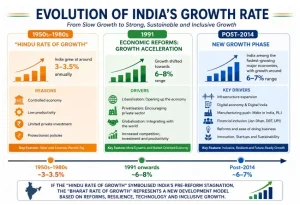
Context: India moved from the low-growth “Hindu rate of growth” (1950s–1991) to a reform-led growth path after 1991 liberalisation, and AI now represents the next transformation opportunity to achieve an 8%+ “Bharat rate of growth.”
AI as Reforms vis-à-vis 1991 Reforms
- 1991 Reforms: Liberalisation ended the licence-permit raj, opened markets, encouraged private investment, attracted foreign capital, and integrated India with the global economy, creating the foundation for faster economic growth.
- AI Revolution: Similar to the 1991 reforms, AI can act as a structural transformation by improving productivity, automating routine tasks, enabling innovation, reducing costs, and creating new opportunities in sectors like healthcare, agriculture, education, governance, and industry.
UPSC Course Fees Online
About ‘Hindu Rate of Growth’
- The term “Hindu rate of growth” refers to India’s low economic growth rate of around 3–3.5% per year during the period 1950s to 1980s, especially before the 1991 economic reforms.
- Origin of Term: The phrase was coined by economist Raj Krishna in the 1970s to describe India’s slow growth performance compared with other developing economies.
- Reasons Behind Low Growth:
- License Raj: Excessive government controls, industrial licensing, and bureaucratic restrictions limited private investment and competition.
- Import Substitution Policy: High tariffs and protectionism reduced global integration and efficiency.
- Low Productivity: Limited technological adoption and weak infrastructure constrained economic expansion.
- Low Investment: Controlled economic policies resulted in lower levels of private and foreign investment.
|
Why is AI the Next Reform Catalyst?
- Productivity Revolution: AI can enhance efficiency, reduce costs, and improve decision-making across healthcare, agriculture, education, governance, judiciary, and manufacturing.
- Innovation Driver: AI can accelerate research, entrepreneurship, and development of new products, creating a technology-led growth ecosystem.
- Leapfrog Opportunity: Similar to Aadhaar, UPI, and affordable data, AI can help India overcome traditional infrastructure limitations and achieve rapid transformation.
- Inclusive Growth Tool: AI can improve access to quality services by enabling personalised healthcare, education, and citizen-centric governance.
- Global Competitiveness: Building AI capabilities can help India become a leader in the digital economy and move towards a higher growth trajectory.
Differences Between 1991 Reforms and AI Era
| Aspect |
1991 Economic Reforms |
AI Era (Reforms 3.0) |
| Nature of Transformation |
Focused on liberalisation, privatisation, and globalisation to move from a controlled economy to a market-driven economy. |
Focuses on building a knowledge-driven and AI-powered economy through technology and innovation. |
| Trigger for Reform |
Triggered by the Balance of Payments crisis and economic instability. |
Triggered by the global AI revolution and competition for technological leadership. |
| Primary Resource |
Growth was driven by capital, investment, trade, and private enterprise. |
Growth will depend on data, computing power, AI models, talent, and innovation. |
| Role of Government |
Government shifted from being a controller to facilitator by reducing regulations and opening markets. |
Government must become an AI ecosystem builder through infrastructure, regulation, and public platforms. |
| Global Integration |
Integrated India with global markets through foreign investment and international trade. |
Requires integration with the global AI ecosystem through technology partnerships and research collaboration. |
| Main Objective |
Improve economic efficiency, attract investment, and accelerate GDP growth. |
Improve productivity, innovation, and create an AI-led growth model. |
| Impact on Industries |
Expanded private sector, services sector, and foreign investment opportunities. |
Will transform sectors like healthcare, agriculture, education, manufacturing, and governance through AI applications. |
| Employment Impact |
Created jobs through services, IT, and new private-sector opportunities. |
Will create new AI-based jobs but may disrupt existing jobs, requiring reskilling. |
| Key Infrastructure |
Focused on physical and economic infrastructure such as markets, industries, and financial systems. |
Requires digital infrastructure, data centres, AI computing, and semiconductor ecosystems. |
| Strategic Importance |
Mainly an economic reform aimed at increasing growth and competitiveness. |
A strategic technology reform linked with economic power, national security, and digital sovereignty. |
Similarities Between 1991 Reforms and AI Era
| Similarity |
1991 Reforms |
AI Era |
| Transformational Opportunity |
Liberalisation unlocked India’s economic potential. |
AI can unlock India’s productivity and innovation potential. |
| Need for Structural Change |
Required reforms in industrial policy, trade, and investment. |
Requires reforms in data governance, AI infrastructure, skills, and research ecosystem. |
| Competition as a Driver |
Global competition improved efficiency of Indian businesses. |
AI competition will push India towards innovation and technological excellence. |
| Long-Term Growth Impact |
Helped India move towards higher growth rates. |
Can help India achieve a technology-led and knowledge-based growth trajectory. |
| Reform Mindset |
Required moving away from protectionism and controls. |
Requires moving towards openness, innovation, and AI adoption. |
Government Policies Supporting AI Reforms 3.0
- IndiaAI Mission (2024): The IndiaAI Mission was launched with an outlay of ₹10,371.92 crore to create a complete AI ecosystem by developing AI compute infrastructure, datasets, indigenous AI models, skilling programmes, and responsible AI frameworks.
- National Strategy for Artificial Intelligence (2018): NITI Aayog introduced the National Strategy for Artificial Intelligence with the vision of “AI for All”, focusing on the use of AI in healthcare, agriculture, education, smart cities, and governance.
- Digital India Programme: The Digital India Programme has created the foundation for AI adoption by expanding digital connectivity, e-governance services, and technology infrastructure across the country.
- Digital Public Infrastructure (DPI) Framework: India’s DPI model, built around platforms such as Aadhaar, UPI, and DigiLocker, demonstrates how open and scalable digital systems can support inclusive AI-based innovation.
- National Data Governance Policy (2023): The National Data Governance Policy aims to improve access, quality, and responsible use of government datasets, which are essential for developing reliable and India-specific AI models.
- National Education Policy (NEP) 2020: The National Education Policy 2020 promotes coding, digital learning, and emerging technologies in education to create an AI-skilled workforce for the future economy.
- India Semiconductor Mission: The India Semiconductor Mission aims to build domestic semiconductor manufacturing and design capabilities, which are crucial for developing AI computing infrastructure and reducing dependence on foreign technology.
- Responsible AI Governance Framework: India is developing responsible AI frameworks to ensure ethical, transparent, secure, and human-centric AI adoption while addressing challenges related to privacy, bias, and accountability.
UPSC Online Courses
AI Applications for Governance
- Healthcare
- AI can improve healthcare delivery through faster disease diagnosis, predictive analytics, and better management of public health programmes.
- It can support medical imaging, early detection of diseases, and efficient allocation of healthcare resources.
- Agriculture
- AI can enhance agricultural productivity through crop advisory systems, precision farming, and climate-based decision-making.
- It can help farmers with weather prediction, pest detection, soil analysis, and better crop planning.
- Judiciary
- AI can improve judicial efficiency by supporting legal research, case management, and document analysis.
- It can help reduce case backlogs by enabling faster information processing and better court administration.
- Education
- AI can promote inclusive and personalised education through adaptive learning platforms and customised learning pathways.
- It can help identify learning gaps, provide digital assistance, and improve access to quality education.
- Governance and Public Service Delivery
- AI can strengthen governance through data-driven policymaking, grievance redressal, fraud detection, and efficient delivery of government services.
- It can make administration more transparent, responsive, and citizen-centric.
- Disaster Management
- AI can strengthen disaster preparedness through early warning systems, risk mapping, and real-time damage assessment.
- It can improve response efficiency during floods, earthquakes, cyclones, and other natural disasters.
- Urban Governance and Smart Cities
- AI can support traffic management, waste management, energy optimisation, and urban planning through real-time data analysis.
- It can help cities become more efficient, sustainable, and citizen-friendly.
- Public Safety and Law Enforcement
- AI can assist law enforcement through crime pattern analysis, cybersecurity monitoring, and intelligent surveillance systems.
- Responsible use of AI can improve public safety while ensuring privacy and accountability.
Challenges in AI Adoption
- Digital Divide: Unequal access to high-speed internet, digital devices, and computing infrastructure may prevent rural, remote, and economically weaker sections from benefiting from AI-based services.
- Without inclusive digital infrastructure, AI may increase existing social and economic inequalities.
- Data Privacy Concerns: AI systems depend on large-scale data collection, creating challenges related to individual privacy, informed consent, data ownership, and secure storage.
- Misuse of personal data can reduce public trust and create risks of surveillance and exploitation.
- AI Bias: AI models learn from existing datasets, and biased or incomplete data can lead to unfair decisions and discriminatory outcomes.
- Bias in AI systems can affect critical areas such as recruitment, healthcare diagnosis, financial services, and public administration.
- Cybersecurity Risks: AI can be misused for creating deepfakes, misinformation campaigns, automated cyber attacks, and advanced fraud techniques.
- Increasing dependence on AI requires stronger cybersecurity systems, digital safeguards, and regulatory oversight.
- High Energy Requirements: Training and operating advanced AI models require enormous computing power, specialised hardware, data centres, and electricity.
- Rising AI demand can create challenges related to energy security, carbon emissions, and sustainable technology development.
- Skill Shortages: India faces a shortage of trained AI professionals, researchers, data scientists, and technology specialists required for large-scale AI adoption.
- Lack of AI literacy among citizens and workers may limit productivity gains and create employment disruptions.
- Dependence on Foreign Technology: Heavy reliance on foreign AI models, advanced semiconductor chips, and cloud infrastructure may create strategic vulnerabilities and technology dependence.
- Developing indigenous AI capabilities is essential for ensuring digital sovereignty and national security.
- Ethical and Regulatory Challenges: Rapid AI development has created concerns regarding accountability, transparency, safety, and human control over automated decisions.
- India needs balanced regulation that promotes innovation while preventing misuse of AI technologies.
Click to Know UPSC Offline Courses
Way Forward
- Increase R&D Investment: India must raise R&D spending beyond the current 0.65% of GDP to strengthen AI research, innovation capacity, and technological competitiveness.
- Greater focus is needed on AI research, computing infrastructure, semiconductor development, and human capital.
- Promote Public–Private Partnerships
- India should collaborate with global hyperscalers such as Amazon Web Services, Google, and Microsoft to develop large-scale AI infrastructure.
- Government support through data centre land, power infrastructure, and data sovereignty frameworks can attract private investment.
- Create a Sovereign AI Infrastructure: India must move from being only an AI consumer to an AI creator by developing the ability to host, operate, customise, and secure Large Language Models (LLMs).
- AI infrastructure should be treated as a strategic capability like space and nuclear programmes.
- Adopt a Hybrid AI Model: India should combine indigenous AI development with open-source global models to reduce dependence on a single technology ecosystem. This will enable cost-effective, secure, and India-specific AI solutions.
- Build AI Compute Capacity: Develop affordable and scalable AI computing infrastructure, data centres, and advanced hardware ecosystems to support research institutions, startups, and public services.
- Diversified compute capacity will reduce risks of foreign technology dependence.
- Leverage India’s Digital Advantage: India’s large population, digital public infrastructure, and data ecosystem provide a strong foundation for AI innovation.
- This advantage can be used to create AI solutions tailored for Indian languages, governance, and development needs.
- Develop AI Human Capital: Strengthen AI education, research training, and industry-oriented skilling programmes to create a skilled workforce.
- A strong talent base is essential for sustaining long-term AI leadership.
Click to Know UPSC OnlyIAS Coaching Centres
Conclusion
Like liberalisation transformed India’s economy in 1991, AI-driven reforms can become the foundation for India’s transition towards a high-growth, innovation-led economy.
 30 Jun 2026