Subject: GS 3: Environment
Context: Recently, a captive-bred, radio-tagged white-rumped vulture (Gyps bengalensis) that was released earlier this year at the Mudumalai Tiger Reserve in Nilgiris district of Tamil Nadu was electrocuted.
IAS coaching
About Mudumalai Tiger Reserve (MTR)
- Mudumalai Tiger Reserve (MTR), located in the Nilgiris district of Tamil Nadu, is one of India’s most ecologically vital protected areas.
- It lies at the tri-junction of Tamil Nadu, Karnataka, and Kerala and part of Western Ghats, a UNESCO World Heritage Site.
- Established as a wildlife sanctuary in 1940, it is one of the earliest protected areas in India and was declared a Tiger Reserve in 2007.
|
About White-rumped Vulture (Gyps bengalensis)
- The White-rumped Vulture (Gyps bengalensis) is a resident Old World vulture native to the Indian subcontinent and is among the most threatened scavenging birds in the world.
- It was once India’s most abundant vulture species but has suffered a catastrophic population decline since the 1990s.
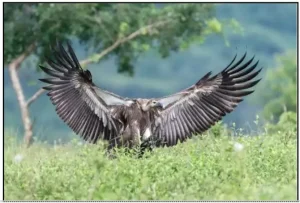
- Physical Characteristics: The species has a dark brown body, a contrasting white rump, a bare black head, and broad wings adapted for soaring flight.
- It is a medium-sized colonial vulture that nests in tall trees and depends on thermal currents for long-distance gliding.
- Habitat: The White-rumped Vulture inhabits open forests, agricultural landscapes, grasslands, and areas close to human settlements where livestock carcasses are available.
 In South India, the Mudumalai–Sathyamangalam–Bandipur–Wayanad landscape supports one of the last viable breeding populations.
- Diet: The species is an obligate scavenger that feeds almost exclusively on the carcasses of domestic and wild ungulates.
- It rarely hunts live prey and plays a specialised role in rapidly disposing of dead animals.
- Ecological Role: White-rumped Vultures provide an essential ecosystem service by removing animal carcasses, preventing disease transmission, and maintaining ecological hygiene.
- They reduce populations of scavengers such as feral dogs, thereby lowering the risk of zoonotic diseases like rabies and anthrax.
- Distribution: The species is distributed across India, Nepal, Bangladesh, Bhutan, Pakistan, and parts of Southeast Asia, although its range has significantly contracted.
- Major Threats (UPSC Prelims 2012)
- Veterinary Drug Poisoning: The veterinary use of diclofenac and other toxic NSAIDs causes kidney failure in vultures after they consume contaminated livestock carcasses.
- Power Infrastructure: Electrocution and collisions with power lines and transmission infrastructure have emerged as major causes of mortality in vulture habitats.
- Other Threats: Habitat degradation, declining food availability, poisoning, and disturbance at nesting sites further threaten long-term population recovery.
- Conservation Status
- IUCN Red List: The White-rumped Vulture is classified as Critically Endangered (CR) on the IUCN Red List.
- Wildlife (Protection) Act, 1972: The species is protected under Schedule I of the WPA 1972 providing the highest level of legal protection in India.
- CITES: The species is listed under Appendix II of CITES, which regulates international trade.
- Conservation Measures
- India has established Vulture Conservation Breeding Centres, Vulture Safe Zones, and banned veterinary diclofenac to facilitate population recovery.
- Conservation agencies also promote bird diverters, insulated power lines, and safe carcass management to reduce human-induced mortality.
Click to Know UPSC Offline Courses
Types of Vultures in India
| Vulture Species |
Scientific Name |
IUCN Status |
| White-rumped Vulture |
Gyps bengalensis |
Critically Endangered (CR) |
| Indian (Long-billed) Vulture |
Gyps indicus |
Critically Endangered (CR) |
| Slender-billed Vulture |
Gyps tenuirostris |
Critically Endangered (CR) |
| Red-headed (Asian King) Vulture |
Sarcogyps calvus |
Critically Endangered (CR) |
| Egyptian Vulture |
Neophron percnopterus |
Endangered (EN) |
| Himalayan Vulture (Himalayan Griffon) |
Gyps himalayensis |
Near Threatened (NT) |
| Cinereous (Eurasian Black) Vulture |
Aegypius monachus |
Near Threatened (NT) |
| Bearded Vulture (Lammergeier) |
Gypaetus barbatus |
Near Threatened (NT) |
| Eurasian Griffon Vulture |
Gyps fulvus |
Least Concern (LC) |
 30 Jun 2026