Scheme for National Awards for e-Governance 2026
Context: Recently, the Department of Administrative Reforms and Public Grievances has invited nominations (1 Sept–15 Oct 2025) for the 23rd National Awards for e-Governance 2026 to honor excellence and innovation in digital governance.
About Scheme for National Awards for e-Governance 2026
- The National Awards for e-Governance was first instituted in 2003.
- Objective: These are presented annually to honor and encourage excellence in implementing e-Governance initiatives.
- The awards seek to recognize significant achievements, foster the sharing of effective practices, and promote innovations in digital governance.
- Awards given annually during the National Conference on e-Governance (NCeG).
- The 2026 awards will highlight achievements in Digital Governance in line with the vision of “Viksit Bharat@2047”.
- Nodal Ministry: Ministry of Personnel, Public Grievances & Pensions (Department of Administrative Reforms and Public Grievances – DARPG)
- Categories:
- Excellence in Government Process Re-engineering for Digital Transformation
- Excellence in Providing Citizen-Centric Delivery
- Excellence in Government Data Sharing and Use for Socio-Economic Development
- Excellence in District-level Initiative in e-Governance (North-East & Hill States + Other States)
- Innovative Use of Emerging Technologies for e-Governance
- Excellence in Adopting Emerging Technologies in AI, Blockchain, IoT, etc.
- Best Use of Data for Disaster Management
- Special Category for Start-ups in e-Governance
- Eligibility: Central Ministries/Departments, State/UT Governments, District Administrations, and Start-ups.
- Projects must have been operational for at least one year.
- Award Benefits: Trophy & Certificate to the winning organization.
- Recognition at national level to inspire replication of best practices.
- Significance: Promotes replication of successful e-Governance models.
- Encourages competition among government entities for improved public service delivery.
- Aligns with Digital India, Ease of Living, and Atmanirbhar Bharat goals.
Animal Stem Cell BioBank and Laboratory
Context: Union Minister Dr. Jitendra Singh inaugurated India’s first-of-its-kind State-of-the-Art Animal Stem Cell Biobank and Animal Stem Cell Laboratory at the National Institute of Animal Biotechnology (NIAB), Hyderabad.
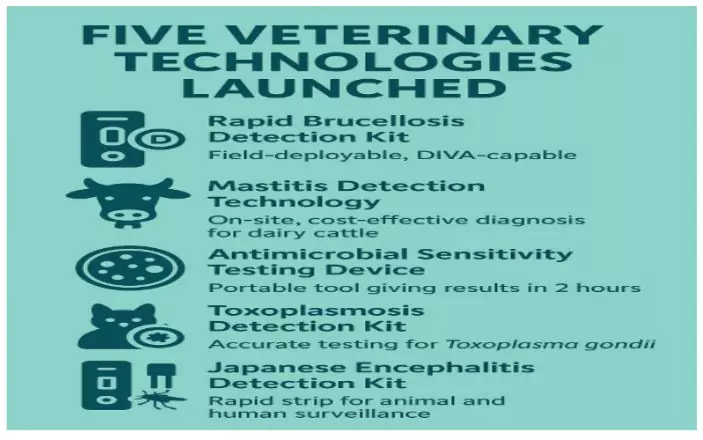
- The Minister also unveiled a set of five breakthrough technologies developed by NIAB for protecting animal health and safeguarding farmer livelihoods.
About the Animal Stem Cell Biobank
- Location & Institution: Situated at NIAB, a premier institute under the Department of Biotechnology’s Biotechnology Research Innovation Council (BRIC).
- Backed by the National Biopharma Mission (NBM)
- Function: Stores and preserves high-quality stem cells from various animal species.
- Partnership: Developed in collaboration with HiMedia Laboratories.
- Purpose: To provide quality-controlled animal stem cells and indigenous, cost-effective cell culture media to veterinary clinics, research institutions, hospitals, and industry.
- Equipment: Stem cell culture unit, 3D bioprinter, bacterial culture lab, cryostorage, autoclave rooms, advanced air handling systems, uninterrupted power backup.
- Focus Areas: Regenerative medicine, cellular therapies for livestock, disease modelling, tissue engineering, reproductive biotechnology.
What is Stem cell banking?
- It is the process of collecting, processing and storing potentially life saving stem cells for future use in therapies and regenerative medicine.
Kalahandi’s Transformation
Context: Once symbolic of deprivation, Kalahandi in Odisha has transformed from one of the state’s most underdeveloped districts into a thriving hub of inclusive rural development.
Earlier condition (before 2000s)
- One of Odisha’s poorest districts, known for hunger and poverty.
- GDDP share < 1% of Odisha’s economy (2001).
- Per capita income ~ ₹19,000.
- Dependent on subsistence farming, poor roads, low investment in health and education.
Turning Point
- Vedanta’s Alumina Refinery at Lanjigarh, set up in early 2000s, became the catalyst for social and economic change.
- Industrialisation here was community-rooted, not exploitative.
Economic Growth
- Growth Rate: Between 2003–2015, GDDP grew over 16%, more than double Odisha’s state average of 6–8%.
- Development has been participatory and symbiotic, with industry coexisting with tribal identity.
Impact
- NITI Aayog Rankings (Aspirational Districts Programme):
-
- Health & Nutrition: 1st in Odisha with 35.48% improvement.
- Education: 2nd in Odisha with 45.72% growth.
- Project Sakhi: Nearly 5,000 tribal women engaged in micro-enterprises (mushroom farming, marigold cultivation, Dhokra and Saura arts).
- Educational Progress: Students scoring 96% and 97% in 2025 board exams; tribal students pursuing engineering, medicine, and research careers.
Aspirational Districts Programme
- Launched in 2018, the scheme aims to transform districts that have showed relatively lesser progress in key social areas, compared to other districts.
INS Sandhayak
Context: Indian Naval Ship Sandhayak, entered Changi Naval Base, Singapore, for a three-day visit coinciding with Singapore’s National Day.
- Purpose: Facilitate technical/professional exchanges and sustain hydrographic support engagements with Singapore’s maritime agencies.
- Diplomacy: Demonstrates India’s growing role in regional hydrographic capacity building under the Indian Navy’s Hydrographic Department.
About INS Sandhayak
- The first indigenous Survey Vessel Large (SVL) with advanced hydrography capability,
- Commissioned in February 2024.
- Developed by: Garden Reach Shipbuilders & Engineers (GRSE), Kolkata
- Roles:
- Primary: Conduct full-scale hydrographic surveys of ports, harbours, navigational channels/routes, coastal areas, and deep seas for safe marine navigation.
- Secondary: Capable of SAR/humanitarian operations, naval missions, and carrying an onboard helicopter with hospital facilities.
- Legacy: Successor to the erstwhile Sandhayak, decommissioned on 4 June 2021.
- Significance: Showcases India’s shipbuilding prowess under the AatmaNirbhar Bharat vision and aligns with the national Amrit Kaal objectives.
Defence Production Soars to an All-time High
Context: India’s annual defence production reached an all-time high of ₹1,50,590 crore in FY 2024–25, marking significant growth in the country’s defence manufacturing capabilities under the Aatmanirbhar Bharat initiative.
Production Milestone
- Growth: About 18% over FY 2023–24 output of ₹1.27 lakh crore.
- Long-Term Increase: 90% growth from ₹79,071 crore in FY 2019–20.
- Defence Exports:
- FY 2024–25: ₹23,622 crore, the highest ever.
- Growth: Increase of ₹2,539 crore (12.04%) from FY 2023–24 exports of ₹21,083 crore.
Significance
- Strategic: Strengthens India’s self-reliance in defence manufacturing.
- Economic: Expands industrial base and boosts export capabilities.
- Future Outlook: Sustained growth expected with continued policy support, private sector participation, and expanding global market presence.
- Aim: ₹3 lakh crore in defence production and ₹50,000 crore in exports by 2029
About Aatmanirbhar Bharat initiative
- Atmanirbhar Bharat represents a vision of a self-reliant India engaging with the world on its own terms, without being protectionist or isolationist
- Its five pillars are:
- Economy: Aiming for a quantum leap to convert adversity into advantage.
- Infrastructure: Shaping the identity of modern India.
- Systems: Driven by 21st-century cutting-edge technology.
- Demography: Focusing on a vibrant and healthy demography.
- Demand: Utilizing the strength of the demand and supply chain intelligently.
Bharat Forecast System
Context: Recently Union Minister of Earth Sciences Dr. Jitendra Singh launched the Bharat Forecast System (BharatFS), a high-resolution global weather prediction model.
About Bharat Forecast System
- BharatFS (Bharat Forecast System) is India’s own super-advanced weather prediction model.
- It’s like a super-smart “weather computer” that predicts the weather for very small areas – as small as 6 km apart – which is far more detailed than most other countries’ systems
- Grid: Operates at 6 km horizontal resolution using Triangular Cubic Octahedral (TCo) dynamical grid.
- Surpasses GFS T1534 (~12 km) and typical global models (9–14 km).
- Super Computer’s Role: New supercomputers Arka (IITM-Pune) and Arunika (NCMRWF-Noida) reduced forecast runtime from ~12 hours to 3–6 hours.
- Improved Forecasting: 30% better accuracy for extreme rainfall prediction over previous operational model.
- Localized Benefits: Captures small-scale weather features, aiding agriculture, reservoir management, and flood risk reduction.
- Development & Collaboration:
- Lead Institution: Indian Institute of Tropical Meteorology (IITM), Pune.
- Supporting Agencies: NCMRWF-Noida and India Meteorological Department (IMD).
Applications
- Sectors Benefited: Monsoon tracking, aviation, cyclone and disaster management, agriculture, waterways, defence, and flood forecasting.
- Disaster Preparedness: Faster and targeted disaster response for extreme weather events.
- Panchayat-Level Coverage: Supports crop planning, irrigation scheduling, and harvesting decisions.
INC-5.2 Talks in Geneva
Context: The fifth session of the Intergovernmental Negotiating Committee (INC-5.2) is underway in Geneva (5–14 August 2025) to finalise a legally binding instrument to end plastic pollution.
About Intergovernmental Negotiating Committee (INC)
- Origin: Formed under a historic resolution adopted at the resumed fifth session of the UN Environment Assembly (UNEA-5.2) in March 2022.
- Mandate: Develop an international legally binding instrument on plastic pollution, including marine pollution.
- Scope: Address the full life cycle of plastic — production, design, and disposal through a comprehensive approach.
- Timeline: Work started in the second half of 2022, with a target to finish negotiations by the end of 2024.
- Key Sessions:
- INC-1: 2022, Punta del Este, Uruguay
- INC-2: 2023, Paris, France
- INC-3: 2023, Nairobi, Kenya (midway point)
- INC-4: 2024, Ottawa, Canada
- INC-5.1: 2024, Busan, Republic of Korea
- INC-5.2: Aug 2025, Geneva, Switzerland
Sea of Galilee in Israel
Context: The Sea of Galilee, a freshwater lake in Israel, has recently turned red, sparking panic among nearby residents and visitors.
- The change in colour was caused by an algae bloom, with officials confirming the water is safe.
- The Water Ministry identified Botryococcus braunii, a green algae from the Chlorophyta group, as the cause.
- When exposed to sunlight, the algae produce a natural red pigment (carotenoids) that accumulates in parts of the lake, creating the red hue.
- Botryococcus braunii has been studied for its ability to produce large amounts of hydrocarbons, making it a potential biofuel candidate.
About Sea of Galilee
- Located in northern Israel within the Jordan Rift Valley, about 210 m below sea level.
- Bordered by the Lower Galilee hills (west & southwest) and Golan Heights (east).
- Largest freshwater lake in the region.
- Known by Other names: Sea of Kinneret, Lake of Gennesaret, Sea of Ginosar, Sea of Tiberias, Lake of Tiberias, Bahr Tubariya.
- Fed primarily by the Jordan River, plus streams and seasonal wadis from the Galilee hills.
- Contains hot water springs and is home to 27 fish species, many endemic.
- Surrounded by historic towns such as Tiberias, Hammat Gader, Korazim, Kursi, Capernaum, and Tabgha.
- Formed over millions of years as the Arabian plate drifted from Africa.
- Climate: Mild winters (~14°C) and hot summers (~31°C), supporting crops like bananas, dates, citrus, and vegetables.
Cancer AI & Technology Challenge (CATCH) Grant Program
Context: IndiaAI Independent Business Division (IBD), in collaboration with the National Cancer Grid (NCG), has announced the launch of the Cancer AI & Technology Challenge (CATCH) Grant Program.
About CATCH Grant Program
- Aim: Promote AI-based innovations in cancer screening, diagnosis, treatment, and healthcare operations.
- Grant Support:
- Pilot grants: Up to ₹50 lakh per project (co-funded by IndiaAI & NCG).
- Scale-up funding: Up to ₹1 crore for nationwide deployment (based on pilot success).
- Focus Areas: AI-enabled screening, diagnostics, clinical decision support, patient engagement, operational efficiency, research, and data curation.
- Eligibility: Startups, Health Tech Firms, Academia, and Hospitals.
- Implementation & Governance
- IndiaAI, an IBD under the Digital India Corporation (DIC) of the Ministry of Electronics and IT (MeitY), is the implementation agency of the IndiaAI Mission
- Aims for democratisation of AI, global leadership, technological self-reliance, and ethical AI.
- NCG: A network of cancer centres for coordinated research, treatment, and care.
World Sanskrit Day
Context: On August 9, 2025, Prime Minister Narendra Modi extended greetings on World Sanskrit Day, reaffirming the government’s commitment to preserving and promoting Sanskrit heritage.
About World Sanskrit Day
- World Sanskrit Day, or Vishva-Sanskrit-Divas, is celebrated annually on Shravan Poornima, which usually falls in August, to honour Sanskrit as a classical language and cultural treasure of India.
- The date coincides with festivals like Raksha Bandhan and Upakarma in various parts of India.
- Origin: Initiated by the Government of India in 1969, with the goal of reviving and encouraging the usage of Sanskrit in everyday life.
- The choice of Shravana Purnima is symbolic as it is traditionally considered auspicious for starting Vedic learning and rituals.
- Government Initiatives to Promote Sanskrit
- Provided the status of Classical Language to Sanskrit in 2005.
- It is also the official language of Uttarakhand.
- Establishing Central Sanskrit Universities.
- Opening Sanskrit Learning Centres.
- Providing grants to Sanskrit scholars.
- Gyan Bharatam Mission to digitise ancient Sanskrit manuscripts.
Significance of Sanskrit
- A Timeless Language: Sanskrit is one of the world’s oldest languages, serving as a repository of India’s spiritual, literary, and scientific heritage for millennia.
- It is the language of Vedas, Upanishads, and Bhagavad Gita.
- Global Relevance: Its linguistic structure and philosophical depth have influenced languages and knowledge traditions across Asia and beyond.
- Role in Modern India: Beyond its cultural value, Sanskrit continues to inspire research in linguistics, computational sciences, and traditional knowledge systems.
 11 Aug 2025