GS II: Bilateral, Regional and Global Groupings and Agreements involving India and/or affecting India’s interests
Context: The Strait of Hormuz remains one of the world’s most critical maritime chokepoints for crude oil, petroleum products, and LNG. For India, which depends heavily on West Asian energy supplies, any disruption in this route can create serious challenges for energy security, inflation management, shipping costs, trade stability, and strategic autonomy.
Maritime Power and Global Prosperity
- Control over sea routes: Countries that control major sea lanes gain influence over trade, resources, naval mobility, and global power.
- Historical examples: The United Kingdom, the United States, Japan, and China show how maritime power can shape economic rise and strategic influence.
- India’s maritime location: India lies at the centre of the Indian Ocean Region (IOR), close to major sea lanes connecting West Asia, Africa, Europe, and East Asia.
Best Online Coaching for UPSC
Importance of the Strait of Hormuz
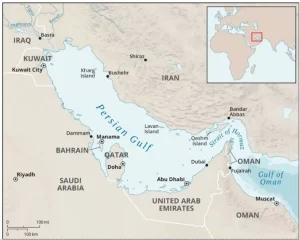
- Critical chokepoint: The Strait of Hormuz connects the Persian Gulf with the Gulf of Oman and the Arabian Sea.
- Energy transit route: It is vital for the movement of crude oil, petroleum products, LNG, and LPG from West Asia to global markets.
- Narrow geography: Its narrow navigational channels make it vulnerable to military tension, naval blockade, piracy risk, mining, insurance spikes, and shipping delays.
India’s Vulnerabilities
- Energy import dependence: India imports a large share of its crude oil and gas requirements, making West Asian supply routes central to its energy basket.
- Inflationary impact: Any disruption in oil and gas supply can increase fuel prices, transport costs, fertiliser costs, and overall inflation.
- Shipping dependence: India has limited Indian-flagged commercial shipping capacity and remains dependent on foreign vessels for a significant part of trade movement.
- Exposure of Indian seafarers: Indian seafarers working on foreign vessels face risks in conflict-prone and piracy-prone corridors such as the Persian Gulf, Red Sea, Gulf of Aden, and Somalia region.
- Limited strategic petroleum buffer: India has created Strategic Petroleum Reserves (SPRs), but the scale remains limited compared to potential long-duration disruptions.
- Freight and insurance shocks: Geopolitical tension around chokepoints increases freight rates, marine insurance costs, and delivery uncertainty.
Wider Strategic Concerns
- Weaponisation of chokepoints: Maritime chokepoints can be used as instruments of coercion during conflict or sanctions.
- Reduced strategic autonomy: Overdependence on a single maritime route reduces India’s policy flexibility during West Asian crises.
- Supply-chain fragility: Energy, fertilisers, petrochemicals, shipping, and industrial production may all be affected by disruption in the Strait.
- External power competition: The Gulf region involves multiple actors including Iran, Gulf monarchies, the United States, China, and European powers, requiring India to maintain diplomatic balance.
Lessons from Other Countries
- UAE’s route diversification: The UAE has developed pipeline infrastructure to reduce exclusive dependence on the Strait of Hormuz.
- Alternative evacuation routes: Pipelines and ports outside narrow chokepoints reduce vulnerability during maritime crises.
- Strategic storage: Major powers maintain larger emergency energy reserves to manage temporary supply disruptions.
India’s Existing Strengths
- Strategic location: India’s location allows it to act as a net security provider in the Indian Ocean Region.
- Skilled seafarer base: Indian seafarers are globally competitive and contribute to maritime manpower and foreign exchange inflows.
- Growing naval capacity: The Indian Navy plays an important role in anti-piracy operations, evacuation missions, maritime domain awareness, and sea-lane security.
- West Asia diplomacy: India maintains relations with Iran, Saudi Arabia, UAE, Qatar, Oman, and Israel, giving it significant diplomatic flexibility.
Way Forward
- Diversify energy suppliers: India must reduce overdependence on any single region by diversifying crude oil, LNG, and LPG sourcing.
- Expand strategic petroleum reserves: Emergency storage capacity should be expanded for crude oil, gas, and petroleum products.
- Strengthen alternative corridors: India should strengthen Chabahar Port, the International North-South Transport Corridor (INSTC), and connectivity with Central Asia, Russia, and Europe.
- Increase Indian-flagged shipping: India needs stronger domestic shipping capacity to reduce dependence on foreign vessels and freight volatility.
- Deepen Gulf partnerships: India should strengthen maritime and energy cooperation with Oman, UAE, Saudi Arabia, and Qatar.
- Maintain balanced Iran policy: India should preserve engagement with Iran for Chabahar, Central Asia connectivity, and regional balancing while managing sanctions-related constraints.
- Improve maritime domain awareness: Real-time tracking, naval coordination, and intelligence-sharing can help protect commercial shipping.
- Protect Indian seafarers: Consular support, naval protection, and crisis-response mechanisms should be strengthened for Indian sailors in high-risk zones.
- Accelerate energy transition: Reducing fossil-fuel import dependence through renewables, green hydrogen, electric mobility, and domestic energy production will strengthen long-term energy security.
Click to Know UPSC OnlyIAS Coaching Centres
Conclusion
The Strait of Hormuz is not merely a geographical passage; it is a strategic pressure point in India’s energy security architecture. India must respond through energy diversification, strategic reserves, maritime capacity, alternative corridors, and balanced West Asia diplomacy to protect its economic stability and strategic autonomy.
 22 Jun 2026