UPSC PYQs

Prelims, Mains & Optional PYQs

UPSC Notes

Comprehensive & Short Notes

Strait of Hormuz & Malacca Model: Maritime Security and Navigation

Strait of Hormuz & Malacca Model: Maritime Security and Navigation 22 Sep 2026

Strait of Hormuz & Malacca Model: Maritime Security and Navigation

GS II: Effect of policies and politics of developed and developing countries on India’s interests.

Context: Continuing tensions around the Strait of Hormuz have renewed discussion on how coastal-state security concerns can be balanced with uninterrupted maritime navigation, with the Malacca Strait model offering a possible framework for cooperative management.
Understanding Maritime Straits

Strait of Hormuz

  • Narrow Waterway: A strait is a narrow maritime passage connecting two larger bodies of water and can serve as a critical chokepoint for international trade and strategic mobility.
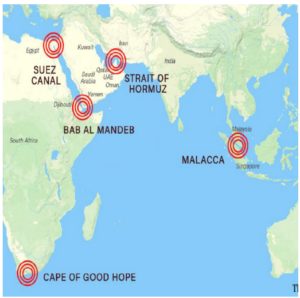
  • Strategic Importance: Major straits facilitate global maritime commerce by providing shorter and strategically important routes between different seas and oceans.
  • Chokepoint Character: Disruption in a strategically located strait can affect trade flows, energy security and maritime connectivity beyond the immediate region.

UPSC Course Fees Online

Territorial Waters under UNCLOS

Strait of Hormuz

  • 12 Nautical Mile Limit: The United Nations Convention on the Law of the Sea (UNCLOS) recognises a territorial sea extending up to 12 nautical miles from the coastal State’s baselines.
  • Coastal-State Jurisdiction: Within the territorial sea, the coastal State exercises sovereignty, subject to the rights and obligations established under international law.
  • Narrow Strait Problem: Where a strait is less than 24 nautical miles wide, territorial seas of the States on either side may meet, creating the need to reconcile coastal sovereignty with navigation rights.

Strategic Importance of the Malacca Strait

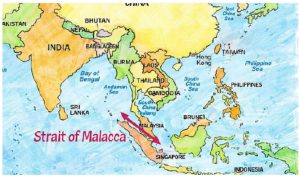
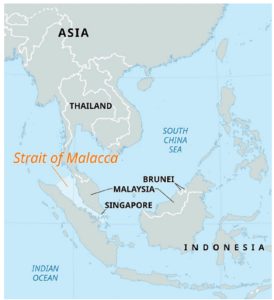
  • Geographical Location: The Strait of Malacca lies between the Malay Peninsula and Indonesia’s Sumatra Island and connects the Andaman Sea with the Strait of Singapore.
  • Commercial Significance: Its geographical position makes it a major maritime route for international trade and gives the surrounding States a strong interest in maintaining its security.
  • Regional Stakeholders: Indonesia, Malaysia and Singapore have interconnected economic and security interests associated with the functioning of the Strait.

Evolution of the Malacca Strait Arrangement

  • Indonesian Sovereignty Concerns: Indonesia under President Sukarno sought greater control over waters between its islands, reflecting concerns regarding sovereignty and external interference.
  • Malaysia–Indonesia Position: Indonesia and Malaysia asserted their rights over their territorial waters, while Singapore’s dependence on maritime commerce created a strong interest in keeping the Strait secure and navigable.
  • Regional Understanding: By 1971, Indonesia, Malaysia and Singapore developed a common position concerning the status and management of the Strait.
  • Cooperative Management: The eventual arrangement demonstrated how sovereignty concerns and international navigation interests could be accommodated through cooperation.

Innocent Passage and Transit Passage

  • Innocent Passage: Innocent passage allows vessels to pass through the territorial sea of a coastal State, provided that the passage remains consistent with the applicable conditions of international maritime law.
  • Transit Passage: Transit passage provides a broader regime for navigation through straits used for international navigation and allows vessels to pass continuously and expeditiously.
  • Naval Navigation: The transit-passage framework is particularly significant for warships and submarines, which can exercise the relevant navigation rights subject to international obligations.
  • Balancing Interests: The distinction between innocent and transit passage reflects the broader effort to balance coastal-state sovereignty with freedom of international navigation.

Cooperative Maritime Governance

  • Navigation Infrastructure: Cooperation in the Malacca Strait included hydrographic surveys, lighthouses and navigation markers to improve maritime safety.
  • Vessel Traffic Management: Vessel Traffic Services supported safer and more efficient movement of ships through the strategically important waterway.
  • Environmental Protection: Cooperation also extended to oil-spill response, marine ecological protection and pollution monitoring.
  • Voluntary Funding: The discussion highlights a voluntary funding mechanism used to support safety and environmental measures rather than functioning as a conventional toll-tax arrangement.

IAS coaching

Strategic Importance of the Strait of Hormuz

Strait of Hormuz

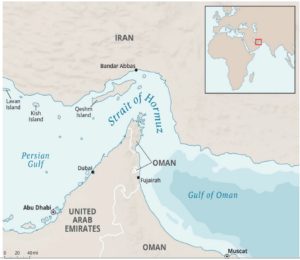
  • Geographical Location: The Strait of Hormuz lies between Iran and Oman and constitutes a narrow maritime passage of major strategic importance.
  • Energy Security: Its location makes it particularly important for the movement of oil and other energy resources, giving it significance for both regional and global energy security.
  • Regional Dependence: Several regional economies depend upon uninterrupted maritime movement through the Strait, creating a shared interest in maritime stability.

Legal and Security Disagreements

  • Iran’s UNCLOS Position: The discussion highlights that Iran has not ratified UNCLOS and has adopted its own position regarding the passage of foreign warships.
  • Permission Requirement: Iran has maintained that foreign warships require its permission for passage, while the United States does not accept this position.
  • Freedom of Navigation: The disagreement therefore involves competing interpretations of coastal-state authority and navigation rights.
  • Broader Security Context: The Hormuz issue is also connected with wider regional security and nuclear concerns, making it substantially more complex than a purely maritime-law dispute.

Possibility of a Malacca-Type Framework

Strait of Hormuz

  • Security Guarantees: A cooperative arrangement could potentially seek to address coastal-state security concerns alongside the interests of States dependent on uninterrupted navigation.
  • Open Navigation: The central objective would be to maintain the Strait as a safe and predictable maritime route while addressing legitimate security concerns.
  • Regional Participation: Countries dependent on energy flows through the Strait have an interest in supporting mechanisms that reduce the possibility of disruption.
  • Existing Proposal: The discussion highlights Qatar’s support for considering a cooperative approach inspired by the Malacca Strait experience.

Limitations of Direct Replication

  • Different Security Environment: The Strait of Hormuz operates within a significantly more complex regional strategic environment than the Malacca Strait.
  • Nuclear Dimension: The presence of broader nuclear-security concerns makes the security guarantees discussed in the Malacca context difficult to replicate directly.
  • Geopolitical Tensions: Existing tensions between Iran, the United States and other regional actors create additional obstacles to a simple cooperative arrangement.
  • Context-Specific Framework: Therefore, the Malacca experience can serve as a reference model rather than a directly transferable template.

Way Forward

  • Confidence-Building: Relevant States should develop confidence-building measures to reduce maritime incidents and miscalculations.
  • Maritime Safety: Cooperation can focus on navigation systems, information sharing, emergency response and pollution control.
  • Regional Cooperation: Energy-producing and energy-consuming States can support mechanisms that ensure predictable and uninterrupted maritime commerce.
  • Legal Dialogue: Continued dialogue can help reconcile differences regarding navigation rights, coastal-state security and international maritime law.
  • Context-Specific Arrangement: Any Hormuz framework should draw lessons from Malacca while accounting for its distinct geopolitical and security environment.

Click to Know UPSC Coaching Centres in India

Conclusion

The Malacca Strait demonstrates how cooperative maritime governance can balance sovereignty, navigation and maritime safety. For the Strait of Hormuz, however, a sustainable arrangement would require integration of international maritime law, regional security concerns and confidence-building mechanisms.

Check Out UPSC CSE Books

Visit PW Store

online store 1

Strait of Hormuz & Malacca Model: Maritime Security and Navigation

Need help preparing for UPSC or State PSCs?

Connect with our experts to get free counselling & start preparing

Free Counselling for UPSC Aspirants

Connect with our experts and take the right next step.

Expert Guidance
Personalized Strategy
100% Free

Book Your Free Session

NEED ASSISTANCE?

Request a Callback

Our counsellor will connect with you and help you choose the right course and centre.

  • Expert Guidance
  • Course & Fee Information
  • Quick Callback Support

Request a Callback

Books
UPSC PYQs
UPSC Notes
Current Affairs
Quick Revise Now !
AVAILABLE FOR DOWNLOAD SOON
UDAAN PRELIMS WALLAH
Comprehensive coverage with a concise format
Integration of PYQ within the booklet
Designed as per recent trends of Prelims questions
हिंदी में भी उपलब्ध
Quick Revise Now !
UDAAN PRELIMS WALLAH
Comprehensive coverage with a concise format
Integration of PYQ within the booklet
Designed as per recent trends of Prelims questions
हिंदी में भी उपलब्ध

<div class="new-fform">


    </div>

    Subscribe our Newsletter
    Sign up now for our exclusive newsletter and be the first to know about our latest Initiatives, Quality Content, and much more.
    *Promise! We won't spam you.
    Yes! I want to Subscribe.