Udaan, Prahaar, Q&A Bank etc.
CA Magazines & Editorials
The Deccan Plateau, India's largest plateau, was formed around 60–70 million years ago by repeated volcanic eruptions during the Late Cretaceous Period. Successive lava flows cooled into basalt, creating the Deccan Traps. Located between the Western and Eastern Ghats, the plateau is known for its fertile black soil, mineral resources, and geological importance.
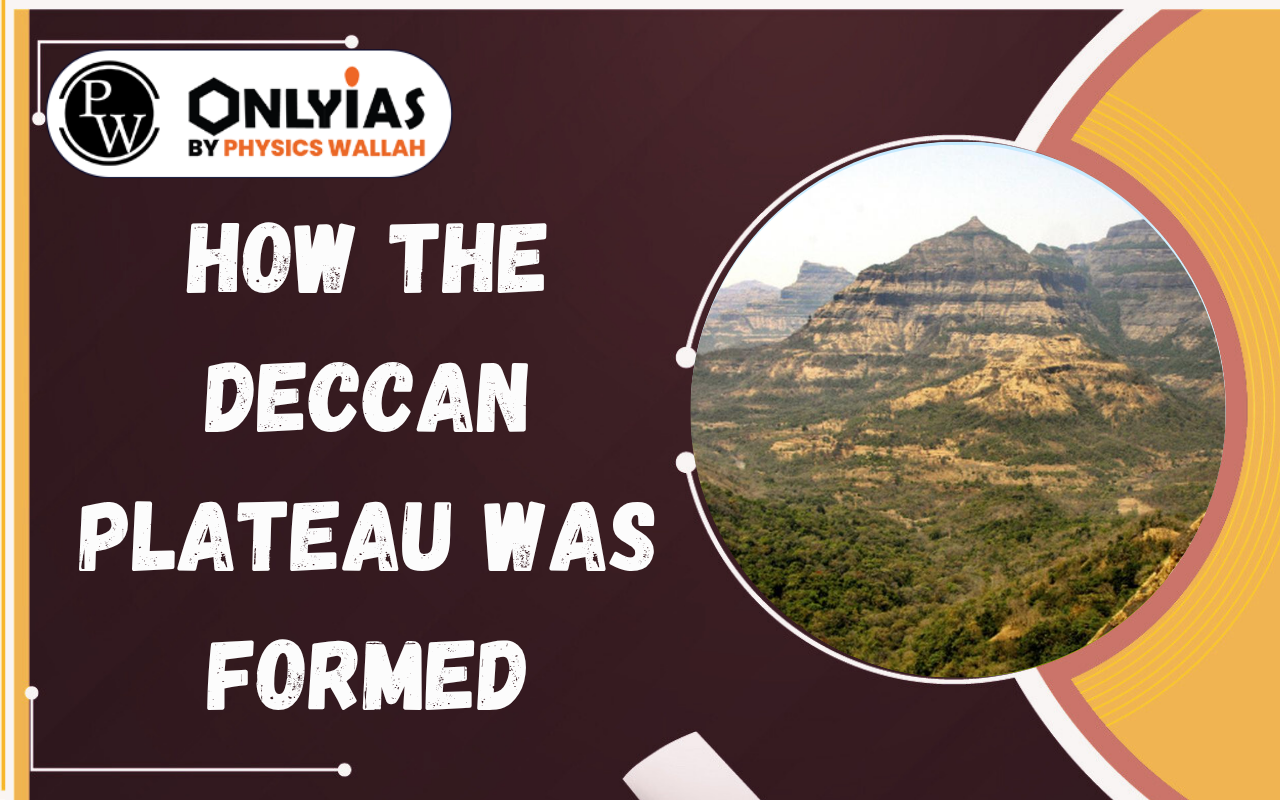
The Deccan Plateau is India’s largest plateau and one of the oldest landforms on Earth. It was formed through repeated volcanic eruptions that covered a vast region with layers of lava millions of years ago. As these lava flows cooled and hardened, they created the basalt-rich plateau seen today.
Understanding how the Deccan Plateau was formed also explains why it is known as the Deccan Traps and why it is one of the world’s most important volcanic landforms.
A plateau is a flat-topped elevated landform. It stands higher than the surrounding land but has a relatively level surface. Plateaus are smaller in height than mountains, but they rise above nearby regions.
Plateaus are found in many parts of the world. Some are formed due to the movement of tectonic plates, while others are created by volcanic eruptions.
Based on their formation, plateaus are mainly of two types.
A tectonic plateau is formed when the Earth’s crust moves upward due to tectonic forces. This happens because of the movement and collision of tectonic plates.
The process is similar to mountain formation. However, instead of forming high peaks, the land rises as a broad and flat surface.
A volcanic plateau is formed by repeated volcanic eruptions. During these eruptions, lava spreads over a large area. As the lava cools and solidifies, it forms thick rock layers.
When this process continues over a long period, the layers build up and create a broad plateau. The Deccan Plateau is among the largest volcanic plateaus in the world.
The Deccan Plateau is located in southern and western India. It lies to the south of the Narmada River. The plateau is situated between the Western Ghats and the Eastern Ghats.
It spreads across approximately eight Indian states and covers an area of more than 5 lakh square kilometres.
The average elevation of the Deccan Plateau is around 600 metres above sea level. Its highest point is Doddabetta Peak, which rises to approximately 2,600 metres.
The Deccan Plateau is made mainly of basalt, which is an igneous rock formed from cooled lava.
Since the plateau was created through repeated volcanic eruptions, it consists of many layers of basalt. These stacked lava layers give the region its unique geological structure.
The Deccan Plateau is also known as the Deccan Traps.
The word “Trap” comes from a word meaning “stairs.” The plateau has many step-like rock formations because it was built from several layers of lava that cooled one above another.
Each volcanic eruption added another layer of basalt. Over millions of years, these layers created the stepped landscape seen today.
The formation of the Deccan Plateau began around 60–70 million years ago during the Cretaceous Period. At that time, the Indo-Australian Plate was moving northward.
During this movement, a series of massive volcanic eruptions occurred in the southwestern part of the Indian subcontinent. These eruptions continued for nearly 30,000 years.
Each eruption released large amounts of lava onto the Earth’s surface. The lava spread across wide regions before cooling and hardening.
As more eruptions took place, fresh lava covered the older layers. This process continued repeatedly and gradually built the Deccan Plateau.
One of the earliest stages of the Deccan Plateau’s formation occurred after the Indo-Australian Plate separated from the African Plate. Cracks developed in the Earth’s crust, allowing lava to reach the surface and spread across large areas before cooling into basalt.
Lava from inside the Earth escaped through these cracks. It spread over the land and cooled into basalt.
This became the foundation of the Deccan Plateau. At the same time, the Indo-Australian Plate continued moving northward.
The next major stage of formation was linked to the Reunion Hotspot. A hotspot is a region inside the Earth’s upper mantle where hot magma rises toward the surface. This magma creates volcanic eruptions. The Reunion Hotspot is located beneath Reunion Island in the Indian Ocean.
As the Indo-Australian Plate passed over this hotspot, repeated volcanic eruptions released enormous quantities of lava.
The lava spread across much of peninsular India. After cooling and solidifying, these lava flows added more layers to the Deccan Plateau.
The western part of the Deccan Plateau has much thicker lava deposits than the eastern side. This suggests that most volcanic eruptions occurred closer to the western region of peninsular India.
The lava gradually flowed eastward before cooling. As a result, the lava layers became thicker in the west and thinner toward the east. Today, much of present-day Maharashtra lies within this thick volcanic region.
The original volcanic surface has changed over millions of years. Natural forces such as rainfall, rivers, wind, and weathering have shaped the plateau into its present form.
Erosion has created valleys, hills, and river basins across the plateau. In recent times, human activities such as mining, agriculture, and urban development have also altered parts of the plateau.
The volcanic origin of the Deccan Plateau has made it rich in mineral resources. Several important minerals are found in this region, including:
The famous Kolar Gold Mines are located within the Deccan Plateau region. The plateau also contains very old rock formations that belong to different geological periods, making it an important area for geological studies.
The Deccan Plateau is important for several reasons.
The Deccan Plateau was formed around 60–70 million years ago through repeated volcanic eruptions during the Late Cretaceous Period. Layer upon layer of basaltic lava gradually built one of the world’s largest volcanic plateaus, now known as the Deccan Traps. Today, the plateau is recognized for its fertile black soil, valuable mineral resources, and geological significance, making it an important part of India’s physical geography.
Check Out UPSC CSE Books
Visit PW Store
Explore SRIJAN Program

The Deccan Plateau was formed by repeated volcanic eruptions that spread layers of basaltic lava over millions of years.
It is called the Deccan Traps because multiple lava flows formed step-like rock layers resembling stairs.
The Deccan Plateau formed around 60–70 million years ago during the Cretaceous Period.
Basalt is the dominant rock found in the Deccan Plateau as it was formed from cooled volcanic lava.
It is important for its volcanic origin, rich mineral resources, fertile black soil, and geological significance.




Explore UPSC Foundation Batches


Connect with our experts to get free counselling & start preparing
Join India’s trusted platform for expert guidance, quality content, proven success.
Learn anytime, anywhere.



India's leading UPSC coaching platform helping aspirants prepare for IAS, IPS, IFS and other Civil Services examinations with the best faculty and proven strategies.
<div class="new-fform">
</div>