
Books

Answer:
|
How to approach the question
|
Introduction
The 73rd Amendment Act established the third tier of governance and provided constitutional recognition to Panchayati Raj Institutions (PRIs). This amendment aligns with Mahatma Gandhi’s vision of Gram Swaraj and aims to transform representative democracy into grassroots participatory democracy, where communities actively contribute to governance and decision-making processes.
Following are the transformative impact of the 73rd Amendment Act at grassroots institutions:
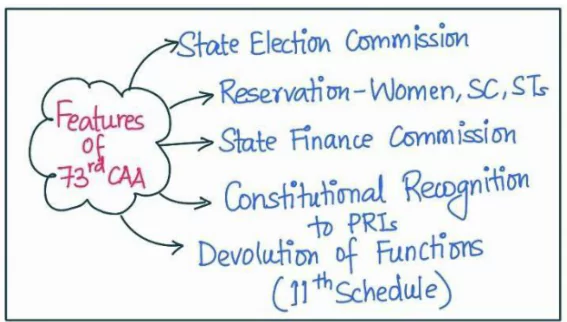 Women Leadership: One-third reservation for women in both membership and leadership roles within PRIs promotes gender equality and empowers women in local governance. Some states like Maharashtra have increased this to 50%.
However, despite these achievements, PRIs face certain challenges in their effective functioning:
Suggestions for Improvement:
The 73rd Amendment Act has institutionalized participatory democracy. To further strengthen this system and ensure a genuine transition from representative democracy to participatory democracy, there is a need for increased public awareness and measures to address the challenges faced by PRIs, such as the provision of dedicated functionaries, devolution of more functions, and adequate financial resources.
To get PDF version, Please click on "Print PDF" button.
Welfare vs Development in India: Understanding the...
Right to Be Forgotten (RTBF) in India: Legal Frame...
131st Constitutional Amendment Bill Defeat: Delimi...
Legal Consequences of Piracy in India: Laws, Penal...
Industrial Accidents in India: Regulatory Gaps, La...
India’s Migration Governance Blind Spot: Gulf Mi...


Connect with our experts to get free counselling & start preparing
Books
Udaan (Prelims Wallah)
Prahaar (Mains Wallah)
Q&A Bank (Prelims & Mains)
Budget & Economic Survey
NCERT Wallah
Marks Booster
हिंदी माध्यम विशेष शृंखला
 Current Affairs
Monthly Current Wallah
Subject Wise Current Affairs
Editorial Analysis
Editorial PDFs
News of The Day
Download Our App



Download Our App
<div class="new-fform">
</div>



 GS Foundation
 Optional Course
 Combo Courses
 Degree Program



 February 2, 2024
 0
0
Latest Comments