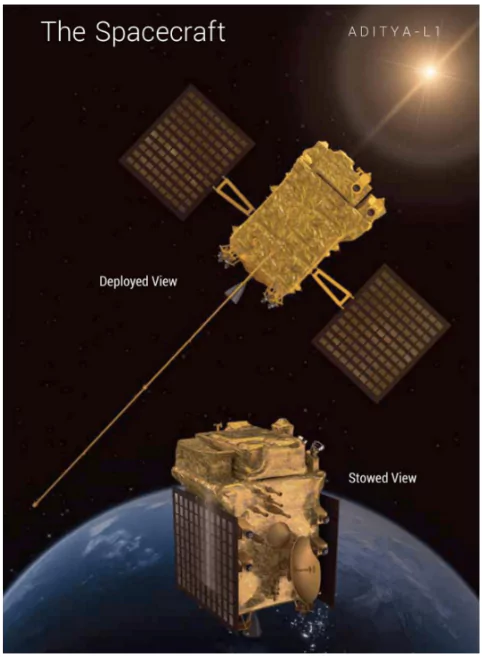
Aditya-L1, India’s first space-based solar observatory, has made a groundbreaking discovery by capturing the first-ever image of a solar flare ‘kernel’ in the lower solar atmosphere.
About Kernel
- A solar flare kernel is a localized brightening in the lower solar atmosphere, marking the starting point of a solar flare.
What is a Solar Flare?
- A solar flare is a sudden, intense burst of energy from the Sun’s atmosphere.
- It occurs due to sudden snapping of the Sun’s dynamic magnetic field, releasing energy in the form of light, radiation, and high-energy charged particles.
How Aditya-L1 Studies Solar Flares?
- Brightening in UV and X-ray: Before and during a solar flare, the affected region of the Sun becomes brighter in ultraviolet (UV) and X-ray wavelengths.
- Observation by Aditya-L1 Instruments: Instruments like SUIT, SoLEXS, and HEL1OS capture these bright flashes and study their characteristics in detail.
 Space-based Study Advantage: Since Earth’s atmosphere blocks harmful solar radiation, studying solar flares is only possible from space-based observatories like Aditya-L1.
Scientific Importance of Studying Solar Flare Kernel
- The brightening observed in the lower atmosphere correlates directly with an increase in plasma temperature in the solar corona.
- This confirms the linkage between energy deposition and temperature evolution in the Sun’s layers.
- The findings offer new insights into solar flare physics, which can improve space weather predictions and help protect satellites and communication networks on Earth.
Findings of Aditya-L1
- The Solar Ultraviolet Imaging Telescope (SUIT) payload detected an X6.3-class solar flare, one of the most intense categories of solar eruptions.
- SUIT recorded the flare in the Near Ultra Violet (NUV) wavelength range (200-400 nm), which had never been observed in such detail before.
Lagrange Point 1 (L1)
- L1 is located 1.5 million km from Earth, offering a constant view of the Sun.
- Advantages Of L1
-
- Enables early detection of solar storms and CMEs.
- Requires minimal fuel for orbit maintenance due to gravitational stability.
- Used by SOHO (Solar and Heliospheric Observatory) for solar research.
|
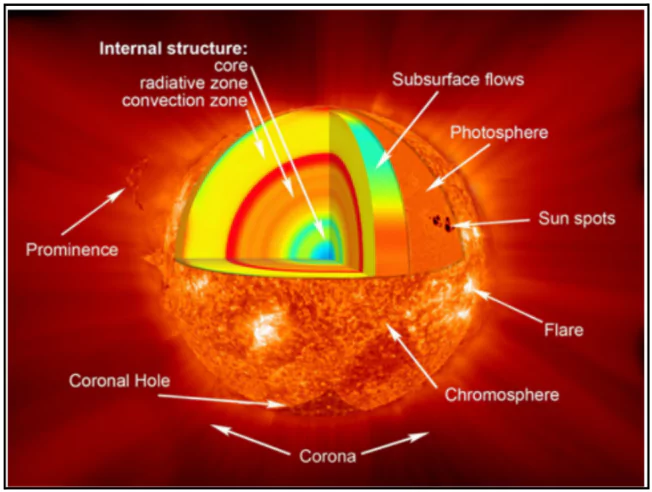
- The observation confirms that flare energy spreads through different layers of the Sun’s atmosphere, impacting the photosphere, chromosphere, and corona.
- The data enhances our understanding of how solar energy is released and transported, validating long-standing scientific theories.
About Aditya-L1 Mission
- Aditya L1 Mission is first Indian mission dedicated to continuous solar observations
- Launched on: September 2, 2023, by ISRO using a PSLV-XL rocket.
- Objective: To study the Sun’s atmosphere, solar wind, and space weather dynamics.
- Orbit: Placed in a halo orbit around the Sun-Earth Lagrange Point 1 (L1) on January 6, 2024.
- L1 points Provides an uninterrupted view of the Sun.
- Significance of Aditya L1 Mission.
- Enables long-term solar observation without interference from Earth’s atmosphere.
- Positions India among elite space agencies like NASA and ESA in solar research.
Phases of Aditya-L1 Mission
- Phase 1: Earth-Bound Orbits and Manoeuvres
- Spent 16 days in Earth-bound orbits to gain the necessary velocity.
- Performed five orbit-raising manoeuvres before transitioning to the next phase.
- Phase 2: Trans-Lagrangian Insertion and Cruise Phase
- Underwent a Trans-Lagrangian insertion manoeuvre to begin its 110-day journey to L1.
- Followed a carefully planned trajectory towards the Lagrange Point 1.
- Phase 3: L1 Orbit and Scientific Operations
- Entered a stable halo orbit around L1.
- Started continuous monitoring of the Sun with its advanced payloads.
Payloads of Aditya L1
| Payload |
Function |
| Visible Emission Line Coronagraph (VELC) |
Observes the solar corona and Coronal Mass Ejections (CMEs). |
| Solar Ultraviolet Imaging Telescope (SUIT) |
Captures UV images of the Sun’s photosphere and chromosphere. |
| Solar Low Energy X-ray Spectrometer (SoLEXS) |
Studies soft X-ray flares from the Sun. |
| High Energy L1 Orbiting X-ray Spectrometer (HEL1OS) |
Examines hard X-ray emissions from solar flares. |
| Aditya Solar Wind Particle Experiment (ASPEX) |
Studies solar wind and energetic ions. |
| Plasma Analyser Package for Aditya (PAPA) |
Analyzes plasma characteristics in interplanetary space. |
| Advanced Tri-axial Digital Magnetometers (MAG) |
Measures low-intensity interplanetary magnetic fields. |
Global Solar Space Programs
- NASA’s Parker Solar Probe (2018): Studies the Sun’s corona and solar winds.
- ESA-NASA Solar Orbiter (2020): Observes the Sun’s poles and magnetic field interactions.
- Helios 2 (1976, NASA & Germany): Early probe that approached within 43 million km of the Sun.
- Advanced Composition Explorer (ACE, 1997): Analyzes solar wind and cosmic rays.
Conclusion
Aditya-L1’s discovery of the solar flare kernel is a major breakthrough in heliophysics. The mission enhances India’s space science capabilities and strengthens global solar research efforts. With future missions planned, India is poised to play a key role in advancing solar physics and space weather forecasting.
 1 Mar 2025