UPSC PYQs

Prelims, Mains & Optional PYQs

UPSC Notes

Comprehensive & Short Notes

Gandhian Ethics and Indian Democracy: Truth, Non-Violence, Swaraj and Inclusion

5 Oct 2026

Gandhian Ethics and Indian Democracy: Truth, Non-Violence, Swaraj and Inclusion

Subject: GS 04: Ethics

Context: The debate on the future of Indian democracy highlights the continued relevance of Gandhian ethics, particularly truth, non-violence, self-restraint, inclusiveness, decentralisation and morally conscious citizenship.  
UPSC Coaching Classes

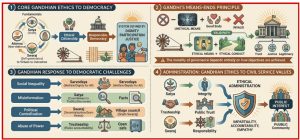
Gandhi’s Ethical Vision of Democracy

  • Swaraj as Ethical Self-Governance: Gandhi’s concept of Swaraj extended beyond political independence to self-restraint, moral autonomy and responsible participation in public life. Democracy, therefore, begins with the ethical conduct of individuals and communities.
  • Satya and Ahimsa: Truth and non-violence formed the moral foundation of Gandhian politics, enabling resistance to injustice while preserving human dignity, dialogue and ethical means.
  • Means and Ends: Gandhi rejected the separation of ethical means from desirable ends. Good governance cannot be justified through unethical methods; therefore, procedural fairness, constitutional propriety and non-violence must not be sacrificed for expedient political outcomes.
  • Sarvodaya and Inclusive Democracy: Gandhi’s vision of Sarvodaya, or welfare of all, placed the dignity and welfare of the weakest at the centre of social and political life. Democracy must therefore ensure that marginalised groups are not merely represented but meaningfully included.
  • Moral Citizenship: Gandhi envisioned citizens who are informed, independent, self-disciplined and morally conscious, capable of placing the larger public interest above narrow personal or sectional interests.
  • Constructive Politics: Gandhi combined resistance to injustice with constructive institution-building, emphasising decentralisation, social cooperation and institutions that promote human welfare rather than merely political power.

Gandhian Ethics and Indian Democracy

Ethical Challenges to Democracy and Gandhian Responses

  • Social Inequality and Marginalisation: Caste discrimination, communal prejudice, gender inequality and economic disparities can make formal political equality inadequate. 
    • Gandhi’s Sarvodaya emphasised the dignity and welfare of the weakest, requiring the concerns of marginalised and vulnerable groups to remain central to public life.
    • Ethical Imperative: Move from formal equality towards dignity, inclusion and meaningful participation.
  • Misinformation and Decline of Truth: Deepfakes, misinformation, propaganda and digital polarisation can distort public opinion and weaken informed democratic choice. 
    • Gandhi’s emphasis on Satya highlights the importance of truthful public discourse and responsible communication.
    • Ethical Imperative: Balance freedom of expression with truthfulness, responsibility and respect for citizens’ autonomy.
  • Political Centralisation and Weakening of Participation: Excessive concentration of political power can weaken accountability, institutional checks and citizen participation. 
    • Gandhi’s Swaraj favoured decentralisation, grassroots participation and greater autonomy in local decision-making.
    • Ethical Imperative: Ensure that public power remains participatory, accountable and oriented towards public welfare.
  • Erosion of Ethical Standards in Public Life: Corruption, conflict of interest, excessive materialism and abuse of public office can weaken institutional trust. 
    • Gandhi’s Seven Social Sins included “Politics without Principles” and “Commerce without Morality”, highlighting the dangers of separating public action and economic activity from ethical responsibility.
    • Ethical Imperative: Integrate principles, integrity and public welfare into political and economic decision-making.

Gandhian Ethics in Public Life and Administration

  • Public Office as Trusteeship: Gandhi’s doctrine of Trusteeship views wealth, authority and social power as carrying obligations towards society. 
    • Public servants can therefore be understood as trustees of public resources, constitutional values and citizen rights, rather than owners of public power.
  • Integrity and Public Interest: Public officials should place truth, constitutional values and public interest above personal, political or institutional interests. 
    • This reflects the Gandhian principle that ethical conduct cannot be subordinated to expediency.
  • Impartiality and Non-Discrimination: Administrative decisions should remain free from caste, religious, political or personal bias, ensuring equal treatment and fairness.
  • Empathy and Substantive Justice: Gandhian ethics requires administrators to understand the lived experiences of vulnerable and marginalised citizens, so that formal equality translates into substantive justice.
  • Courage of Conviction: Ethical public service requires the courage to resist unjust, discriminatory or unlawful practices through constitutional and institutional means.
  • Electoral Responsibility: Democracy requires citizens to exercise their franchise through reason, informed judgment and concern for the larger public interest, rather than narrow identities, personal relationships or immediate benefits.
  • Constitutional Morality: Gandhian moral citizenship can complement Ambedkar’s idea of Constitutional Morality. 
    • Ethical individuals sustain ethical institutions by respecting constitutional values, institutional procedures, rights and democratic norms.
  • Civil Service Values: Gandhian ethics closely resonates with the core public-service values of selflessness, integrity, objectivity, accountability, openness, honesty and leadership, as reflected in the Nolan Principles. 
    • These values convert personal morality into professional administrative conduct.

Way Forward

  • Ethical Citizenship: Strengthen constitutional morality, civic education, critical thinking and responsible democratic participation.
  • Truthful Public Discourse: Promote media literacy, fact-checking and responsible use of AI-generated content while protecting freedom of expression.
  • Ethical Institutions: Ensure that institutional processes uphold integrity, transparency, impartiality and procedural fairness, consistent with Gandhi’s means–ends principle.
  • Inclusive Governance: Ensure that marginalised groups receive equal dignity, voice and access to institutions.
  • Decentralised Democracy: Strengthen local governance and participatory institutions to make decision-making more responsive and accountable.
  • Trusteeship in Public Administration: Treat public office, public resources and institutional authority as a trust, with officials remaining accountable to citizens and constitutional values.
  • Ethical Leadership: Public leadership should combine competence with integrity, empathy, restraint and accountability, ensuring that power remains an instrument of public welfare.

Click to Know UPSC Offline Courses

Conclusion

Gandhi remains relevant not merely as a symbol of Satyagraha, but as a guide to ethical citizenship, inclusive institutions, truthful public discourse and accountable power. His emphasis on ethical means, trusteeship, Sarvodaya and moral self-governance can help democracy move beyond procedural democracy towards a culture of dignity, responsibility, participation and justice.

News Source: Indian Express

Check Out UPSC CSE Books

Visit PW Store

online store 1

Gandhian Ethics and Indian Democracy: Truth, Non-Violence, Swaraj and Inclusion

Need help preparing for UPSC or State PSCs?

Connect with our experts to get free counselling & start preparing

Free Counselling for UPSC Aspirants

Connect with our experts and take the right next step.

Expert Guidance
Personalized Strategy
100% Free

Book Your Free Session

NEED ASSISTANCE?

Request a Callback

Our counsellor will connect with you and help you choose the right course and centre.

  • Expert Guidance
  • Course & Fee Information
  • Quick Callback Support

Request a Callback

Books
UPSC PYQs
UPSC Notes
Current Affairs
Quick Revise Now !
AVAILABLE FOR DOWNLOAD SOON
UDAAN PRELIMS WALLAH
Comprehensive coverage with a concise format
Integration of PYQ within the booklet
Designed as per recent trends of Prelims questions
हिंदी में भी उपलब्ध
Quick Revise Now !
UDAAN PRELIMS WALLAH
Comprehensive coverage with a concise format
Integration of PYQ within the booklet
Designed as per recent trends of Prelims questions
हिंदी में भी उपलब्ध

<div class="new-fform">


    </div>

    Subscribe our Newsletter
    Sign up now for our exclusive newsletter and be the first to know about our latest Initiatives, Quality Content, and much more.
    *Promise! We won't spam you.
    Yes! I want to Subscribe.