In-Flight Internet Service

3 Jan 2025

In-Flight Internet Service

Air India to become the first Indian airline to roll out Wi-Fi Internet connectivity services on board domestic and international flights.

  • Wi-Fi will be available free of charge on the airline’s Airbus A350, Boeing 787-9, and select Airbus A321neo aircraft
  • Nelco in partnership with Panasonic Avionics Corporation will provide the service to select Air India’s domestic flights

In-Flight Internet Service

How In-flight Wifi Works?

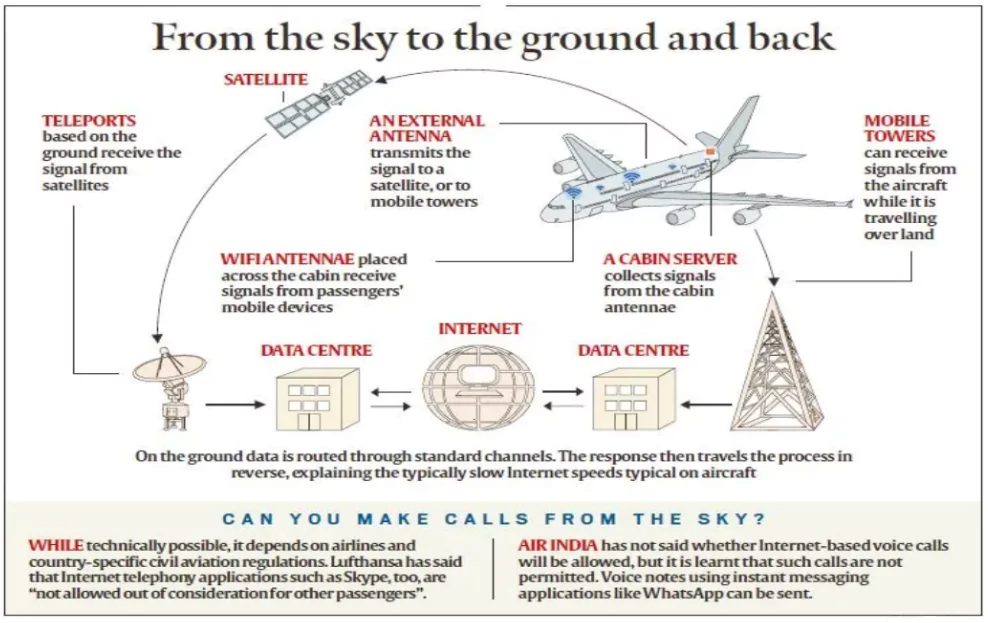
  • Multiple Wi-Fi antennas are located inside the aircraft cabin, which get signals from passengers’ devices. 
    • The signals are sent to an on-board server from these in-cabin antennae
  • Technologies For providing in-flight Internet Connectivity: In-flight connectivity systems primarily use two kinds of technologies requiring special antennae and other equipment to be installed on the aircraft
  • Air-to-ground (ATG) technology:
    • Working: An antenna is usually placed around the plane’s belly which picks up signals from the nearest tower on the ground or ground receiver, to provide connectivity on board the aircraft.
    • Limitation: The availability of nearby ground towers is the biggest limitation as network could break if the flight passes over water body, deserted land, or sparsely populated areas
  • Satellite -based connectivity:
    • The Internet is transmitted to aircraft from ground stations through satellites using antennae mounted on top of the aircraft’s body.
    • Advantage: It offers wider coverage as it is useful in providing connectivity when the aircraft is flying over regions without ground towers.

Enroll now for UPSC Online Course

  • The Flight and Maritime Connectivity (Amendment) Rules, 2024:
    • As per the new notified rules, in-flight passengers will be allowed to use internet services through Wi-Fi only after electronic devices are permitted for use in the aircraft ie. (after reaching  an altitude of 3,000 meters in Indian airspace)
      • The current safety protocols restrict electronic device use during critical phases of flight (takeoff and landing) and upto 3000meters to avoid interference with terrestrial mobile networks.
  • Concerns: 
    • Lack of Encryption: Many in-flight Wi-Fi networks don’t use strong encryption standards, which can make it easy for hackers to intercept communications.
    • Rogue Networks: Malicious actors can create fake Wi-Fi networks that look legitimate, tricking passengers into connecting.
    • Malware: Rogue networks can deliver malware to your device while you’re browsing the internet.
    • Man-in-the-middle attacks: Hackers can intercept communication between your device and the network, gaining access to sensitive data.
    • Device Vulnerabilities: many travelers have unpatched systems with all ports and protocols enabled and listening, putting their devices at risk to attacks by other travelers.
In-Flight Internet Service

Explore UPSC Foundation Course

Need help preparing for UPSC or State PSCs?

Connect with our experts to get free counselling & start preparing

Aiming for UPSC?

Download Our App

      
Quick Revise Now !
AVAILABLE FOR DOWNLOAD SOON
UDAAN PRELIMS WALLAH
Comprehensive coverage with a concise format
Integration of PYQ within the booklet
Designed as per recent trends of Prelims questions
हिंदी में भी उपलब्ध
Quick Revise Now !
UDAAN PRELIMS WALLAH
Comprehensive coverage with a concise format
Integration of PYQ within the booklet
Designed as per recent trends of Prelims questions
हिंदी में भी उपलब्ध

<div class="new-fform">


    </div>

    Subscribe our Newsletter
    Sign up now for our exclusive newsletter and be the first to know about our latest Initiatives, Quality Content, and much more.
    *Promise! We won't spam you.
    Yes! I want to Subscribe.