Subject: GS 2: Polity & Governance
Context: Despite recording nearly 1.77 lakh road accident deaths annually, India has failed to establish the Supreme Court-mandated trauma care network across States and UTs, undermining effective use of the Golden Hour—the crucial first 60 minutes for saving accident victims.
UPSC Coaching Classes
Status Report- Supreme Court Mandates vs. State Reality
The Supreme Court’s review, started after a petition by the road safety group SaveLIFE Foundation, focused on five key life-saving measures. The actual work done by states shows big gaps:
- Single Emergency Number (112 NERS): This nationwide system was launched in 2019 to merge all emergency lines (police, fire, health) into one number to avoid confusion.
- However, out of the eight states that account for two-thirds of all road deaths in India, seven have still not merged their medical emergency lines into this single 112 number.
- GPS in Ambulances: The court ordered that all ambulances, including private fleets, must have GPS tracking linked to a public dashboard.
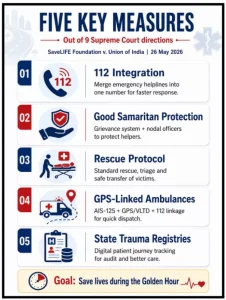 Currently, 13 states have no GPS or very little GPS tracking (limited only to government vehicles). Furthermore, six states refuse to make their tracking dashboards public.
- Protection for Good Samaritans: Even though the Motor Vehicles Act protects bystanders who help accident victims, people still fear police harassment.
- Out of the eight highest-fatality states, only two—Maharashtra and Karnataka—have set up a proper grievance system to protect these helpful citizens.
- Digital Trauma Registries: A trauma registry is a digital database that tracks an injured patient’s journey from the accident site, through the ambulance, to hospital treatment and discharge.
- It is essential to audit and improve medical care. Currently, 22 states do not have a trauma registry, relying instead on manual, unlinked paper records at local hospitals.
- On-Scene Rescue Protocols: While 17 states have created standard rules for rescue work, high-fatality states like Karnataka still lack a formal, combined protocol for safely moving victims from crash sites to hospitals.
Why State Emergency Systems are Failing
- Lack of Coordination: Road safety requires cooperation between three departments- Transport, Home (Police), and Health.
- At the state level, these departments work in isolation, which blocks the integration of emergency systems.
- Leaving Out Private Ambulances: State tracking systems mostly ignore private ambulances. Because they are not linked to a central control room, emergency operators cannot locate or send the closest private ambulance to a crash site.
- Reliance on Paper Records: Without digital, real-time data collection, state health departments cannot track how long it takes a victim to reach the hospital, making it impossible to fix delays in emergency care.
- Fear of Harassment: While the central law protects Good Samaritans, the lack of local accountability means citizens still fear being questioned by police or hospitals, stopping them from helping victims.
Systemic Impact- Why This Failure Kills
- Loss of the Golden Hour: Unlinked networks cause huge delays between the time of the accident and the arrival of an ambulance, turning treatable injuries into deaths.
- No Public Accountability: Keeping ambulance tracking dashboards hidden from the public means issues like slow responses or wrong dispatches go completely unchecked.
- Blind Policy Decisions: Without centralized trauma registries, states do not know which stretches of highways have the highest death rates, preventing them from setting up trauma centers where they are needed most.
Simple Policy Solutions Moving Forward
- Link Financial Grants to Performance: The Central Government should give extra development funds only to those states that fully implement the 112 network and open their ambulance tracking to the public.
- Mandate Digital Registries: States must stop using manual logbooks and adopt integrated systems like Tamil Nadu’s real-time model, which tracks ambulance timing and patient health data on a single digital screen.
- Create a Unified Road Safety Authority: To break department silos, states need a single, legal authority with direct power over traffic, police, and emergency medical fleets.
- Compulsory GPS Licensing: State transport laws should make public GPS tracking a mandatory condition for licensing any commercial or private ambulance.
India’s Position and Legal Options
- Global Commitment: India is committed to SDG Target 3.6, which aims to halve road traffic deaths and injuries, while the Government has identified road safety as a national priority.
- Implementation Gap: Despite India’s strong record in Humanitarian Assistance and Disaster Relief (HADR) operations abroad, the absence of a nationwide trauma care network highlights a significant gap between policy intent and ground-level implementation.
- Constitutional Enforcement: The Union Government can invoke Article 256 to direct States to implement Supreme Court-mandated trauma care measures, thereby strengthening protection of the Right to Life (Article 21).
Click to Know UPSC OnlyIAS Coaching Centres
Conclusion
The Supreme Court’s findings prove that India’s high road accident death rate is primarily an administrative and implementation failure, not a lack of laws. Saving lives on national highways requires a swift shift from simply making rules to building verifiable emergency infrastructure and treating rapid trauma care as a basic citizen right.
 26 Jun 2026