Subject: GS 2: Polity & Governance
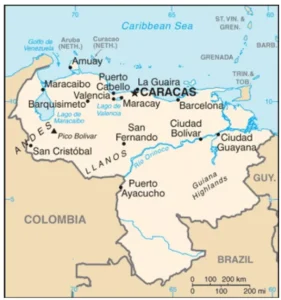
Context: On June 24, 2026, two powerful earthquakes (M 7.2 and 7.5) struck Venezuela’s north-central region within a minute, highlighting the combined challenges of tectonic risk, urban vulnerability, and disaster preparedness.
Key Highlights of the Recent Earthquake
- Magnitude and Sequence: The first earthquake measured magnitude 7.2 and was followed roughly 39 seconds later by a stronger magnitude 7.5 earthquake.
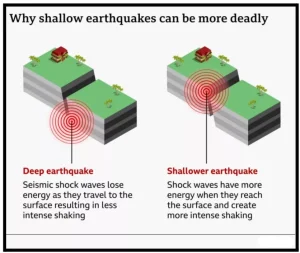
- Both events were shallow, producing violent ground shaking that maximized surface destruction.
- Human Impact: Various Reports confirm that the death toll has risen to at least 235 deaths and over 4,300 injuries.
- Total casualties are expected to rise dynamically as rescue operations continue and over 40,000 citizens remain missing under flattened debris.
 Geographic Spread: The primary impact zone spans Caracas and five north-central states- Miranda, La Guaira, Aragua, Carabobo, and Falcón.
- The epicenters were located near the Yumare–Morón region, west of Caracas.
- Tremors were powerful enough to trigger high-rise evacuations in neighboring Colombia (Bogotá) and parts of Brazil.
- Infrastructure Failure: Over 100 large structures underwent complete collapse, including a 13-story residential block in Playa Grande and a 22-story tower block in Altamira.
- Vital lifelines including power grids, telecommunications, water supply, medical networks, and operations at the main Simón Bolívar International Airport suffered severe systemic failure.
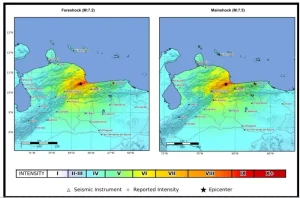 State Action: The Venezuelan administration declared a national state of emergency, mobilizing heavy machinery for debris clearance and attempting to clear priority transit routes to enable primary search-and-rescue triage.
About Seismic Doublet
- A seismic doublet refers to two closely spaced, comparable-magnitude earthquakes occurring in the same tectonic region within a very short span of time.
 Deviation from Routine Sequences: In standard seismic sequences, a singular massive mainshock is followed by an aftershock pattern consisting of significantly weaker, smaller tremors as the crust adjusts.
 -
- A doublet sequence delivers two major energy releases from distinct but closely linked ruptures.
- Stress Transfer Mechanism: The initial magnitude 7.2 earthquake altered the localized crustal stress field.
- This rapid static or dynamic stress transfer destabilized a closely related adjacent fault segment, triggering the secondary, more powerful magnitude 7.5 mainshock 39 seconds later.
UPSC Online Preparation
What Caused the Earthquakes?
- Plate Boundary Setting: Venezuela occupies a highly active plate margin, marking the boundary zone where the Caribbean Plate and the South American Plate interact.
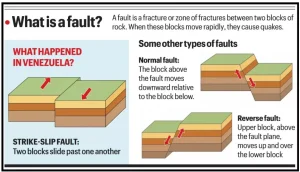
- Strike-Slip Faulting: The United States Geological Survey (USGS) confirmed that both earthquakes resulted from shallow strike-slip faulting along the complex San Sebastián fault system.
- In strike-slip tectonic structures, adjacent lithospheric blocks slide horizontally past one another along vertical fault planes.
- Rupture Depth Variations: While both tremors were shallow, regional agencies noted key variation- the initial magnitude 7.2 foreshock originated at a depth of approximately 22 km, while the subsequent magnitude 7.5 mainshock was exceptionally shallow, rupturing at a depth of just 10 km, releasing its kinetic energy directly adjacent to urban surface structures.
Why Were the Earthquakes So Destructive?
- Sequential Structural Loading Effect: Infrastructure was subjected to cumulative structural weakening.
- Buildings whose columns and load-bearing walls were fractured by the initial 7.2 shock had their structural dampening capacity exhausted, leading to instant, progressive collapse when the 7.5 mainshock hit 39 seconds later.
- Energy Yield vs. Magnitude Scale: The Richter or Moment Magnitude scale is logarithmic; a one-unit magnitude increase equates to a roughly 32-fold increase in energy release.
- The step-up from magnitude 7.2 to 7.5 meant the second quake released approximately 2.8 times more seismic energy, multiplying the destruction.
- Extreme Sub-Surface Proximity: The 10 km hypocenter depth of the mainshock meant that seismic waves traveled a minimal distance to the surface, experiencing very little crustal attenuation and striking urban foundations with violent peak ground acceleration.
- Urban Density and Structural Vulnerability: Dense urban centers like Caracas feature high concentrations of multi-story structures.
- Weak compliance with seismic-resistant construction codes, informal masonry, and a lack of systematic retrofitting created an extensively vulnerable building stock.
- Compounding Lifeline Failures: The concurrent destruction of power lines and telecommunications crippled rescue coordination during the vital “Golden Hour.”
- Furthermore, regional hospitals suffered physical structural damage, causing emergency triage spaces to buckle under mass casualty influxes.
- Pre-existing Humanitarian and Institutional Stress: The disaster struck a country already dealing with intense economic and institutional crises.
- This systemic strain compromised the government’s domestic emergency reserves and left the state highly dependent on rapid foreign relief.
- Early-Warning Deficiencies: Population exposure was maximized due to a limited or absent effective local early-warning capability, leaving dense residential communities with zero lead time to execute evacuation protocols.
Learning from this Earthquake
- Dynamic Seismic Hazard Modeling: Building design frameworks must be revised to transition away from single-shock assumptions.
- Civil engineering codes must incorporate multi-shock or doublet risk profiles to handle prolonged peak ground acceleration.
- Redundant Emergency Communication Systems: To prevent total communication blackouts, disaster frameworks must mandate the rapid deployment of decentralized, transportable satellite terminals, radio networks, and mesh communication systems.
- Mandatory Structural Auditing: Vulnerable cities must institute strict urban planning protocols, combining mandatory seismic-resistant audits with targeted retrofitting of aging public housing and dense, multi-story masonry blocks.
- Proactive Micro-Level Governance: Urban resilience depends on decentralized disaster management, necessitating ward-level evacuation maps, structurally protected open spaces, and mandatory hospital safety audits.
- Tailored International Protocols for Fragile States: Global disaster response frameworks (such as the UN INSARAG network) must develop fast-tracked operational protocols specifically tailored for countries experiencing acute socioeconomic or institutional crises.
India’s Response
- Official Diplomatic Statement: The Indian Prime Minister expressed deep condolences to the citizens and government of Venezuela, officially conveying India’s solidarity and stating that India stands ready to extend all possible assistance during this period of crisis.
- Global South Humanitarian Leadership: This immediate diplomatic response reflects India’s strategic foreign policy doctrine of acting as a first responder and a responsible actor across the Global South.
- Inferred Operational Capabilities: Drawing from past disaster diplomacy deployments—such as Operation Dost during the Turkey-Syria earthquake—India’s potential humanitarian assistance and disaster relief (HADR) footprint, if requested by Venezuela, could include the swift deployment of:
- Specialized National Disaster Response Force (NDRF) search-and-rescue teams.
- Indian Army medical corps personnel and mobile field hospitals.
- Essential emergency relief materials, including specialized drugs, structural sensors, and sanitation supplies.
Click to Explore UPSC Offline Coaching
Conclusion
The Venezuela earthquake doublet shows that disasters are not merely natural events; they become crises when geological hazards interact with vulnerable buildings, weak infrastructure, and limited institutional preparedness. The tragedy reinforces the need for resilient urban planning, seismic retrofitting, early warning systems, and coordinated international disaster response.
 26 Jun 2026