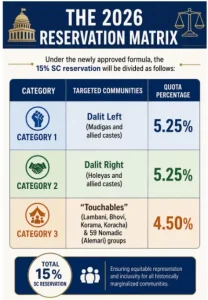
Recently, the Karnataka Government has approved a new sub-classification framework within the 15% SC quota to resolve a prolonged recruitment deadlock and address intra-Dalit disparities.
UPSC Online Coaching
Key Policy Highlights

- Recruitment Restart: The government will immediately begin filling 56,432 vacant posts. Previous notifications based on the older 6:6:5 ratio (under the 17% plan) will be withdrawn and replaced with this new matrix.
- Nomadic Community Safeguards: Within Category 3, one in every five posts is reserved specifically for the 59 nomadic (Alemari) communities. If no candidate is available from these groups, the post remains within Category 3 for other sub-castes.
- Addressing the 50% Cap: While the state legislature previously passed a law for 17% SC reservation, the government has reverted to the 15% limit for now to avoid legal hurdles regarding the Supreme Court’s 50% reservation ceiling.
- Backlog Provision: The Chief Minister noted that 6% of posts (2% SC and 4% ST) will be treated as “backlog” pending a High Court decision on the state’s move to push total reservation to 56%.
About Sub-classification
- Sub-classifications refer to dividing a broader reserved category, like Scheduled Castes (SCs), into smaller groups based on their varying levels of social and economic backwardness to ensure fair distribution of benefits.
- Need for Sub-classification: Subclassification is necessary because benefits of reservation often disproportionately reach relatively advanced sub-castes, leaving the most marginalized among SCs still deprived.
- For example among Other Backward Classes (OBCs), individuals earning above a certain income threshold are termed as “Creamy Layer” and are excluded from reservation, ensuring that benefits reach the truly disadvantaged “Non-Creamy Layer.”
About Scheduled Castes
- Definition: Scheduled Castes (SCs) are communities that are historically disadvantaged and were subjected to untouchability and social discrimination.
- Constitutional Basis: Under Article 341(1), the President of India specifies the castes deemed as Scheduled Castes for each State and Union Territory.
- Parliamentary Power: Article 341(2) empowers Parliament to include or exclude castes from the SC list through legislation.
Constitutional Provisions Related to SCs and Reservations
- Article 14: Guarantees equality before the law.
- Article 15(4): Permits special provisions for the advancement of socially and educationally backward classes, including SCs.
- Article 16(1): Ensures equal opportunity in public employment.
- Article 16(4): Allows reservation in public employment for backward classes.
- Article 341(1): Authorises the President to notify Scheduled Castes.
- Article 341(2): Grants Parliament the power to modify the SC list.
- Article 246: Deals with the subject matter of laws made by Parliament and State Legislatures, relevant post-identification of SCs.
|
| Arguments in Favour for Sub-Classification |
Arguments Against Sub-Classification |
- Equitable Distribution: Ensures that the most marginalized within SCs benefit from reservations, not just the relatively advanced groups.
|
- Fragmentation Risk: May divide the Scheduled Castes, weakening their collective political and social strength.
|
- Promotes Substantive Equality: Moves beyond formal equality to achieve real social justice based on actual needs.
|
- Deviation from Homogeneity Principle: Scheduled Castes were recognized as a homogenous group under Article 341; subclassification could undermine this basis.
|
- Addresses Historical Injustice: Recognizes layered discrimination and ensures targeted affirmative action for the most disadvantaged.
|
- Administrative Complexity: Adds complexity in identifying sub-groups, collecting reliable data, and monitoring implementation.
|
- Judicial Endorsement: Recent Supreme Court decisions (2024-25) allow subclassification if data-driven and justified.
|
- Potential for Political Misuse: Subclassification might be influenced by political pressures rather than genuine social backwardness.
|
- Learning from OBC Model: The “creamy layer” concept among OBCs has helped reservations reach the truly needy.
|
- Legal Uncertainty: Continuous litigation and lack of clear criteria could delay or derail the process.
|
- Dynamic Response to Change: Allows updating the reservation policy based on evolving socio-economic realities within SCs.
|
- Fear of Reduced Benefits: Some sub-castes may fear losing access to benefits they currently enjoy.
|
Supreme Court Decision on Sub-Classification of Scheduled Castes
- E.V. Chinnaiah Case (2005) : Held that SCs under Article 341 formed a homogenous group and could not be sub-categorised.
- Davinder Singh Case (2014): Referred the issue for reconsideration to a 5-judge Constitution Bench.
- Supreme Court 2020 Ruling: A 5-judge Bench found that the E.V. Chinnaiah judgment requires reconsideration.
- 2024 Constitution Bench (7-Judge) in State of Punjab v. Davinder Singh: Revisited Article 341 jurisprudence and held that intra-SC sub-classification is constitutionally permissible, subject to empirical justification and judicial review.
Click to Know UPSC Coaching Centres in India
Way Forward
- A commission similar to the G. Rohini Commission (for OBC sub-categorisation) could be established.
- The goal must be to address internal disparities among SC groups while preserving community unity and collective strength.
- Policymakers must engage with SC community representatives, legal experts, and social scientists for better understanding of the categorisation.