Makhana: The ‘Black Diamond’

3 Feb 2025

Makhana: The ‘Black Diamond’

Union Finance Minister Nirmala Sitharaman announced the establishment of a Makhana Board in Bihar.
About Makhana (Fox Nuts)

Makhana

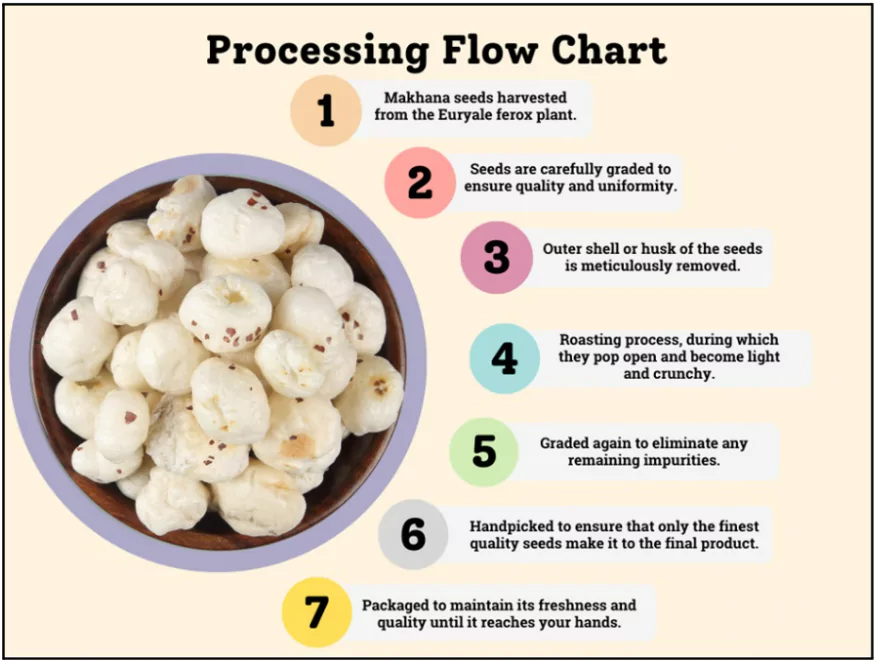
  • Makhana, also known as fox nut, is the dried edible seed of the prickly water lily (Euryale ferox).
  • It is found in freshwater bodies across South and East Asia.
  • The plant is recognized for its violet and white flowers and large round prickly leaves, often exceeding one meter in diameter.
  • Due to its dark outer layer, Makhana is referred to as the ‘Black Diamond’.

Nutritional Value and Uses

  • Makhana is low in fat, high in carbohydrates, and a good source of protein.
  • It is rich in minerals and is widely used in:
    • Traditional medicine
    • Health and wellness products
    • Snacks and culinary preparations such as commonly consumed as popped Makhana, also called ‘Lava’.

Enroll now for UPSC Online Course

Major Producing Regions

  • Bihar accounts for 90% of India’s total Makhana production.
  • The main producing districts in Bihar include:
    • Darbhanga, Madhubani, Purnea, Katihar, Saharsa, Supaul, Araria, Kishanganj, and Sitamarhi (Mithilanchal region).
    • The first four districts contribute to 80% of Bihar’s total Makhana output.
    • Geographical Indication (GI) Tag: Mithila Makhana received the Geographical Indication (GI) tag in 2022.
  • Other states cultivating Makhana include: Assam, Manipur, West Bengal, Tripura, and Odisha.
  • Makhana is also grown in Nepal, Bangladesh, China, Japan, and Korea.
  • The Bihar government has been advocating for Minimum Support Price (MSP) for Makhana.

Climatic Conditions for Makhana Cultivation

  • Makhana is an aquatic crop that thrives in tropical and subtropical regions.
  • It is cultivated in stagnant water bodies such as ponds, lakes, ditches, wetlands, and land depressions with water depths of 4-6 feet.
  • Ideal climatic conditions:
    • Temperature Range: 20°C – 35°C
    • Relative Humidity: 50% – 90%
    • Annual Rainfall: 100 – 250 cm

About Makahan Board

  • The Makhana Board is set to be arranged  with  a budget of ₹100 crore.
  • The board will provide training, financial assistance, and access to government schemes for Makhana farmers.
  • The board aims to boost production, processing, value addition, and marketing of Makhana (Fox Nuts).

Check Out UPSC NCERT Textbooks From PW Store

Significance of the ‘Makhana Board’

  • Bihar’s Export Challenges:
    • Although Bihar is the largest producer, Punjab and Assam are the largest exporters of Makhana.
    • Punjab does not even cultivate Makhana, yet leads in exports due to better processing infrastructure.
    • Bihar lacks food processing units, export infrastructure, and cargo facilities at airports.
  • Low Productivity and High Costs: Makhana cultivation is labor-intensive and costly.
    • Farmers have not widely adopted high-yield varieties like Swarna Vaidehi and Sabour Makhana-1.

Role of the Makhana Board

  • Train farmers to improve production techniques.
  • Promote investment in the food processing sector.
  • Develop export infrastructure to increase global market reach.
  • Ensure better financial incentives and MSP for Makhana farmers.

Makhana under ODOP

  • Makhana is recognized as an ODOP product under the One District One Product (ODOP) scheme.
  • The Union government provides subsidies to Makhana processors for:
    • Branding and marketing.
    • Infrastructure development in Bihar

Enroll now for UPSC Online Classes

One District One Product (ODOP) Scheme

  • The ODOP scheme was launched by the Ministry of Food Processing Industries to promote district-level economic growth.
  • It aims to maximize each district’s potential, support local businesses, and create employment opportunities, especially in rural areas.
  • The initiative is aligned with the ‘Atmanirbhar Bharat’ vision, fostering self-reliance and regional economic development.
  • Origin: First launched on January 24, 2018, by the Uttar Pradesh Government to boost district-based industries.
    • Due to its success, it was adopted by the Central Government as a national initiative.
  • Implementation: The scheme is implemented alongside the ‘Districts as Export Hubs’ (DEH) initiative, managed by the Directorate General of Foreign Trade (DGFT), Department of Commerce.
    • The Department for Promotion of Industry and Internal Trade (DPIIT) plays a crucial role in implementation.

Significance of ODOP: Aims to turn every district into an export hub by scaling manufacturing and supporting local businesses.

  • Encourages domestic and global trade by connecting local manufacturers with foreign markets.

Ready to boost your UPSC 2025 preparation? Join PW’s UPSC online courses today!

Makhana: The ‘Black Diamond’

Explore UPSC Foundation Course

Need help preparing for UPSC or State PSCs?

Connect with our experts to get free counselling & start preparing

Aiming for UPSC?

Download Our App

      
Quick Revise Now !
AVAILABLE FOR DOWNLOAD SOON
UDAAN PRELIMS WALLAH
Comprehensive coverage with a concise format
Integration of PYQ within the booklet
Designed as per recent trends of Prelims questions
हिंदी में भी उपलब्ध
Quick Revise Now !
UDAAN PRELIMS WALLAH
Comprehensive coverage with a concise format
Integration of PYQ within the booklet
Designed as per recent trends of Prelims questions
हिंदी में भी उपलब्ध

<div class="new-fform">


    </div>

    Subscribe our Newsletter
    Sign up now for our exclusive newsletter and be the first to know about our latest Initiatives, Quality Content, and much more.
    *Promise! We won't spam you.
    Yes! I want to Subscribe.