UPSC PYQs

Prelims, Mains & Optional PYQs

UPSC Notes

Comprehensive & Short Notes

Regenerative Agriculture in India: Practices, Benefits & Government Initiatives

25 Aug 2026

Regenerative Agriculture in India: Practices, Benefits & Government Initiatives

Subject: GS Paper 3: Indian Economy

Context: India’s agriculture and allied sectors recorded 4.45% decadal growth during FY16–FY25, but soil degradation, intensive cultivation, chemical use and erratic rainfall threaten its sustainability. 
  • Regenerative agriculture offers a pathway to restore soil health, enhance biodiversity and build climate resilience. 

Best Online Coaching for UPSC

About Regenerative Agriculture

  • It is a holistic farming approach aimed at restoring soil health, enhancing biodiversity and strengthening ecosystem resilience.
    • Unlike sustainable agriculture, which seeks to maintain existing conditions, regenerative agriculture seeks to actively improve them.
    • It focuses on rebuilding the ecological foundations of agriculture while ensuring long-term productivity and farm prosperity.
  • Regenerative AgricultureCore Principles:  Minimise soil disturbance, Maintain soil cover, Protect living roots, Integrate livestock, Limit chemical inputs, Enhance biodiversity.
  • Link Between Regenerative Agriculture And SDGs: 
    • SDG 13 – Climate Action: Regenerative agriculture helps strengthen climate resilience and reduce agricultural emissions.
    • Target 13.1: It enhances farmers’ resilience and adaptive capacity to climate-related risks and natural disasters.

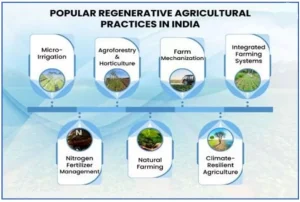
Popular Regenerative Practices in India

  • Water And Resource Efficiency: 
    • Micro-Irrigation: Drip and sprinkler systems deliver water directly/efficiently to crops, reducing wastage and improving drought resilience.
    • Farm Mechanisation: Enables timely and precise farm operations while improving the efficiency of water, fuel and fertiliser use.
  • Soil And Nutrient Management: 
    • Nitrogen-Use Efficiency: Appropriate fertiliser selection, dosage and timing reduce nitrous oxide emissions and nutrient losses.
    • Natural Farming: It is a chemical-free agricultural approach rooted in India’s traditional knowledge systems. 
      • It uses on-farm biological inputs such as Jeevamrut, Beejamrut, GhanJeevamrut, Neemastra and Dashparni, along with mulching, multi-cropping, continuous cover cropping and minimal soil disturbance.
    • Soil-Health Practices: Green manuring, cover cropping and mulching improve soil fertility, organic matter, moisture retention, nutrient cycling and carbon sequestration.
  • Integrated and Climate-Resilient Farming
    • Integrated Farming Systems (IFS): Integrates crops, livestock, fisheries and allied activities to maximise resource use, diversify incomes and reduce crop-failure risks.
    • Agroforestry: Combines trees with crops to enhance farm income, soil moisture and carbon storage; particularly useful for rejuvenating degraded rainfed lands.
    • Climate-Resilient Agriculture (CRA): Promotes balanced nutrient use, efficient water and pest management, soil moisture conservation, and appropriate land preparation.
    • Community Measures: Water-sharing, seed/fodder systems, community nurseries and collective marketing strengthen resilience to climate shocks.

Significance of Regenerative Agriculture

  • Environmental Benefits
    • Soil restoration: Rebuilds soil organic matter, structure, and fertility.
    • Biodiversity: Supports pollinators, beneficial insects and soil microorganisms.
    • Climate mitigation: Enhances carbon storage and helps reduce agricultural emissions.
    • Water conservation: Improves water retention and reduces runoff, erosion and pollution of water bodies.
  • Economic And Social Benefits
    • Lower Input Costs: Reduced dependence on synthetic fertilisers, pesticides and irrigation lowers the overall cost of cultivation.
    • Higher Farm Profitability: Healthier soils can stabilise yields, reduce input costs and improve farmers’ net incomes.
    • Livelihood Diversification: Integration of allied activities creates additional income sources and employment opportunities.
    • Greater Resilience: Diversified and healthier farming systems improve farmers’ ability to withstand climate variability and market fluctuations.

Government Initiatives To Promote Regenerative Agriculture

  • National Mission on Natural Farming (NMNF): Launched in 2024 to create a support ecosystem for the transition to natural farming.
    • Provides an output-based incentive of ₹4,000/acre/year for two years, up to one acre per farmer.
    • Provides for 10,000 need-based Bio-input Resource Centers and natural farming clusters supported by Community Resource Persons.
    • As of March 2026: 18,786 clusters, 8.80 lakh hectares covered and 18.19 lakh farmers enrolled.
  • Paramparagat Krishi Vikas Yojana (PKVY): Launched in 2015 to promote organic farming.
    • Provides support for organic cultivation, certification, and market access.
    • Farmers receive ₹31,500 per hectare over 3 years.
    • 16.90 lakh hectares have been covered under the scheme since its launch, as of October 2025.
  • Per Drop More Crop (PDMC): Implemented since 2015–16 to improve on-farm water-use efficiency through drip and sprinkler irrigation.
    • Provides 55% assistance to small and marginal farmers and 45% to other farmers.
    • About 109 lakh hectares had been covered by May 2026, with ₹26,325 crore in central assistance released.
  • Rainfed Area Development Program (RAD): Promotes Integrated Farming Systems through an area-based cluster approach.
    • Integrates crops with horticulture, livestock, fisheries, and apiculture.
    • Since inception: 9.53 lakh hectares covered and 15.73 lakh farmers benefited.
    • Provides ₹30,000/family for IFS adoption and ₹10,000/cluster for training and capacity building.
  • Agroforestry Component Under PM-RKVY: Supports agroforestry nurseries and quality planting material, along with skill development, R&D, and other technical activities.
    • During 2025–26, 135 new nurseries were established, and around 176.59 lakh saplings were raised.
  • Soil Health Card Scheme: Launched in 2015 to provide plot-wise scientific soil assessments.
    • Assesses soil on 12 key parameters and provides crop-specific recommendations for fertilizers and soil treatments.
    • Issued every 2 years, the Soil Health Card helps farmers understand the nutrient status and physicochemical conditions of their soils. 
    • It provides crop-specific recommendations on the appropriate use of chemical fertilisers, bio-fertilisers, organic inputs, and soil treatments.
    • As of March 2026, 25.89 crore Soil Health Cards had been generated.
    • In addition, 70,002 Krishi Sakhis have been trained to support the dissemination of soil health advisories at the grassroots level.

Click to Know UPSC Offline Courses

Challenges Associated With Regenerative Agriculture

  • High Transition Costs: Adoption requires investment in new equipment, bio-inputs, seeds and farm management practices, creating financial burdens for small farmers.
  • Initial Yield Uncertainty: Farmers may experience lower or fluctuating yields during the transition period, while benefits to soil health take time to materialise.
  • Knowledge and Skill Gaps: Lack of technical knowledge, training and extension support limits farmers’ ability to implement regenerative practices effectively.
  • Weak Market Incentives: Limited premium markets, assured prices, value-chain linkages and consumer awareness reduce the economic incentive for adoption.
  • Limited Institutional Support: Inadequate credit, insurance, research, extension services and policy incentives, along with difficulties in measuring outcomes such as carbon sequestration, hinder large-scale adoption.
  • Climate and Regional Variability: Regenerative practices are context-specific and their effectiveness varies according to soil, climate, crops and local farming systems.

Check Out UPSC CSE Books

Visit PW Store

online store 1

Regenerative Agriculture in India: Practices, Benefits & Government Initiatives

Need help preparing for UPSC or State PSCs?

Connect with our experts to get free counselling & start preparing

Free Counselling for UPSC Aspirants

Connect with our experts and take the right next step.

Expert Guidance
Personalized Strategy
100% Free

Book Your Free Session

NEED ASSISTANCE?

Request a Callback

Our counsellor will connect with you and help you choose the right course and centre.

  • Expert Guidance
  • Course & Fee Information
  • Quick Callback Support

Request a Callback

Books
UPSC PYQs
UPSC Notes
Current Affairs
Quick Revise Now !
AVAILABLE FOR DOWNLOAD SOON
UDAAN PRELIMS WALLAH
Comprehensive coverage with a concise format
Integration of PYQ within the booklet
Designed as per recent trends of Prelims questions
हिंदी में भी उपलब्ध
Quick Revise Now !
UDAAN PRELIMS WALLAH
Comprehensive coverage with a concise format
Integration of PYQ within the booklet
Designed as per recent trends of Prelims questions
हिंदी में भी उपलब्ध

<div class="new-fform">


    </div>

    Subscribe our Newsletter
    Sign up now for our exclusive newsletter and be the first to know about our latest Initiatives, Quality Content, and much more.
    *Promise! We won't spam you.
    Yes! I want to Subscribe.