UPSC PYQs

Prelims, Mains & Optional PYQs

UPSC Notes

Comprehensive & Short Notes

Water Security in India: Freshwater Resources, Water Stress and Solutions

3 Oct 2026

Water Security in India: Freshwater Resources, Water Stress and Solutions

Subject: GS 01: Geography

Context: According to the Central Water Commission (CWC), live storage in 178 major reservoirs stood at around 70% of total capacity below the 10-year average of 76.62%.
  • The situation highlights growing concerns over India’s freshwater security amid rainfall variability, groundwater depletion and rising demand.

Best Online Coaching for UPSC

India’s Freshwater Resource Base

  • High Population, Limited Water Resources: India has 18% of the world’s population and about 15% of its livestock, but only 4% of global freshwater resources.
  • Water Security in IndiaDependence on Monsoon: The Southwest Monsoon contributes over 70% of India’s annual rainfall and is critical for replenishing reservoirs, rivers and groundwater.
  • Himalayan Water Sources: The Indian Himalayan Region, often called the “Water Tower of Asia”, is the source of major river systems such as the Indus, Ganga and Brahmaputra.
  • Peninsular Rivers: Major peninsular rivers include the Godavari, Krishna, Mahanadi, Narmada, Tapi, Cauvery and Pennar, which are largely dependent on monsoon rainfall.
  • Groundwater Dependence: India depends heavily on groundwater for irrigation, domestic consumption and industrial use.

Status of Water Availability in India

  • Annual Water Availability: The CWC estimates India’s average annual water availability at 2,115.95 BCM for 1985–2023.
  • Declining Per Capita Availability: Per capita water availability declined from 5,177 m³ in 1951 to 1,486 m³ in 2021 and is projected to fall to 1,367 m³ by 2031.
  • Water Stress Threshold: According to the Falkenmark Index, availability below 1,700 m³ per capita indicates water stress, while below 1,000 m³ indicates water scarcity.
  • Groundwater Depletion: 11.13% of groundwater assessment units are classified as over-exploited, while another 13.59% are critical or semi-critical.
  • High Groundwater Dependence: India is the world’s largest groundwater user, accounting for around 25% of global groundwater abstraction, according to the World Bank.

Major Drivers of Water Stress in India

  • Erratic Monsoon: Uneven and variable monsoon rainfall affects reservoir storage and groundwater recharge.
  • Climate Variability: Climate variability and extreme weather events are increasing uncertainty in water availability.
  • Rapid Urbanisation: Rapid urbanisation and encroachment of water bodies reduce local water storage and groundwater recharge.
  • Groundwater Over-extraction: Excessive groundwater extraction has resulted in declining groundwater levels in several regions.
  • Degradation of Himalayan Springs: Degradation and drying of Himalayan springs threaten long-term water availability.
  • Rising Water Demand: Growing demand from agriculture, households, industries and energy generation is putting additional pressure on freshwater resources.

Global Freshwater Distribution

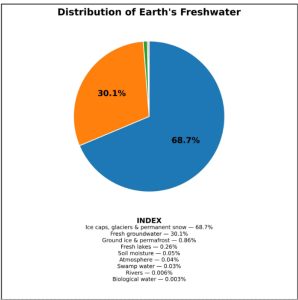
  • Predominance of Saline Water: Around 96.5% of Earth’s water is saline, while only about 2.5% is freshwater.
  • Limited Accessible Freshwater: Nearly 69% of freshwater is stored in glaciers and ice caps, around 30% as groundwater, while only a very small fraction is accessible as surface water.
  • Multiple Dimensions of Water Security: Water security depends not merely on the quantity of freshwater but also on its availability, accessibility, quality, geographical distribution and rate of renewal.

UPSC Course Fees Online

Global Water Insecurity: UN Water Bankruptcy Report, 2026

  • Growing Global Water Insecurity: Nearly 75% of the global population lives in countries classified as water-insecure or critically water-insecure.
  • Declining Aquifers: Around 70% of major aquifers show long-term declining trends.
  • Threat to People and Food Production: Nearly 3 billion people and more than half of global food production are located in areas where water storage is declining or unstable.
  • Water-Stressed Agriculture: More than 170 million hectares of irrigated cropland face high or very high water stress.

Implications of Growing Water Stress

  • Food Security: Water-intensive agriculture increases pressure on groundwater resources and can affect agricultural productivity.
  • Energy Security: Low reservoir levels can affect hydropower generation.
  • Urban Water Security: Rapidly growing cities face recurring water shortages and potential “Day Zero” situations.
  • Livelihood Security: Water scarcity affects agriculture, livestock and rural livelihoods.
  • Ecological Security: Reduced water availability threatens wetlands, rivers, forests and biodiversity.

Measures to Strengthen Water Security

  • Groundwater Management: Promote aquifer-based groundwater management and regulate excessive extraction.
  • Rainwater Harvesting: Expand rainwater harvesting, watershed development and artificial groundwater recharge.
  • Efficient Irrigation: Improve irrigation efficiency through micro-irrigation and suitable cropping patterns.
  • Restoration of Water Bodies: Restore lakes, ponds, wetlands and urban water bodies.
  • Himalayan Spring Management: Strengthen spring-shed management in the Himalayan region.
  • Wastewater Reuse: Promote treated wastewater reuse in agriculture and industry.
  • Integrated Water Governance: Improve coordination between States through integrated river-basin and water-resource management.

Click to Explore UPSC Offline Coaching

Conclusion

India’s water challenge is increasingly one of availability, accessibility and sustainable management, rather than simply the absolute quantity of freshwater. Strengthening groundwater governance, improving water-use efficiency and building climate-resilient water infrastructure are essential for long-term water, food and livelihood security.

News Source: IE

Check Out UPSC CSE Books

Visit PW Store

online store 1

Water Security in India: Freshwater Resources, Water Stress and Solutions

Need help preparing for UPSC or State PSCs?

Connect with our experts to get free counselling & start preparing

Free Counselling for UPSC Aspirants

Connect with our experts and take the right next step.

Expert Guidance
Personalized Strategy
100% Free

Book Your Free Session

NEED ASSISTANCE?

Request a Callback

Our counsellor will connect with you and help you choose the right course and centre.

  • Expert Guidance
  • Course & Fee Information
  • Quick Callback Support

Request a Callback

Books
UPSC PYQs
UPSC Notes
Current Affairs
Quick Revise Now !
AVAILABLE FOR DOWNLOAD SOON
UDAAN PRELIMS WALLAH
Comprehensive coverage with a concise format
Integration of PYQ within the booklet
Designed as per recent trends of Prelims questions
हिंदी में भी उपलब्ध
Quick Revise Now !
UDAAN PRELIMS WALLAH
Comprehensive coverage with a concise format
Integration of PYQ within the booklet
Designed as per recent trends of Prelims questions
हिंदी में भी उपलब्ध

<div class="new-fform">


    </div>

    Subscribe our Newsletter
    Sign up now for our exclusive newsletter and be the first to know about our latest Initiatives, Quality Content, and much more.
    *Promise! We won't spam you.
    Yes! I want to Subscribe.