GS II: Government policies and interventions for development in various sectors and issues arising out of their design and implementation.
Context: Recently, the Union Home Ministry announced a high-level committee headed by interlocutor Pankaj Kumar Singh (Former Deputy National Security Advisor) to formulate a constitutional and administrative settlement for the long-standing Gorkha issue through a “Permanent Political Solution”.
About Gorkhas
- Gorkhas are a diverse ethnolinguistic community, predominantly associated with the Nepali-speaking population of India, with a strong historical presence in the Himalayan region.
- Geographical Presence: They are concentrated particularly in Sikkim, Darjeeling and Kalimpong in West Bengal, besides significant populations across Assam, Uttarakhand, Himachal Pradesh and other northeastern and Himalayan regions.
- Military Tradition: Gorkhas have a long-standing association with the Indian Army, particularly through the Gorkha Regiments, known for their military service and distinctive traditions.
- Language & Culture: Nepali is an Eighth Schedule language of the Constitution, while Gorkha cultural traditions reflect diverse Himalayan ethnic and linguistic influences.
Best Online Coaching for UPSC
Background & Evolution of Governance Models
- Gorkhaland Demand: The issue centres on the decades-long demand for political self-rule, protection of Gorkha ethnic and linguistic identity, and creation of a separate Gorkhaland State covering the Darjeeling hills and parts of the Terai and Dooars.
- Darjeeling Gorkha Hill Council, 1988: Established through a tripartite agreement to provide regional autonomy, but remained constrained by limited legislative and financial powers.
- Tripartite Mechanism: The process involves the Union Government, West Bengal Government and representatives of the Gorkha community and hill-based political organisations.
- Gorkhaland Territorial Administration, 2011: Created as a semi-autonomous administrative body, but limited fiscal devolution, administrative friction and unresolved statehood aspirations reduced its effectiveness.
- Interlocutor: Pankaj Kumar Singh, former Deputy National Security Adviser, was appointed in October 2025 to facilitate structured negotiations.
Core Demands & Grievances
- Identity and Self-Rule: Protection of the distinct Gorkha ethnic, linguistic and cultural identity and greater political autonomy.
- Separate State of Gorkhaland: Demand for carving out a separate state from northern West Bengal, primarily covering the Darjeeling–Kalimpong hills, to secure greater political autonomy, protect distinct Gorkha identity, and address perceived developmental and governance deficits.
- Constitutional Safeguards: Demands include Scheduled Tribe status for 11 left-out Gorkha communities and stronger constitutional protection.
- Developmental Deficits: Concerns relate to infrastructure, employment, education, healthcare and livelihoods, particularly in tea-growing areas.
- Devolution Deficit: Earlier arrangements faced inadequate legislative, administrative and financial autonomy.
Strategic & Security Imperatives
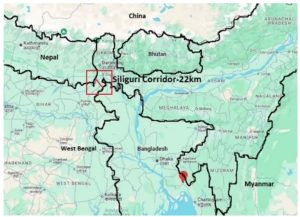
- Siliguri Corridor: The approximately 20–22 kilometre-wide “Chicken’s Neck” Corridor is the critical land link connecting mainland India with the North-Eastern States.
- Border Sensitivity: Proximity to Nepal, Bhutan and Bangladesh gives the region significant geopolitical and internal security importance.
- Critical Connectivity: Disruptions along National Highway 10, a key route connecting the region with Sikkim, can affect civilian connectivity, military logistics and strategic mobility.
- Internal Security: Prolonged agitation in this sensitive border region can create security vulnerabilities and logistical bottlenecks.
Constitutional & Administrative Options
| Option |
Constitutional Provision |
Key Consideration |
| Separate State |
Article 3 |
Core Gorkhaland demand, but faces opposition to territorial division of West Bengal. |
| Union Territory |
Article 3 |
Greater role for the Union Government, but may intensify Centre-State tensions. |
| Sixth Schedule Autonomous District Council |
Article 244(2) |
Could provide stronger constitutional autonomy over land, forests and local governance, subject to constitutional and demographic considerations. |
| Autonomous State Model |
Article 244A |
Provides for an autonomous State with a legislature and Council of Ministers; presently applicable to specified areas of Assam and would require appropriate constitutional action for replication elsewhere. |
UPSC Online Coaching
Major Challenges
- Demographic Complexity: The Terai and Dooars have a heterogeneous population comprising Gorkhas, Adivasis, Rajbanshis and Bengalis, making territorial reorganisation contentious.
- Political Fragmentation: Multiple hill-based organisations and competing leaderships make achieving a unified regional consensus difficult.
- State Resistance: Strong opposition to the territorial bifurcation of West Bengal remains a major political constraint.
- Economic Viability: Dependence on tea, tourism and allied sectors raises concerns regarding the fiscal sustainability of a new administrative arrangement.
- Security-Development Balance: Any settlement must reconcile regional aspirations with territorial integrity and national security.
Way Forward
- Asymmetric Federalism: Explore a customised governance arrangement with meaningful legislative, administrative and financial powers, rather than creating another nominal autonomous body.
- Conflict-Sensitive Settlement: Protect the interests of Gorkha and non-Gorkha communities, particularly in the diverse Terai and Dooars region.
- Genuine Devolution: Ensure adequate funds, functions and functionaries for effective regional self-governance.
- Inclusive Development: Complement the political settlement with investment in tea-garden livelihoods, youth employment, education, healthcare and connectivity.
- Consensus Building: Strengthen the Tripartite Mechanism through sustained dialogue among the Union Government, State Government and diverse regional stakeholders.
- Strategic Prudence: The final settlement should balance regional identity, federalism, democratic aspirations, territorial integrity and national security.
Click to Know UPSC Coaching Centres in India
Conclusion
A constitutional, inclusive and decentralised settlement can reconcile Gorkha aspirations, federal integrity and national security, ensuring lasting peace and development in the region.
 27 Aug 2026