India-France Relations at G7 Summit 2026: Key Outcomes, Strategic Partnership & Innovation Cooperation

15 Jun 2026

India-France Relations at G7 Summit 2026: Key Outcomes, Strategic Partnership & Innovation Cooperation

Recently, the Indian Prime Minister traveled to France to participate in the 52nd G7 Summit in Évian, France (June 15–17, 2026).

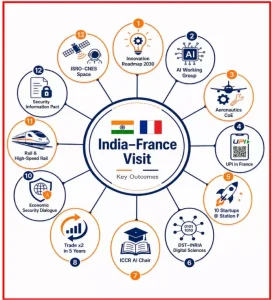
  • During the Indian Prime Minister’s visit to France, India and France announced 13 agreements covering technology, trade, space, education, and innovation.
  • 2026 declared as India-France Year of Innovation; events like Bharat Innovates 2026.
  • Prime Minister of India and President of the French Republic jointly inaugurated Bharat Innovates 2026 on June 14, 2026, in Nice, France.

Best Online Coaching for UPSC

About 52nd G7 Summit (2026)

  • Host and Venue: The 52nd G7 Summit is being held from 15–17 June 2026 in Évian-les-Bains, under the presidency of France.
  • About the G7: The G7 is an informal grouping of Canada, France, Germany, Italy, Japan, the United Kingdom, and the United States, with the European Union also participating.
  • Key Agenda: Major discussions focus on global security, the Ukraine conflict, Artificial Intelligence (AI) governance, critical minerals, economic resilience, and supply-chain security.
  • Outreach Partners: India has been invited as an outreach partner, along with Brazil, South Korea, and Kenya.
  • Significance for India: Provides a platform to advance the interests of the Global South, strengthen cooperation in technology, trade, and critical minerals, and deepen engagement with major advanced economies.

Key Outcomes of the Visit

The 13 major outcomes can be structured into four simple pillars:
  • Technology, Artificial Intelligence (AI), and Digital Systems:
    • Innovation Roadmap 2030: A long-term bilateral plan to guide joint work in critical technologies, research, and higher education.
    • India-France RelationsJoint AI Working Group: A new team to focus on AI governance and responsible AI rules, combining Indian tech growth with European standards.
    • Centre of Digital Sciences: Created between India’s Department of Science and Technology (DST) and France’s INRIA to support joint computer research.
    • UPI Expansion: Expanding India’s Unified Payments Interface (UPI) to major transport hubs like Paris and Nice airports, taking India’s Digital Public Infrastructure (DPI) deeper into Europe.
  • Defense, Security, and Space Work:
    • General Security Agreement: A vital pact to share and protect classified information, which will help in deep intelligence sharing and local weapon manufacturing.
    • Space Exploration: A deal between ISRO and France’s CNES to work together on human spaceflight and microgravity research (useful for India’s Gaganyaan mission).
  • Trade, Infrastructure, and Economic Security:
    • High-Level Trade Mechanism: A new group tasked with a clear plan to double bilateral trade from the current $16 billion over the next five years.
    • Economic Security Dialogue: A new forum to protect supply chain resilience in critical areas like semiconductors, critical minerals, and cybersecurity from global disruptions.
    • Railway Progress: A joint statement to help modernize India’s networks and high-speed rail corridors using French expertise.
  • Education, Skilling, and Startups:
    • Aeronautics Skill Center: Setting up a National Centre of Excellence in Kanpur to train Indian youths in aviation and aerospace, aligning with the Skill India mission.
    • Station F Incubation: Welcoming 10 more Indian startups to Station F in Paris (Europe’s largest startup hub) to help them get global funds.
    • Indian Council for Cultural Relations (ICCR) India Chair: Set up at Université Paris-Saclay focusing on “AI, Innovation, and Culture” to increase academic research.
    • Health Data Hub: A joint pilot project between ICMR and France to share health data safely for AI-driven medical research.

Horizon 2047 – India-France Strategic Roadmap

  • Purpose: To chart the future of India-France relations until 2047, celebrating centenaries of India’s independence and diplomatic ties.
  • Adoption: July 2023, during PM Modi’s visit to France.
  • Key Areas:
    • Defense: Enhanced cooperation, joint projects.
    • Space: Strengthened ISRO-CNES collaboration.
    • Nuclear Energy: Focus on sustainable solutions via Jaitapur and modular reactors.
    • Innovation & Tech: Promoting advancements in AI, cybersecurity, and digital infrastructure.
    • Sustainable Development: Climate action, blue economy, clean energy.
    • Cultural Exchange: Boosting people-to-people ties.
    • Indo-Pacific: Specific roadmap for regional cooperation.
  • Objectives: Strategic autonomy, global challenge response, and fostering innovation.

About France

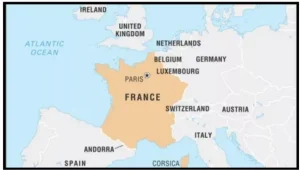
  • Mainland France is famously shaped like a Hexagon and is the largest country in Western Europe.
  • Hemispheric Location: Located in the Northern and Eastern Hemispheres.
  • India-France RelationsSurrounding Water Bodies:
    • North: English Channel (La Manche) and the North Sea.
    • West: Bay of Biscay (Atlantic Ocean).
    • South: Mediterranean Sea (specifically the Gulf of Lion).
  • Bordering Nations:
    • Belgium (North)
    • Luxembourg (Northeast)
    • Germany (East) — Boundary follows the Rhine River.
    • Switzerland (East) — Separated by the Jura Mountains.
    • Italy (Southeast) — Separated by the Alps.
    • Monaco (Southeast enclave)
    • Andorra (Southwest) — Located in the Pyrenees.
    • Spain (Southwest) — Boundary follows the Pyrenees Mountains.
  • Strategic Maritime “Choke Points” & Islands:
    • Strait of Dover: The narrowest part of the English Channel, separating France (Calais) from the UK (Dover).
    • Corsica: A large Mediterranean island belonging to France, located north of the Italian island of Sardinia.
    • Maritime Reach: Due to its territories, France has the second-largest Exclusive Economic Zone (EEZ) in the world (over 11 million km2), most of which is in the Indo-Pacific.

Overseas France

Region Territory Location Detail
Indian Ocean
  • Réunion Island & Mayotte
  • Key for the “Joint Strategic Vision” with India.
South America
  • French Guiana
  • Borders Brazil and Suriname. Home to the Kourou Space Centre (used by ISRO).
Caribbean
  • Guadeloupe & Martinique
  • Part of the Lesser Antilles.
Pacific Ocean
  • New Caledonia & French Polynesia
  • Rich in nickel and critical minerals.

  • Physical Boundaries (Natural Dividers):
    • Pyrenees: Separates France from Spain.
    • Alps: Separates France from Italy and Switzerland (Mont Blanc is the highest peak here).
    • Jura Mountains: Separates France from Switzerland.
    • Vosges Mountains: Located in the East, near the Rhine valley.
    • Massif Central: An ancient highland region in south-central France.
  • Important Rivers:
    • Seine: Flows through Paris into the English Channel.
    • Loire: The longest river in France; flows into the Atlantic.
    • Rhône: Rises in Switzerland, flows through Lake Geneva, and empties into the Mediterranean.
    • Garonne: Rises in the Pyrenees and flows into the Atlantic via the Gironde Estuary.

[/orange_table]

The Multidimensional Architecture of Relations

  • Historical and Political Foundations:
    • Strategic Consistency: Since the establishment of diplomatic ties in 1947, France has remained India’s most consistent Western partner. 
      • Notably, in 1998, France was the first country to sign a Strategic Partnership with India and refused to impose sanctions after the Pokhran-II nuclear tests, recognizing India’s security imperatives.
    • Support for Global Ambitions: France remains the most vocal advocate for India’s permanent seat in a reformed United Nations Security Council (UNSC) and its membership in the Nuclear Suppliers Group (NSG).

UPSC Online Coaching

History of India-France Relations

  • Early Interactions (17th–18th Century)
    • Colonial Presence: France established its presence in India during the 17th century, competing with the British and Portuguese for trade and territorial control.
      • The French East India Company was founded in 1664, and trading posts were established in Pondicherry (now Puducherry), Chandernagore (now Chandannagar), Mahe, Yanam, and Karaikal.
    • Anglo-French Rivalry: The Carnatic Wars (1746–1763) between the British and French East India Companies were fought for control over South India.
      • The French were eventually defeated, leading to the decline of their territorial ambitions in India.
  • Post-Independence Era (1947–1990s):
    • Diplomatic Relations: India and France established diplomatic relations in 1947, shortly after India’s independence.
      • France supported India’s non-aligned stance during the Cold War and maintained a balanced relationship despite India’s closer ties with the Soviet Union.
    • Cultural Ties: The French Institute of Pondicherry (1955) and the Alliance Française network in India played a significant role in promoting cultural and academic exchanges.
    • Economic Cooperation: France became a key partner in India’s industrialization efforts, particularly in sectors like energy, aviation, and infrastructure.
  • Strategic Partnership (1998–Present):
    • Landmark Agreement: In 1998, India and France signed their first-ever Strategic Partnership, marking a new era in bilateral relations. This was India’s first strategic partnership with any country.
    • Pillars of Partnership: The partnership is built on three main pillars: defence and security, civil nuclear cooperation, and space collaboration.
    • Defence Cooperation: France has been a reliable defence partner, supplying advanced military equipment such as the Mirage 2000 fighter jets and Scorpene submarines.
    • Civil Nuclear Cooperation: France played a crucial role in supporting India’s civil nuclear program after the Indo-US nuclear deal (2008).

Key Milestones in the 21st Century

  • 2008: France supported India during the NSG (Nuclear Suppliers Group) waiver, enabling India to engage in civil nuclear trade globally.
  • 2015: PM Modi visited France, and the two countries agreed to enhance cooperation in renewable energy, urban development, and counter-terrorism.
  • 2016: The Rafale deal was signed, marking a significant milestone in defence cooperation.
  • 2018: President Emmanuel Macron visited India, and the two countries adopted the Joint Strategic Vision for Cooperation in the Indian Ocean Region.
  • 2023: The 25th anniversary of the Strategic Partnership was celebrated, and the Horizon 2047 roadmap was adopted to guide the partnership for the next 25 years.
  • 2026: India and France upgraded their ties to a Special Global Strategic Partnership, with a greater focus on co-development and co-production of defence technologies under Make in India
    • The two countries launched the India–France Year of Innovation 2026, expanded cooperation in Artificial Intelligence (AI), critical minerals, digital technologies, and scientific research, and agreed to strengthen economic security and resilient supply chains
    • They also aim to double bilateral trade within five years while deepening collaboration in education, health, skilling, and emerging technologies.

  • Defense and Strategic Cooperation- The “Sovereign” Pillar: Defense is the bedrock of this alliance, transitioning from a buyer-seller model to a joint design and production framework.
    • Naval & Air Power: Beyond the 36 Rafale jets, the partnership now includes 26 Rafale-Marine jets and the continued indigenization of Scorpène-class submarines (Kalvari-class).
    • Interoperability: Regular conduct of high-complexity military exercises such as Varuna (Naval), Garuda (Air Force), and Shakti (Army).
    • Example: The Safran-HAL partnership for co-developing high-thrust engines for the AMCA (Advanced Medium Combat Aircraft) program.
  • Indo-Pacific Synergy and Maritime Security: As a “resident power” with territories like Réunion Island and Mayotte, France is India’s primary partner in the Western Indian Ocean.
    • Maritime Domain Awareness (MDA): Joint use of satellite data and naval facilities to monitor non-traditional threats (piracy, illegal fishing) and ensure a Free, Open, and Inclusive Indo-Pacific (FOIIP).
  • Civil Nuclear, Energy, and Space: Nuclear Renaissance: Renewed commitment to the Jaitapur Nuclear Power Project (JNPP) and a new focus on Small Modular Reactors (SMRs) for clean energy transition.
    • Space Frontier: Cooperation between ISRO (Indian Space Research Organisation) and CNES (Centre National d’Études Spatiales) on the TRISHNA climate satellite and the Gaganyaan (Human Spaceflight) mission.

France Significance for India

  • From Buyer to Technology Partner: India is moving beyond simply purchasing defence equipment to co-developing and co-producing advanced technologies with France under the Make in India initiative.
    • Examples include cooperation on Rafale fighter jets and Scorpène-class submarines.
  • Supports Strategic Autonomy: France is among India’s most trusted strategic partners and generally shares advanced technologies without major political conditions.
    • This helps India pursue an independent foreign policy while strengthening its defence capabilities.
  • Reduces Dependence on China: The new Economic Security Dialogue will support cooperation in critical minerals, supply chains, and emerging technologies.
    • It helps India diversify sources of key imports and reduce over-reliance on China.
  • Strengthens India’s Presence in Europe: Cooperation on Artificial Intelligence (AI) governance and the expansion of Unified Payments Interface (UPI) can increase India’s influence in Europe’s digital ecosystem.
    • It also gives India a greater role in shaping future European digital and technology standards.

Why Does Partnership Matters?

  • Strategic Autonomy: Both nations prioritize their right to make independent decisions. For India, France is a bridge to the Global North; for France, India is a gateway to the Global South.
  • Technological Sovereignty: By co-developing critical technologies (AI, Semiconductors, Jet Engines), both nations reduce dependence on volatile global supply chains.
  • Climate Leadership: As co-founders of the International Solar Alliance (ISA), they lead the global discourse on the Paris Agreement and green finance.
  • Counter-Terrorism Solidarity: The tribute at the 26/11 Memorial (Taj Mahal Palace) reaffirms that the partnership is anchored in a shared, uncompromising stance against global terror.
  • The “Partnership of the People”: The launch of the Year of Innovation 2026 at the Gateway of India and the cinema-themed lunch (cinema as a bridge) show that the alliance is utilizing Culture and Creative Industries as economic drivers.
  • Health & Youth Engagement: Symbolic acts like the Marine Drive jog serve as “lifestyle diplomacy,” targeting the youth demographic and promoting a positive message about health and fitness.

Challenges and Concerns that need to be Tackled

  • Low Commercial Trade: While political and defense ties are excellent, bilateral trade remains very low (around $16 billion). Doubling it in five years will be tough without removing non-tariff barriers (hidden trade restrictions like tough quality checks).
  • Different Geopolitical Views: France often takes a softer, more balanced approach toward China. On the other hand, India faces active border disputes with Beijing. Their views on European security conflicts also differ slightly.
  • Slow Bureaucracy: Turning broad policy goals like the Innovation Roadmap 2030 into real ground-level business investments often gets delayed by red tape and slow approvals in both nations.

Way Forward

  • Set Strict Timelines: The new High-Level Trade Mechanism must have clear quarterly deadlines to solve trade issues quickly rather than holding delayed annual talks.
  • Link Small Businesses to Global Supply Chains: The Kanpur aerospace center should be used to connect Indian MSMEs (Micro, Small, and Medium Enterprises) directly with French aerospace giants like Airbus and Safran.
  • Use Trilateral Frameworks: India and France should expand their bilateral success into trilateral partnerships (like India-France-UAE) to secure maritime routes in the Indo-Pacific and Western Indian Ocean.

Click to Know UPSC Offline Courses

Conclusion

The 13 summit outcomes prove that India-France relations have outgrown traditional defense deals. The relationship is now firmly focused on future technology, economic security, and human skill. By joining forces in AI governance, space research, and supply chain safety, India and France have successfully modernized their alliance to handle the strategic challenges of the coming decade. 

Check Out UPSC CSE Books

Visit PW Store

online store 1

India-France Relations at G7 Summit 2026: Key Outcomes, Strategic Partnership & Innovation Cooperation

Explore UPSC Foundation Course

Need help preparing for UPSC or State PSCs?

Connect with our experts to get free counselling & start preparing

Aiming for UPSC?

Download Our App

      
Quick Revise Now !
AVAILABLE FOR DOWNLOAD SOON
UDAAN PRELIMS WALLAH
Comprehensive coverage with a concise format
Integration of PYQ within the booklet
Designed as per recent trends of Prelims questions
हिंदी में भी उपलब्ध
Quick Revise Now !
UDAAN PRELIMS WALLAH
Comprehensive coverage with a concise format
Integration of PYQ within the booklet
Designed as per recent trends of Prelims questions
हिंदी में भी उपलब्ध

<div class="new-fform">


    </div>

    Subscribe our Newsletter
    Sign up now for our exclusive newsletter and be the first to know about our latest Initiatives, Quality Content, and much more.
    *Promise! We won't spam you.
    Yes! I want to Subscribe.