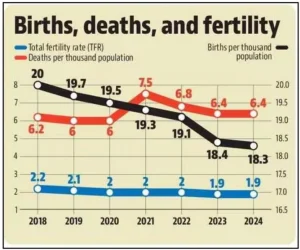
The Sample Registration System (SRS) Report 2024 released by the Office of the Registrar General of India highlights India’s continuing demographic transition.
UPSC Online Classes
About Sample Registration System (SRS)
- The Sample Registration System (SRS) is India’s largest demographic survey system for estimating birth rate, death rate, and other fertility and mortality indicators.
- It provides reliable annual data on population dynamics at the national and State levels.
- Conducted By: Office of the Registrar General & Census Commissioner, India under the Ministry of Home Affairs.
- Operational since 1969–70 on the recommendations of statistical experts to strengthen India’s vital statistics system.
- Key Areas Covered
- Fertility Indicators
- Birth Rate (BR)
- Total Fertility Rate (TFR)
- Age-Specific Fertility Rate (ASFR)
- Mortality Indicators
- Death Rate (DR)
- Infant Mortality Rate (IMR)
- Maternal Mortality Ratio (MMR)
- Population and Health Trends
- Life Expectancy at Birth
- Sex Ratio at Birth
- Rural-Urban demographic trends
|
Key Findings of Sample Registration System (SRS) Report 2024

- Birth Rate: India’s Crude Birth Rate (CBR) declined marginally from 18.4 (2023) to 18.3 (2024).
- Rural birth rate remained higher (20.2) than urban areas (14.7).
- Sex Ratio at Birth improved slightly to 918 girls per 1000 boys (2022–24 average).
- Fertility Trends: India’s Total Fertility Rate (TFR) remained at 1.9, below the replacement level of 2.1 for the fifth consecutive year.
- Urban fertility rate remained low at 1.5, while rural TFR stayed at replacement level (2.1).
- Declining fertility reflects urbanisation, women’s education and changing socio-economic patterns.
- Death Rate: Crude Death Rate (CDR) remained unchanged at 6.4 in 2024, still above pre-Covid levels.
- Rural death rate (6.8) remained higher than urban death rate (5.6).
- Infant Mortality Rate (IMR) improved slightly from 25 to 24 deaths per 1000 live births.
- Leading Causes of Death:
- Non-communicable diseases accounted for nearly 60% of deaths.
- Cardiovascular diseases remained the leading cause of mortality, increasing to 32.1% of total deaths.
- Deaths from respiratory infections declined but remained above pre-pandemic levels.
PW OnlyIAS ExtraEdge
- About Crude Birth Rate (CBR): Crude Birth Rate refers to the number of live births occurring in a year per 1,000 population.
- It is an important demographic indicator used to measure population growth trends and reproductive patterns.

- About Crude Death Rate (CDR): Crude Death Rate refers to the number of deaths occurring in a year per 1,000 population.
- According to the World Health Organization, it is a key indicator of population health and mortality conditions.

- About Total Fertility Rate (TFR): Total Fertility Rate refers to the average number of children a woman is expected to bear during her reproductive years (15–49 years).
- A TFR of 2.1 is known as the “replacement rate”.
- At 2.1: A population remains stable because, on average, a woman and her partner replace themselves, assuming child survival until age 15 and without factoring in migration.
- Above 2.1: The population generally grows.
- Below 2.1: The population will eventually shrink if there are no offsetting immigration levels.
|
Click to Explore UPSC Offline Coaching
Conclusion
India’s demographic transition reflects declining fertility and improving health indicators, necessitating stronger healthcare, elderly support, gender equity and human capital-focused policy interventions.