Subject: GS 3: Environment
Context: India annually burns millions of tonnes of crop residue, worsening air pollution and greenhouse gas emissions, while soils suffer declining soil organic carbon and fertility.
- Biochar offers a sustainable solution by converting biomass waste into a valuable soil-enhancing resource.
UPSC Online Coaching
About Biochar: (UPSC CSE Prelims 2020)

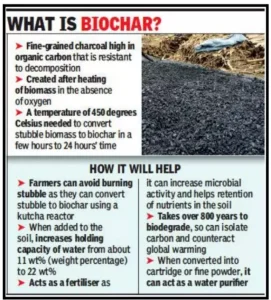
- Biochar is a charcoal-like substance that’s made by burning organic material from agricultural and forestry wastes (also called biomass) in a controlled process.
- Biochar converts carbon into a stable form and is cleaner than other forms of charcoal.
- Raw Material: It is made from biomass sources like, wood chips, plant residues, manure or other agricultural waste products
- Byproducts: Syngas and bio-oil, usable for energy and fuel.
- Process: Biochar is produced during pyrolysis, a thermal decomposition of biomass in an oxygen-limited environment called pyrolysis.
- Physical Attributes: Biochar is black, highly porous, lightweight, fine-grained and 70 percent composed of carbon
- Properties: Rich in stable carbon, can persist in soil for 100–1,000 years.
Production Potential in India:
-
- India produces over 600 million metric tonnes of agricultural residue and 60 million metric tonnes of municipal solid waste annually.
- A large part of this is openly burned or dumped, leading to pollution and greenhouse gas emissions.
- Utilising 30–50% of this waste could yield 15–26 million tonnes of biochar each year and remove 0.1 gigatonnes of carbon dioxide-equivalent (GtCO₂e) annually.
- Byproducts and Energy Potential:
- Syngas: Generated during pyrolysis (20–30 million tonnes annually), syngas can produce 8–13 terawatt-hours (TWh) of electricity—0.5–0.7% of India’s annual electricity—replacing 0.4–0.7 million tonnes of coal.
- Bio-oil: Production of 24–40 million tonnes per year could offset 12–19 million tonnes of diesel or kerosene (about 8% of demand), reducing crude oil imports and over 2% of fossil-fuel emissions.
Why is Biochar Important for India?
- Addressing the Crop Residue Burning Crisis: Large-scale burning of crop residues contributes significantly to air pollution, greenhouse gas emissions, and nutrient loss.
- Converting agricultural waste into biochar provides a productive alternative that reduces environmental damage while creating value from biomass that would otherwise be discarded.
- Restoring Degraded Soils: Many Indian soils suffer from declining levels of soil organic carbon, which affects nutrient retention, water availability, and overall productivity.
- Biochar helps restore soil health by increasing carbon content and improving soil structure.
- Supporting Climate-Smart Agriculture: As climate change increases the frequency of droughts, heat waves, and erratic rainfall, improving soil resilience becomes essential. Biochar enhances the capacity of soils to retain moisture and nutrients, helping crops withstand climatic stress.
- Enhances Water-Holding Capacity: Its highly porous structure enables soils to retain more water, reducing moisture stress and improving crop performance during dry periods.
- Improves Nutrient Retention: Biochar reduces nutrient leaching and improves nutrient-use efficiency, thereby enhancing the effectiveness of fertilisers and lowering input costs.
- Promotes Beneficial Soil Microorganisms: The porous surface of biochar provides a favourable habitat for beneficial microbes that support nutrient cycling and soil biological activity.
- Improves Soil Structure: Biochar enhances soil aggregation, reduces compaction, and improves aeration, resulting in healthier root development and greater productivity.
- Increases Crop Productivity: Several studies have shown that biochar application can increase crop yields by 10–30%, particularly in nutrient-deficient and degraded soils.
Evidence from India:
- Maharashtra: Field trials in the Akola district of Maharashtra have demonstrated that biochar derived from maize stalks improves soil organic carbon levels and overall soil fertility in black cotton soils.
- Kerala: Research in Kerala has shown that biochar produced from coconut leaf stalks improves soil quality across different cropping systems, highlighting the potential of locally available biomass resources.
|
Contribution to Climate Change Mitigation
- Carbon Sequestration: Biochar is recognised as a carbon-negative technology because it captures atmospheric carbon through plant biomass and stores it in a stable form within the soil.
- Reduction in Greenhouse Gas Emissions: The conversion of agricultural residues into biochar prevents emissions associated with open-field burning and reduces methane generation from biomass decomposition.
- Enhanced Climate Resilience: By improving water retention and nutrient availability, biochar helps agricultural systems adapt to changing climatic conditions and extreme weather events.
Role in Sustainable Agriculture and Circular Economy
- Converting Waste into Wealth: Biochar transforms agricultural residues from a disposal problem into a productive resource that enhances soil health and agricultural sustainability.
- Utilisation of Urban Organic Waste: The feedstock for biochar is not limited to agricultural residues. Municipal biodegradable waste, sewage sludge, and other organic waste streams can also be converted into biochar.
- Reducing Landfill Burden: India generates nearly 62 million tonnes of municipal solid waste annually, more than half of which is biodegradable. Converting such waste into biochar supports circular economy principles and reduces methane emissions from landfills.
UPSC Coaching Classes
Biochar and Carbon Markets
- Potential for Carbon Credits: Biochar qualifies as a persistent carbon dioxide removal (CDR) technology under internationally recognised carbon accounting frameworks.
- Economic Incentives for Farmers: Under methodologies such as VM0042 Agricultural Land Management, biochar projects can generate carbon credits by accounting for both avoided emissions from residue burning and long-term carbon sequestration.
- Additional Rural Income: Each tonne of certified biochar can generate approximately 2–2.8 tonnes of carbon dioxide-equivalent credits, creating additional revenue opportunities for farmers, cooperatives, and rural enterprises.
- Indian Innovation: Technologies such as the KISAN Kiln developed by IIT Kharagpur are enabling smallholder farmers to convert agricultural waste into biochar and participate in emerging carbon markets.
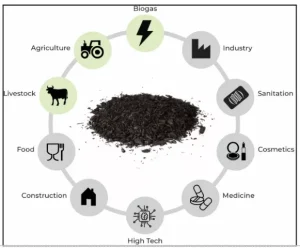
Applications Across Various Sectors:
- Agriculture: Enhances soil moisture and fertility, especially in dry and degraded soils.
- Cuts nitrous oxide emissions by 30–50% (273× more potent than carbon dioxide)
- Reduces fertilizer need by 10–20% and increases crop yield by 10–25%
- Carbon Capture: Modified biochar can absorb carbon dioxide from industrial gases, though current efficiency is lower than conventional methods.
- Construction: Adding 2–5% biochar to concrete improves strength and heat resistance (increase by 20%) and captures ~115 kg CO₂ per cubic metre of concrete.
- Wastewater Treatment: One kilogram of biochar can treat 200–500 litres of water.
- With 70 billion litres of wastewater generated daily in India, this implies a demand of 2.5–6.3 million tonnes of biochar annually.
- Other Key Benefits:
- Long-term carbon sink (100–1,000 years).
- Reduces open burning, landfill emissions, and urban pollution.
- Byproducts contribute to energy security.
- Generates rural employment (potential: 5.2 lakh jobs through decentralised production units).
- Supports soil regeneration, water retention, and climate resilience.
|
Key Challenges
- Limited Farmer Awareness: Biochar remains largely confined to research institutions and pilot projects, with limited awareness among farmers.
- High Initial Investment: The establishment of pyrolysis units and biochar production infrastructure requires significant upfront investment.
- Lack of Standardisation: Variations in feedstock and production methods affect biochar quality, creating challenges for large-scale adoption.
- Weak Market Linkages: The absence of well-developed value chains and carbon market access limits commercial viability.
- Monitoring and Certification Challenges: Carbon-credit generation requires robust systems for measurement, reporting, and verification.
Global Best Practices:
- Kenya: Kenya has successfully converted rice husks into biochar, generating certified carbon credits while improving soil pH and nutrient availability.
- Thailand: Thailand has integrated biochar into national soil rehabilitation and carbon management initiatives and linked certification mechanisms to carbon registry systems.
- Brazil: Research conducted by Embrapa has demonstrated significant improvements in crop productivity through the use of biochar derived from sugarcane bagasse.
|
Way Forward
- Promote Decentralised Biochar Production: Village-level and Farmer Producer Organisation (FPO)-based biochar units should be established to convert locally available biomass into valuable soil amendments.
- Integrate Biochar into Agricultural Programmes: Biochar should be incorporated into initiatives related to soil health management, natural farming, carbon farming, and sustainable agriculture.
- Develop Carbon Market Ecosystems: A dedicated framework should enable farmers and cooperatives to benefit from domestic and international carbon-credit markets.
- Strengthen Research and Standardisation: Research institutions should develop region-specific biochar technologies and quality standards based on local feedstock availability.
- Create Biomass Value Chains: Efficient systems for biomass collection, aggregation, transportation, and processing should be developed to ensure reliable feedstock supply.
- Support Capacity Building: Extension services and awareness programmes should educate farmers regarding the benefits and application of biochar.
- Encourage Public-Private Partnerships: Collaboration between government, research institutions, private enterprises, and farmer organisations can accelerate technology deployment and market development.
Click to Know UPSC Offline Courses
Conclusion
Biochar offers a sustainable solution to India’s twin challenges of crop-residue burning and declining soil health. Scaling its adoption can enhance agricultural productivity, strengthen climate resilience, promote circular economy practices, and support long-term food and environmental security.