Recently, WTO Director-General, stressed the need to maintain the WTO’s relevance amid challenges like the U.S. blocking Appellate Body appointments, with plurilateral agreements offering a potential solution to modernize global trade rules.
About World Trade Organisation (WTO)
- WTO is the only global international trade organisation which deals with rules of trade between nations.
- The WTO commenced operation on 1st January 1995, under the Marrakesh Agreement, signed on 15 April 1994 by 124 nations.
- It has replaced the General Agreement on Tariffs and Trade (GATT) which commenced in 1948.
- Created by: Uruguay Round negotiations (1986-94)
 Members: 166 members
- Headquarters: Geneva, Switzerland.
Organisational Structure Of WTO
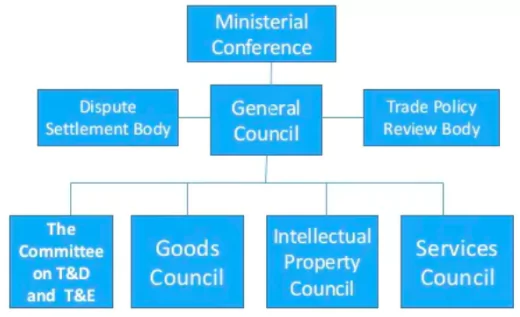
- Ministerial Conference: It is the highest decision making body of the WTO, meeting at least every two years.
- General Council: It oversees the WTO’s day to day operation, and meets regularly at the Headquarters Geneva.
- It also acts as Trade Negotiations committee, the Dispute Settlement body, and the Trade policy review body.
- Dispute Settlement Panels: Established to examine specific trade disputes between WTO members and issue reports with findings and recommendations.
- Appellate Body: Reviews appeals from decisions by WTO dispute settlement panels. Its rulings play a vital role in interpreting and upholding WTO rules.
Relevance of WTO in the Present Time
- Foundation for Global Trade Rules: The WTO continues to provide a legal framework for global trade, ensuring rules are consistent and binding.
- The WTO’s role in the Doha Development Agenda (DDA) and its continued advocacy for trade liberalization in sectors like agriculture and services.
Doha Development Agenda (DDA)
- Launched in 2001 at the Fourth WTO Ministerial Conference in Doha, Qatar.
- Aim: To achieve major reforms in the international trading system by addressing issues like agricultural subsidies, market access for developing countries, and sustainable development.
|
- Dispute Settlement Mechanism (DSM): Even with its current challenges, it provides a platform for resolving trade conflicts between members, promoting predictability and legal certainty in global trade.
- India’s victory in the US anti-dumping duties case is a key example where the WTO DSM was instrumental in resolving a trade dispute.
- Multilateral Framework for Trade: The WTO facilitates multilateral negotiations, providing a platform where diverse countries, especially developing economies like India, can advocate for their trade interests.
- The Trade Facilitation Agreement (TFA) negotiated in the WTO framework, focusing on simplifying customs procedures, was a key achievement in making global trade more efficient.
- Global Trade in Goods and Services: The WTO continues to be pivotal in regulating global trade in goods and services, ensuring that countries comply with established trade standards.
- The WTO’s agreements on services under the General Agreement on Trade in Services (GATS) are key for countries like India, which is a global leader in IT services.
- Adaptation to Emerging Trade Issues: The WTO is attempting to adapt to new trade dynamics, such as digital trade, e-commerce, and environmental sustainability.
- The WTO has initiated discussions on e-commerce and investment facilitation, areas that were previously underrepresented in the global trade framework.
Issues faced by the WTO as a Multilateral Agreement
- Consensus-Based Decision-Making is Ineffective: WTO’s reliance on consensus makes it hard to address complex trade issues, especially with 166 countries.
- The Doha Development Agenda (DDA) faced deadlocks due to differing priorities between developed and developing countries.
- Over 20 years, DDA progress stalled, highlighting the inefficiency of consensus-based decision-making.
- Stagnation in Multilateral Negotiations: The WTO struggles to make progress on key issues like agriculture and market access.
- Agricultural subsidies remain contentious, with India opposing the WTO’s 10% subsidy cap.
- The Doha Round has stalled, and market access talks have yielded little progress.
- Inability to Address Emerging Trade Issues: The WTO framework struggles with modern challenges like e-commerce and environmental regulations.
- E-commerce is a growing issue, but the WTO lacks a comprehensive framework.
- While plurilateral agreements on e-commerce exist, they are outside the WTO framework.
- Dysfunctional Dispute Settlement Mechanism (DSM): The Appellate Body has been non-functional since 2019, delaying dispute resolution.
- The US blocked new appointments, preventing the DSM from operating effectively since 2017.
- Protectionist Policies and Trade Wars: Growing protectionism undermines the WTO’s core principles.
- The US-China trade war escalated with tariffs, disrupting global markets.
- Tariffs imposed by the US and others have caused significant market disruptions.
- Increasing Proliferation of Free Trade Agreements (FTAs): As WTO negotiations stall, countries turn to FTAs, bypassing the WTO framework.
- India signed FTAs with the EU, Australia, and ASEAN, often conflicting with WTO rules.
- In 2025, the number of FTAs surpassed 600, up from less than 100 in 2000.
- Limited Ability to Adapt to Global Economic Shifts: The WTO struggles to address global issues like climate change and technology-driven trade.
- RCEP goes beyond the WTO’s scope, addressing investment and environmental sustainability.
Key Trends in Global Trade Dynamics
- Shift from Multilateralism to Regionalism: The growth of Regional Trade Agreements (RTAs) and Free Trade Agreements (FTAs) has overshadowed the traditional multilateral approach.
- RCEP (Regional Comprehensive Economic Partnership) and EU Trade Agreements have become more prominent as multilateral negotiations like those within the WTO stagnate.
- Rise of Digital Trade and Technology: The expansion of digital trade is transforming global commerce, driven by advancements in e-commerce, data flows, and artificial intelligence.
-
- The US-Japan Digital Trade Agreement addresses issues like data privacy, cross-border data flow, and digital taxation.
- Growing Protectionism: Protectionist policies are on the rise, as countries prioritize domestic industries and security concerns over global trade integration.
-
- The US-China Trade War has seen both countries imposing tariffs and trade barriers, disrupting global supply chains.
- Global Supply Chain Shifts: The global supply chain is undergoing restructuring due to factors like the pandemic, geopolitical instability, and rising labor costs.
-
- RCEP focuses on regional supply chains, which is reshaping trade patterns across Asia-Pacific.
- Environmental Sustainability in Trade: Environmental concerns are now a key driver in trade discussions, with countries and corporations emphasizing sustainability and green trade policies.
-
- There is increasing integration of sustainability clauses in trade agreements, influencing the global flow of goods and services, especially in industries like energy and manufacturing.
- The Role of Developing Economies: Developing countries are increasingly asserting themselves in global trade negotiations, focusing on inclusive growth and fairer trade practices.
-
- India’s push for more inclusive trade terms in agreements like the Doha Development Agenda (DDA) highlights the role of developing economies.
- Impact of Trade Wars and Geopolitical Tensions: Geopolitical tensions, particularly between major powers, are reshaping trade patterns and influencing countries to align with strategic partners.
-
- The US-China trade war and Brexit have highlighted the link between geopolitics and trade policies.
About Information Technology Agreement (ITA)
- Signed: 13 December 1996 at the WTO Singapore Ministerial Conference.
- Objective: Eliminate tariffs on IT products to boost trade.
- Coverage: Computers, telecom equipment, semiconductors, software, scientific instruments, and related parts.
- Key Features
- Zero Tariffs: Members must eliminate and bind customs duties at 0% for listed IT products.
- MFN Basis: Benefits extend to all WTO members, even non-participants.
- Participants: Started with 29 members, now 81 members (covering 97% of global IT trade).
|
Alternative Trade Mechanisms to the WTO
- Plurilateral Agreements (PAs): Trade agreements among a subset of WTO members focusing on specific issues like e-commerce, investment, or intellectual property.
- The Information Technology Agreement (1996) eliminated tariffs on tech products, benefiting countries covering 90% of world trade in IT.
- Offers flexibility and faster negotiations compared to WTO’s consensus-based approach.
- Bilateral and Regional Free Trade Agreements (FTAs): Trade agreements between two or more countries to liberalize trade and address specific sectors.
- India has signed numerous FTAs with countries like the EU, Australia, and ASEAN, to secure trade benefits.
- Regional Comprehensive Economic Partnership (RCEP): A mega-regional trade agreement between 15 Asia-Pacific countries, including China, Japan, Australia, and India.
- Focuses on broader economic integration, including investment and environmental sustainability, going beyond WTO frameworks.
- Free Trade Area of the Americas (FTAA): A proposed agreement to establish a comprehensive trade area across the Americas, promoting regional integration.
- Promotes liberalization and cooperation among member states without waiting for global consensus at the WTO.
Plurilateral Agreements (PAs)
- Plurilateral agreements are trade agreements between a subset of WTO members, focusing on specific issues or sectors.
- Unlike multilateral agreements that require the participation of all WTO members, PAs involve a smaller group of countries that agree to specific commitments while allowing other WTO members to join at a later stage.
- Types of PAs:
-
- Exclusive PAs: The benefits of the agreement are limited to the participating countries, and non-participants do not receive benefits unless they join.
- Example: The Missile Technology Control Regime (MTCR) or the Hague Code of Conduct.
- Open (MFN-based) PAs: The benefits of the agreement are extended to all WTO members on a Most-Favored-Nation (MFN) basis, even if they are not participants. Non-participating countries can opt to join later.
- Example: The Information Technology Agreement (ITA), which eliminated tariffs on IT products, benefiting countries accounting for over 90% of global trade in IT products.
Benefits of Plurilateral Agreements (PAs)
- Flexibility in Addressing Specific Issues: PAs allow countries to focus on particular sectors or issues that may not be possible in broader, multilateral negotiations.
- Faster Negotiations: PAs can proceed more quickly as they involve fewer countries and less complexity than multilateral negotiations, speeding up trade liberalization.
- Bypass Deadlocks in Multilateral Negotiations: When the WTO consensus proves difficult, PAs allow like-minded countries to address pressing issues without waiting for full global agreement.
- Potential for Expansion to Multilateralism: PAs can evolve from limited agreements to multilateral solutions as more countries join and benefit from the agreement.
- Promotes Regional Cooperation: PAs can promote regional cooperation among neighboring countries, strengthening economic ties and improving regional trade networks.
Way Forward for the WTO
- Adopt “Variable Geometry” for Plurilateral Negotiations: Allow countries to participate in plurilateral agreements based on issues of interest, without requiring full consensus.
- This will reduce deadlocks and let like-minded countries address specific trade issues.
- Introduce Threshold Criteria for Participation: Set criteria, like a share of global trade, for countries initiating plurilateral discussions.
- This ensures important economies lead negotiations and allows others to join later.
- Shift to Majority Rule: Use majority rule for deciding which issues should be addressed through plurilateral negotiations.
- This will allow the WTO to address critical trade issues faster.
- Integrate Plurilateral Outcomes into the WTO Framework: Make plurilateral outcomes binding and integrate them into the WTO’s rules.
- This ensures that plurilateral agreements become part of the global trade system.
- Reform Decision-Making Processes: Reform the WTO’s decision-making to be more flexible and responsive to global changes.
- This will allow the WTO to address current trade challenges more quickly.
- Promote FTAs, PAs, and the WTO: Use FTAs and PAs as tools that complement the WTO framework.
- FTAs and PAs drive trade liberalization, while the WTO ensures global coherence.
- Encourage Inclusivity in Plurilateral Agreements: Gradually expand plurilateral agreements to include more developing economies.
- This promotes inclusive growth and gives developing countries a chance to influence global trade.
Conclusion
Plurilateral agreements offer a pragmatic solution to modernize WTO rules, addressing its challenges like consensus deadlocks and the non-functional Appellate Body. By integrating PAs and reforming decision-making, the WTO can remain relevant, ensuring inclusive and sustainable global trade, particularly for developing nations like India.
 27 Jun 2025