The Indian Prime Minister’s upcoming attendance at the 2026 G-7 Summit in France underscores India’s transition from a peripheral invitee to a pivotal geopolitical partner, driven by a redesigned diplomatic focus on Europe and the Global South.
Evolution of India-G7 Engagement

- Historical timeline: India’s partnership began in 2003 under Prime Minister Atal Bihari Vajpayee, continued via five invitations to Dr. Manmohan Singh (2005–2009), and solidified into annual participation by Prime Minister Narendra Modi since 2019.
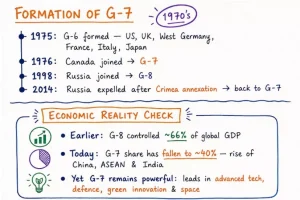
- Shifting economic weight: As the G-7’s share of global GDP declined to roughly 40% due to the rise of major emerging economies like India and China, the bloc increasingly relies on India as a stable democratic anchor and technology partner.
- Voice of the Global South: Under current leadership, India has established itself as the primary interlocutor for developing nations within plurilateral forums dominated by advanced Western powers.
UPSC Online Preparation
The Indo-Mediterranean Strategic Framework
- Geostrategic convergence: A defining feature of modern Indian foreign policy is the Indo-Mediterranean corridor, an emerging framework explicitly connecting the Indian Ocean to Europe through trade, technology, data, and energy pathways.
- The IMEC catalyst: Launched during India’s 2023 G-20 presidency, the India-Middle East-Europe Economic Corridor (IMEC) serves as the operational baseline for this 21st-century economic network.
- Joint diplomatic vision: In May 2026, Prime Minister Modi and Italian Prime Minister Giorgia Meloni co-authored a foundational op-ed reinforcing this link as an essential corridor for ideas, data, and green technology.
Domestic Imperatives and European Cooperation
- Economic goals: India relies heavily on European capital and technological collaboration to achieve Atmanirbharta (self-reliance) in deep-tech and to scale rapid industrialization for its youth.
- Trade milestones: Demonstrating this deep alignment, India concluded a landmark Free Trade Agreement (FTA) with the European Union earlier this year.
- Geopolitical balancing: Securing European backing is crucial for India to safeguard transit routes through the Middle East against emerging geopolitical shifts and regional axis rivalries.
A Counterweight in Global Strategic Space
- Inclusive model: Unlike single-state initiatives like China’s Belt and Road Initiative, the Indo-Mediterranean vision operates multilaterally, assigning a collaborative role to every participating nation.
- Emergence of the Indo-Atlantic: This framework could eventually formalize into an Indo-Atlantic strategic space, serving as a critical western counterpart to the established Indo-Pacific architecture.
Click to Explore UPSC Offline Coaching
Conclusion
India’s continuous engagement with the G-7 is no longer symbolic. It marks India’s evolution into a vital global power capable of reshaping continental trade routes, bridging the Global South with industrial nations, and balancing complex geopolitical dynamics across Europe and Asia.