Recently, the Supreme Court of India has directed a high-powered committee chaired by Justice S. Ravindra Bhat to prepare a comprehensive action plan for making prisons disabled-friendly.
UPSC Coaching Classes
Key Observations by the Supreme Court
- Fundamental Rights Endure in Custody: The Supreme Court of India reaffirmed that imprisonment restricts movement, not constitutional rights, prisoners continue as rights-bearing individuals.
- Substantive Equality under Article 14: True equality demands reasonable accommodation, ensuring disabled prisoners receive targeted support (ramps, accessible facilities, aids) to offset structural disadvantages.
- Dignity, Autonomy & Article 21: The right to life extends beyond survival to dignified and independent living, imposing a positive duty on the State to provide necessary assistive infrastructure and care.
- Constitutional Morality over Administrative Ease: The Court held that security concerns or administrative constraints cannot override basic rights, prioritising human dignity over procedural convenience.
Background of the Issue
- Medical and Accessibility Neglect: The case of G. N. Saibaba highlighted serious deficiencies in prison healthcare and accessibility infrastructure, where a severely disabled inmate experienced deterioration in health due to lack of adequate facilities and specialized care.
- Denial of Basic Assistive Support: The case of Stan Swamy exposed institutional insensitivity, where even a basic assistive device such as a sipper was denied to a prisoner suffering from Parkinson’s disease.
- This incident became a powerful example of how minor accommodations essential for dignity are often overlooked in custodial settings.
- Violation of Statutory Mandates: Such instances were found to be in violation of the Rights of Persons with Disabilities Act, 2016, which mandates non-discrimination, accessibility, and reasonable accommodation for persons with disabilities across all public institutions, including prisons.
Key Directives for Prison Reform
- Creation of an Assistive Ecosystem: The Court directed that prisons must provide a comprehensive range of assistive devices such as wheelchairs, hearing aids, and other support systems, tailored to the specific functional needs of each prisoner.
- This approach ensures that prisoners are not forced into dependence or indignity due to lack of basic support.
- Institutional Convergence for Effective Implementation: The inclusion of the Department of Empowerment of Persons with Disabilities and State Social Justice Departments aims to ensure that policy formulation and implementation are guided by expertise in disability rights and social welfare.
- Standardization of Accessibility Norms: The Court emphasized the need for uniform national standards for accessibility, procurement, and maintenance of assistive devices, so that prisoners across different states receive equitable treatment and facilities.
- Time-Bound Compliance Mechanism: A four-month deadline was prescribed for submission of the report, ensuring that the reform process is time-bound and outcome-oriented.
Status of Disabled-Friendly Prisons in India
- The Data Void- “Invisibility by Design”:
- The NCRB Gap: As of the Prison Statistics India (PSI) 2023 report (released in late 2025), the National Crime Records Bureau still does not centrally maintain specific data on the disability status of inmates.
- Marginalization Overlap: Research from the Vidhi Centre for Legal Policy (2026) indicates that while marginalized groups (Dalits, Adivasis, Muslims) are overrepresented in prisons, the lack of disability markers means their specific accessibility needs are statistically erased.
- Acquired Disability: A critical “hidden” fact is that many prisoners acquire disabilities while incarcerated due to poor healthcare, custodial violence, or aging without geriatric care.
- Infrastructure- The Barrier to Reform:
- Colonial Architecture: Over 70% of India’s central and district jails are housed in pre-independence buildings. These structures were built for containment, not inclusion, making “retrofitting” (adding ramps, tactile paths) structurally difficult.
- Sanitation Deficit: Independent audits show that even in modernized jails, less than 10% of toilets meet the universal accessibility standards required for wheelchair users.
- Assistive Device Denial: The high-profile Stan Swamy (Parkinson’s) and G.N. Saibaba cases serve as empirical evidence that the denial of basic aids (like sippers or wheelchairs) is a systemic issue rather than an isolated oversight.
- The “Double Punishment” Doctrine: In legal theory, this is often referred to as the “Doctrine of Unauthorized Hardship”:
- Primary Punishment: Loss of liberty (authorized by court).
- Secondary Punishment: Loss of dignity, health, and autonomy due to an inaccessible environment (unauthorized by law).
- Judicial Stand (2026): In April 2026, the Supreme Court directed a high-powered committee to create an “Assistive Ecosystem,” ruling that failure to provide mobility aids is a punishable offense under the Rights of Persons with Disabilities (RPwD) Act, 2016.
|
Best Online Coaching for UPSC
Why the Court’s Intervention Was Necessary
- The “Double Punishment” Problem: A disabled prisoner suffers twice—first through loss of liberty (legal punishment) and second through daily hardship due to inaccessible infrastructure, amounting to an additional, unjust burden.
- Loss of Independence & Dignity: Absence of assistive devices and accessible facilities forces dependence on others for basic tasks, leading to erosion of self-respect and adverse health outcomes.
Institutional and Legal Context of Prison Reform
- Federal Nature of Prison Administration: Under the Seventh Schedule of the Constitution, ‘prisons’ fall under the State List, leading to variation in infrastructure, funding, and reform initiatives across states.
- Colonial Legacy of Prison Laws: The continued reliance on the Prisons Act, 1894 reflects a control-oriented and punitive approach, which is not aligned with modern principles of rehabilitation and human rights.
- Reform-Oriented Guidelines: The Model Prison Manual 2016 introduced a progressive framework emphasizing rehabilitation, welfare, and human dignity, but its non-binding nature has resulted in uneven implementation.
|
- Ignoring Legal Mandates: Despite the Rights of Persons with Disabilities Act, 2016, prisons have largely remained non-compliant, reflecting systemic insensitivity and rights violations.
- Outdated & Non-Inclusive Infrastructure: Most prisons, built under a colonial, security-centric design, lack inclusivity, making conditions particularly harsh for persons with physical and mental disabilities.
Initiatives Related to Prison Reforms in India
- Legislative & Policy Modernization: India is moving from 19th-century colonial laws toward a 21st-century correctional system.
- Model Prisons and Correctional Services Act, 2023: A significant initiative to replace the archaic Prisons Act of 1894. It shifts the focus from “retribution” to “reformation and rehabilitation.”
- Model Prison Manual (2016): Provides states with a rights-based framework for prison diet, medical care, and legal aid.
- Disabled-Friendly Prison Initiative (2026): Ensures that the Rights of Persons with Disabilities (RPwD) Act, 2016 is enforced within jails to provide reasonable accommodation and barrier-free access for disabled inmates.
- Structural Reforms & Decarceration: These initiatives target the systemic crisis of overcrowding and the plight of undertrial prisoners.
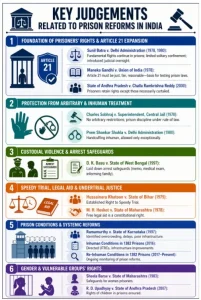
- Hussainara Khatoon v. State of Bihar (1979): Recognized the Right to a Speedy Trial as a Fundamental Right, leading to the release of thousands of undertrials.
- Undertrial Review Committees (UTRCs): Established in every district to quarterly review cases of prisoners eligible for bail or those who have served half their maximum sentence (Section 436A CrPC).
- NALSA Initiatives: The National Legal Services Authority provides free legal aid clinics inside prisons to ensure that poverty does not prevent access to justice.
- Rama Murthy v. State of Karnataka (1997): Identified 9 major systemic issues, including lack of medical care and poor infrastructure, urging a transition to a reformative system.
- Technology & Digital Infrastructure: Modernization through the National e-Governance Plan increases transparency and administrative efficiency.
- E-Prisons Project: A digital database under the Interoperable Criminal Justice System (ICJS) that tracks prisoner records, health history, and court dates.
- Video Conferencing (VC): Used for virtual court hearings and telemedicine, reducing the logistical burden and security risks of transporting inmates.
- National Prisoners Information Portal: Facilitates “E-mulaqat” (online visitation), allowing families to book virtual or physical meetings with inmates.
- Rehabilitation & Vocational Welfare: The ultimate goal of reform is to reduce recidivism by ensuring successful social reintegration.
- Open and Semi-Open Prisons: Successfully implemented in states like Rajasthan, allowing low-risk prisoners to live with families and work in the community to foster self-reliance.
- Skill Development: Partnerships with NIOS and IGNOU allow inmates to pursue education and vocational training (carpentry, digital literacy) to improve employability post-release.
- R.D. Upadhyay v. State of Andhra Pradesh (2007): Focused on the welfare of children living with incarcerated mothers, ensuring their right to food, healthcare, and education.
- Mental Health Programs: Increasing use of tele-psychiatry and wellness sessions like Vipassana to address the psychological toll of incarceration.
|
Click to Explore UPSC Offline Coaching
Global Initiatives & Best Practices
- United Nations Standard Minimum Rules (Nelson Mandela Rules): These rules lay down minimum standards for humane treatment of prisoners, including provisions for reasonable accommodation and accessibility for persons with disabilities.
- United Nations Convention on the Rights of Persons with Disabilities (UNCRPD): India, as a signatory, is obligated to ensure equal access to justice and public institutions, including prisons, by removing physical and institutional barriers.
- International Best Practice- Norway Model: Norway’s prison system emphasizes human dignity, accessibility, and rehabilitation, where infrastructure is barrier-free and living conditions are humane, based on the principle that loss of liberty is the only punishment imposed by the State.
Challenges in implementation
- Infrastructural Limitations: Many prisons are old and structurally unsuitable for accessibility modifications, making retrofitting both technically challenging and resource-intensive.
 Financial and Human Resource Constraints: There is a lack of adequate funding, assistive devices, and trained personnel, which limits effective implementation of reforms.
- Security Concerns and Administrative Resistance: Authorities often raise concerns about the potential misuse of assistive devices, leading to hesitation in adopting accessibility measures.
- Inter-State Disparities: Due to the federal structure, there is uneven adoption of reforms across states, resulting in variations in prison conditions.
Way Forward
- Institutionalizing Accessibility Audits: It is essential to establish regular and comprehensive accessibility audits across all prison facilities, covering infrastructure, administrative processes, and service delivery mechanisms.
- These audits should translate into time-bound action plans with dedicated financial support, ensuring that accessibility becomes an integral component of prison modernization.
- Transforming Institutional Mindset: Sustainable reform requires a shift in institutional attitudes from control-oriented functioning to empathy-driven administration.
- Regular training and sensitization programs should equip prison officials with knowledge of disability rights, legal obligations, and humane practices, thereby improving implementation outcomes.
- Leveraging Technology for Healthcare Access: The use of telemedicine and digital healthcare platforms can bridge the gap between custodial limitations and healthcare needs, particularly for prisoners with chronic illnesses or mobility impairments, ensuring continuous and specialized medical care.
- Strengthening Oversight and Accountability: Institutions such as the National Legal Services Authority should be empowered to conduct regular inspections, monitor compliance, and provide accessible grievance redressal mechanisms, ensuring that reforms are effectively implemented.
- Comprehensive Legislative Reform: India must move towards modern, rights-based prison legislation, replacing outdated colonial laws with a framework that incorporates accessibility standards, rehabilitation goals, and accountability mechanisms aligned with international human rights norms.
Click to Know UPSC Coaching Centres in India
Conclusion
The intervention by the Supreme Court of India marks a shift toward inclusive and humane prisons, affirming that Fundamental Rights persist in custody. It ensures state power is limited by human dignity, so loss of liberty does not mean loss of dignity.
 22 Apr 2026