Udaan, Prahaar, Q&A Bank etc.
CA Magazines & Editorials
 29 Apr 2026
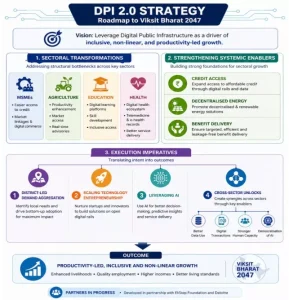
Recently, the NITI Aayog launched the DPI@2047 roadmap to guide India’s next phase of digital transformation.
Explore UPSC Foundation Courses

Explore UPSC Foundation Courses

Explore Prarambh Course

Explore Prarambh Course

| Aspect | DPI 1.0 | DPI 2.0 (2025–2035) | DPI 3.0 (2035–2047) |
| Core Focus | Digital inclusion | Productivity & livelihood-led growth | Broad-based prosperity & advanced economy |
| Objective | Ensure access to basic digital services | Enhance efficiency, incomes, and employment | Achieve high-income, innovation-driven economy |
| Key Approach | Build foundational digital rails | Expand DPI into economic sectors | Integrate advanced technologies at scale |
| Major Components | Identity, payments, basic data sharing | Sector-specific DPIs (agriculture, MSMEs, health, education) | Advanced digital ecosystems across all sectors |
| Key Platforms | Aadhaar, Unified Payments Interface | Sectoral platforms + AI-enabled systems | AI-driven, interoperable, intelligent systems |
| Role of Technology | Enable access and inclusion | Improve productivity using AI & data | Drive innovation, automation, and global leadership |
| Scale of Impact | Financial inclusion, DBT delivery | Livelihoods, MSME growth, service efficiency | Economy-wide transformation and prosperity |
| Governance Model | Centralised rollout | District-led, decentralised implementation | Highly adaptive, ecosystem-driven governance |
| Key Drivers | Identity + Payments + Connectivity | AI + Data + Entrepreneurship | Frontier tech (AI, Web3, advanced analytics) |
| Outcome | Inclusion (banking, welfare access) | Productivity, jobs, income growth | Viksit Bharat – high living standards and innovation economy |
Check Out UPSC CSE Books
Visit PW Store






Connect with our experts to get free counselling & start preparing
Join India’s trusted platform for expert guidance, quality content, proven success.
Learn anytime, anywhere.



India's leading UPSC coaching platform helping aspirants prepare for IAS, IPS, IFS and other Civil Services examinations with the best faculty and proven strategies.
<div class="new-fform">
</div>