Subject: GS 3: Environment
Context: The Government of India has unveiled a comprehensive roadmap for establishing Green Urea production in the country by creating a dedicated market for Green Ammonia under the National Green Hydrogen Mission (NGHM).
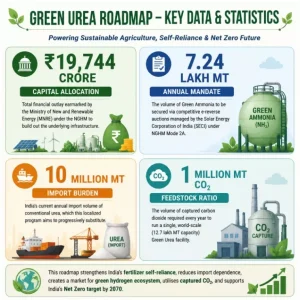
- The initiative aims to reduce the carbon footprint of fertilizer production, enhance fertilizer self-reliance, promote the Green Hydrogen ecosystem, and contribute towards India’s Net Zero emissions target by 2070.
Key Features of the Government Roadmap
- Creation of a Green Ammonia Market: The Government proposes to procure 7.24 lakh metric tonnes (MT) of Green Ammonia annually through e-reverse auctions conducted by the Solar Energy Corporation of India (SECI) under Mode 2A of the National Green Hydrogen Mission (NGHM).
- The assured procurement is expected to create stable market demand for Green Ammonia and encourage private investment in Green Hydrogen production.
- Establishment of Green Urea Manufacturing Plants: The Department of Fertilizers (DoF) has issued an Expression of Interest (EOI) inviting proposals for establishing Green Urea manufacturing facilities across the country.
- A high-level consultation involving NTPC, SECI, fertilizer manufacturers, Green Hydrogen developers, electrolyzer manufacturers, and technology providers was held to discuss implementation strategies.
- Differential Subsidy Mechanism: Since Green Ammonia is currently more expensive than conventionally produced Grey Ammonia, the Government has proposed an offtaker-side differential subsidy mechanism.
- Under this arrangement:
- SECI will procure Green Ammonia from producers.
- Fertilizer manufacturers will receive Green Ammonia at prevailing Grey Ammonia market prices.
- The Department of Fertilizers will reimburse the price difference to SECI, ensuring cost neutrality for fertilizer companies.
- Long-Term Investment Support: The Government proposes to provide producer-side financial support through long-term procurement agreements of up to 10 years, thereby reducing investment risks and encouraging commercial-scale Green Ammonia production.
- Integrated Multi-Ministerial Approach: The Ministry of New and Renewable Energy (MNRE) will support Green Hydrogen infrastructure under the National Green Hydrogen Mission.
- The Department of Fertilizers will develop the policy framework required for integrating Green Ammonia into India’s fertilizer production chain.
Best Online Coaching for UPSC
About Green Urea
- Green Urea is urea manufactured using Green Ammonia, which is produced from Green Hydrogen generated through renewable energy-powered water electrolysis, instead of conventionally produced Grey Ammonia derived from fossil fuels.
- Although carbon dioxide (CO₂) remains an essential raw material for urea synthesis, Green Urea production seeks to utilize captured industrial CO₂ through Carbon Capture, Utilisation and Storage (CCUS) technologies, thereby significantly lowering overall greenhouse gas emissions.
How is Green Urea Produced?
- Step 1: Production of Green Hydrogen- Water is split into hydrogen and oxygen through electrolysis, using electricity generated from renewable sources such as solar and wind energy.
- Step 2: Production of Green Ammonia- Green Hydrogen reacts with nitrogen extracted from atmospheric air through the Haber-Bosch process to produce Green Ammonia (NH₃).
- Step 3: Production of Green Urea- Green Ammonia reacts with captured carbon dioxide (CO₂) to produce Green Urea (CO(NH₂)₂), thereby converting industrial emissions into a productive input for fertilizer manufacturing.
Green Urea vs Grey Urea
| Parameter |
Grey Urea |
Green Urea |
| Hydrogen Source |
- Fossil fuels (Natural Gas/Naphtha)
|
- Renewable energy-powered electrolysis
|
| Feedstock |
|
|
| Carbon Emissions |
|
|
| Energy Source |
|
|
| Environmental Impact |
|
- Low-carbon and sustainable
|
Earlier India’s Initiatives
- National Green Hydrogen Mission (NGHM): Approved in January 2023 with a financial outlay of ₹19,744 crore.
- Aims to position India as a global hub for Green Hydrogen production, utilization, and exports.
- Green Ammonia Programme (Mode 2A): Introduced under NGHM to create assured demand for Green Ammonia through government-supported procurement.
- Pudimadaka Green Urea Pilot Plant: Developed by NETRA, the R&D arm of NTPC, at Pudimadaka, Andhra Pradesh.
- The 150 tonnes per day pilot plant integrates Green Hydrogen production with Carbon Capture, Utilisation and Storage (CCUS) and serves as a demonstration model for commercial Green Urea production.
- Promotion of Carbon Capture Technologies: The Government is encouraging the utilization of captured CO₂ from thermal power plants, steel plants, and cement industries for sustainable fertilizer manufacturing.
Click to Explore UPSC Offline Coaching
Significance of the Green Urea Roadmap
- Promotes Fertilizer Self-Reliance: The initiative aims to reduce India’s dependence on imported urea by expanding domestic production through sustainable manufacturing technologies.
- Supports India’s Net Zero Target: Replacing fossil fuel-based ammonia with Green Ammonia will substantially reduce greenhouse gas emissions from the fertilizer sector and contribute towards India’s Net Zero target by 2070.
- Strengthens the Green Hydrogen Ecosystem: Assured demand for Green Ammonia is expected to stimulate investments across the Green Hydrogen value chain, including renewable energy, electrolyzers, storage, and transportation infrastructure.
- Promotes Industrial Decarbonisation: The utilization of captured CO₂ from thermal power plants, cement factories, and steel industries supports industrial decarbonisation while promoting a circular carbon economy.
- Encourages Technological Self-Reliance: The roadmap will promote domestic manufacturing of electrolyzers, Green Hydrogen technologies, carbon capture systems, and advanced fertilizer production technologies under the broader objective of Aatmanirbhar Bharat.
- Supports Sustainable Agriculture: Green Urea enables environmentally sustainable fertilizer production while ensuring the long-term availability of a critical agricultural input, thereby strengthening India’s food and fertilizer security.
 29 Jun 2026