Subject: GS 3: Science & Technology
Context: Recent Addresses by Lok Sabha Speaker highlighting the transition of India’s intellectual capital underscore a vital theme: the organic bridge connecting ancient scientific inquiry with the modern network of Indian Institutes of Technology (IITs).
- This continuum underpins India’s modern journey from post-colonial recovery to global technological self-reliance (Atmanirbhar Bharat).
UPSC Online Preparation
The Modern Pillars- The IIT Ecosystem
The IITs represent the pinnacle of India’s post-independence technological education framework, shifting the nation from a consumer of global technology to a primary producer.
- Institutional Design: IITs are autonomous, elite public institutions specifically chartered to cultivate world-class technical personnel and engineering pioneers.
 Legislative Status: Formally designated as Institutes of National Importance by Acts of Parliament, giving them academic and administrative independence.
- Evolution: The ecosystem originated in 1951 at Kharagpur—repurposing the historic Hijli Detention Camp from a site of colonial subjugation into a center of intellectual creation. Today, this grid has grown to 23 distinct campuses worldwide.
Ancient Foundations- India’s Scientific Heritage
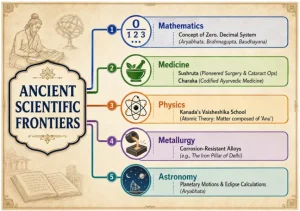
- Centuries before the formalization of modern laboratory science, the Indian subcontinent hosted highly sophisticated networks of empirical research, mathematical deduction, and institutionalized education.
- Major Knowledge Hubs of Antiquity:
-
- Takshashila (Taxila): Operating on a decentralized academic model without rigid central classrooms, it was a melting pot of statecraft and science.
- It shaped foundational thinkers like Panini (the grammarian who formalized Sanskrit linguistics) and Chanakya (Kautilya, the master strategist of the Arthashastra).
- Located in present-day Punjab province of Pakistan
- Nalanda: Recognized as the world’s premier residential international university.
- It maintained a massive library system and rigorous entrance standards, drawing global intellectuals including Chinese pilgrims Hiuen Tsang and I-Tsing, who meticulously recorded its scholarly traditions.
- Located in Present-Day Bihar
- Vikramshila: Established under Pala patronage, this was a highly structured, state-administered center specializing in advanced metaphysics, logic, and a systematic framework for teacher-training.
- Located in Present-Day Bihar
Institutional Policy- Reviving and Driving Innovation
To convert this historical heritage into modern economic value, the state has deployed several statutory, structural, and funding interventions.
- Structural Overhauls & Indigenous Roots:
- National Education Policy (NEP) 2020: Mandates a structural shift away from rote learning toward multidisciplinary education, cross-domain flexibility, and institutional R&D.
- Indian Knowledge Systems (IKS) Centers: Established natively within various IITs, these dedicated centers focus on interdisciplinary research to validate and integrate indigenous technologies (traditional water harvesting, historical metallurgical blends, mathematical algorithms) into modern engineering.
- Funding & Research Catalysts:
- Anusandhan National Research Foundation (ANRF): Actively links academia, private industries, and state agencies to streamline funding and eliminate bureaucratic bottlenecks in state research.
- Prime Minister’s Research Fellowship (PMRF): A targeted financial initiative explicitly designed to retain top-tier domestic talent within IITs and premier science clusters for advanced doctoral research.
- Frontiers of Deep-Tech & Entrepreneurship:
- Strategic Missions: Targeted state-backed programs like the National Quantum Mission (securing quantum cryptography and computing) and the IndiaAI Mission (building sovereign computing infrastructure).
- Incubation Frameworks: The Atal Innovation Mission (AIM) introduces grassroots tinkering spaces in schools, while Startup India provides the venture capital runway to commercialize technologies developed inside institutional laboratories.
Click to Explore UPSC Offline Coaching
 23 Jun 2026