Subject: GS 2: Polity & Governance
Context: The Ministry of Panchayati Raj released the ‘National Study Report on Low Participation in Gram Sabha Across States/UTs’ .
- The report is prepared by the National Institute of Rural Development and Panchayati Raj, to identify reasons for low citizen participation and recommend reforms for strengthening grassroots democracy.
- The assessment covered 26 States and Union Territories and approximately 400 Gram Panchayats, including 50 PESA Gram Panchayats and 130 Women-Friendly Gram Panchayats.
- The study demonstrates that low participation in Gram Sabha is multidimensional, influenced by socio-economic, institutional, governance and behavioural factors rather than a single underlying cause.

UPSC Course Fees Online
Timeline: Evolution of Panchayati Raj and Gram Sabha
| Period/Year |
Major Development |
| Pre-Independence Period |
Traditional village assemblies and community-based governance systems existed across several rural regions of India and functioned as local platforms for collective discussions and dispute resolution. |
| 1882 |
The Ripon Resolution emphasized the importance of local self-government and laid the foundation for strengthening local administrative institutions in British India. |
| 1957 |
Balwant Rai Mehta Committee recommended a three-tier Panchayati Raj structure and emphasized democratic decentralization and public participation in local governance. |
| 1959 |
The Panchayati Raj system was formally introduced in Rajasthan, marking the beginning of institutionalized decentralized rural governance in independent India. |
| 1978 |
The Ashok Mehta Committee highlighted the need for strengthening Panchayati Raj Institutions and improving participatory local governance mechanisms. |
| 1992–93 |
73rd Constitutional Amendment Act accorded constitutional status to Panchayati Raj Institutions and strengthened the framework of democratic decentralization. |
| Article 243A (Part IX) |
Gram Sabha was formally recognized as a constitutional body to facilitate direct citizen participation in local governance processes. |
| Present Context |
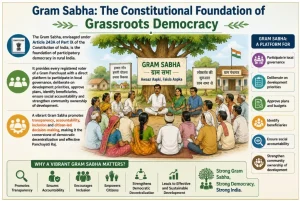
Gram Sabha functions as a key platform for participatory local governance, GPDP planning, community accountability, beneficiary identification, and village-level decision-making within the Panchayati Raj system. |
Gram Sabha and the Sustainable Development Goals (SDGs)
- SDG 1 (No Poverty): Identifies beneficiaries, approves the Gram Panchayat Development Plan (GPDP), and monitors implementation of poverty alleviation and livelihood schemes.
- SDG 5 (Gender Equality): Promotes women’s participation and leadership through Gram Sabhas and Mahila Sabhas, ensuring gender-inclusive decision-making.
- SDG 10 (Reduced Inequalities): Enhances participation of SCs, STs, women, youth, persons with disabilities and other vulnerable groups, fostering inclusive governance.
- SDG 11 (Sustainable Communities): Supports community-led planning for sustainable infrastructure, sanitation, natural resource management and disaster resilience.
- SDG 16 (Peace, Justice & Strong Institutions): Strengthens transparency, accountability, social audits, grievance redressal and participatory democracy at the grassroots
Key Findings of Report
- Livelihood Constraints: Livelihood and time-related constraints emerged as the single largest barrier to participation (55.5%), followed by awareness and communication issues (16.22%), highlighting the need for both livelihood-sensitive scheduling and stronger citizen outreach.
- Occupational Commitments Limit Attendance: Busy work schedules (41.74%) and agricultural activities (30.26%) emerged as the most significant occupational constraints affecting participation in Gram Sabha meetings.
- Underrepresentation of Vulnerable Groups: Migrant households (17.61%), youth (16.73%), elderly citizens (15.80%) and women (13.40%) were identified among the least represented groups in Gram Sabha processes.
- Awareness–Knowledge Gap in Gram Sabha Functioning: The study revealed an important distinction between awareness of Gram Sabha meetings and understanding of Gram Sabha processes.
- While awareness regarding the conduct of Gram Sabha meetings was generally high, knowledge relating to citizen rights, quorum requirements, decision-making processes and the institutional role of Gram Sabha was comparatively lower in several areas
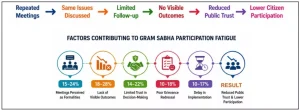
- Emergence of ‘Gram Sabha Participation Fatigue’: Beyond these barriers, the study identified an emerging phenomenon termed ‘Gram Sabha Participation Fatigue’, wherein repeated meetings without visible outcomes, unresolved grievances, repetitive discussions and limited follow-up on decisions gradually reduce public enthusiasm for participation.

- Drivers of Participation Fatigue: The findings indicate that participation fatigue is primarily driven by transparency concerns (45.46%), lack of relevance of discussions (42.0%), repetitive discussions (33.4%), trust deficit (32.7%), political interference (27.9%) and weak grievance resolution (16.2%).
- Together, these factors gradually reduce public confidence and willingness to participate in Gram Sabha.
- Awareness and Community Mobilisation as Key Solutions: Respondents identified awareness and community mobilisation as the most effective measures for improving participation. Awareness and publicity (48.2%) emerged as the highest priority, followed by door-to-door mobilisation (22.2%), convenient meeting timings (10.6%) and more interactive Gram Sabha meetings (7.0%).
- Transparency and Accountability for Sustained Public Trust: Respondents also emphasized greater transparency, visible implementation of decisions, effective grievance redressal, women’s participation, improved accessibility and regular participation of officials as essential measures for sustaining public confidence in Gram Sabha.
- Innovative Best Practices for Participatory Governance: The study further documented several innovative practices across States and Union Territories—including SHG-led mobilisation, thematic Gram Sabhas, Bal Sabhas, women-centric initiatives and technology-enabled communication systems—which provide practical models for strengthening participatory local governance.
Way Forward
- National Awareness and Procedural Literacy Mission: Launch a National Gram Sabha Awareness, Procedural Literacy and Mobilisation Mission to strengthen citizen awareness, procedural understanding and democratic participation.
- Institutionalised Community Mobilisation: Institutionalize structured pre-Gram Sabha mobilisation through Ward Members, Self-Help Groups, frontline workers, youth groups and community institutions to ensure wider citizen outreach.
- Livelihood-Sensitive Meeting Scheduling: Promote livelihood-sensitive scheduling of Gram Sabha meetings by considering agricultural cycles, local work patterns, migration realities and community preferences.
- Strengthening Inclusive Participation Platforms: Strengthen Mahila Sabhas, Ward Sabhas, Youth Sabhas and other inclusive participation platforms to improve representation of women, SCs, STs, youth and other vulnerable groups.
- Institutionalising Transparency and Accountability: Institutionalize Action Taken Reports (ATRs), grievance tracking systems, public review mechanisms and follow-up processes to improve transparency, accountability and public trust.
- Advance Disclosure of Public Information: Ensure advance public disclosure of Gram Sabha agendas, beneficiary lists, budgets, development priorities and implementation status through both physical and digital platforms.
- Strengthening Institutional Convergence: Strengthen convergence between Panchayati Raj Institutions and line departments to improve service delivery, grievance redressal and responsiveness to community concerns.
- Leveraging Digital Technologies for Citizen Engagement: Leverage digital technologies including SMS alerts, WhatsApp groups, IVRS systems, Panchayat digital notice boards and eGramSwaraj-linked communication systems to enhance citizen engagement and participation.
- Promoting Citizen-Centric and Outcome-Oriented Governance: Promote citizen-centric and outcome-oriented Gram Sabha processes by encouraging meaningful discussions, local problem-solving, visible follow-up actions and community-led decision-making.
Click to Explore UPSC Offline Coaching
Major Government Initiatives Related to Panchayati Raj Institutions (PRIs)
- Gram Panchayat Development Plan (GPDP): Enables Gram Panchayats to prepare participatory, need-based and convergent local development plans through Gram Sabha consultations.
- eGramSwaraj Portal: A digital governance platform for planning, budgeting, accounting, monitoring and reporting Panchayat activities, promoting transparency and efficiency.
- AuditOnline: Facilitates online auditing of Panchayat accounts, strengthening financial accountability and transparency.
- Rashtriya Gram Swaraj Abhiyan (RGSA): A centrally sponsored scheme aimed at capacity building, training and institutional strengthening of Panchayati Raj Institutions and elected representatives.
- SVAMITVA Scheme: Provides property cards using drone-based mapping, enabling clear land ownership, reducing disputes and improving Panchayat-level planning and revenue generation.
- Panchayat Advancement Index (PAI): A performance assessment framework that evaluates Panchayats across nine Localized Sustainable Development Goals (LSDGs) to promote evidence-based planning and good governance.
- Mission Antyodaya: Assesses village-level infrastructure, public services and socio-economic indicators to support integrated rural development planning.
- Localisation of Sustainable Development Goals (LSDGs): Encourages Panchayats to integrate the SDGs into Gram Panchayat Development Plans (GPDPs) for inclusive and sustainable local development.
- Meri Panchayat Mobile App: Enables citizens and Panchayat representatives to access Panchayat information, monitor development works and promote citizen engagement.
- National Gram Swaraj Campaign: Promotes good governance, participatory democracy and awareness among Panchayat representatives through training, workshops and outreach programmes.
|
Conclusion
The National Study on Low Participation in Gram Sabha demonstrates that strengthening participation requires moving beyond attendance-focused approaches towards improving awareness, procedural literacy, inclusion, transparency, responsiveness and visible governance outcomes. The study provides an evidence-based roadmap for strengthening Gram Sabha as a vibrant institution of participatory democracy, local accountability and community-led development across rural India.