UPSC PYQs

Prelims, Mains & Optional PYQs

UPSC Notes

Comprehensive & Short Notes

VB-GRAM G Act 2025: ₹300 Daily Wage Floor, Features & Implications

2 Jul 2026

VB-GRAM G Act 2025: ₹300 Daily Wage Floor, Features & Implications

Subject: GS 2: Polity & Governance

Context: The Union Government has notified a minimum daily wage of ₹300 under the Viksit Bharat–Guarantee for Rozgar and Ajeevika Mission (Gramin) [VB-GRAM G] Act, 2025, which came into force on 1 July 2026, replacing the Mahatma Gandhi National Rural Employment Guarantee Act (MGNREGA), 2005.
IAS coaching

Viksit Bharat GRAMG

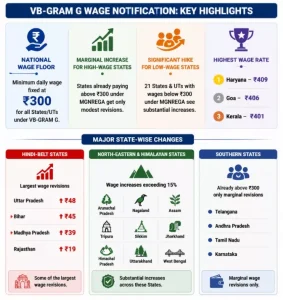
Key Highlights of the Wage Notification

  • National Wage Floor: The Centre has fixed a minimum daily wage of ₹300, ensuring that no State or Union Territory pays less than this amount under VB-GRAM G.
  • Significant Hike for Low-Wage States: Twenty-one States and Union Territories with wages below ₹300 under MGNREGA have witnessed substantial wage increases to meet the new national floor.
  • Highest Wage Rate: Haryana continues to have the highest notified wage at ₹409 per day, followed by Goa (₹406) and Kerala (₹401).

Major State-wise Changes

  • Hindi-Belt States: Uttar Pradesh (+₹48), Bihar (+₹45), Madhya Pradesh (+₹39) and Rajasthan (+₹19) have witnessed some of the largest wage revisions.
  • North-Eastern and Himalayan States: Arunachal Pradesh, Nagaland, Assam, Tripura, Sikkim, Jharkhand, Himachal Pradesh, Uttarakhand and West Bengal have also received wage increases exceeding 15%.
  • VB-GRAM GSouthern States: Telangana, Andhra Pradesh, Tamil Nadu and Karnataka, where wages were already above ₹300, have seen only marginal revisions.

Objectives of the New Wage Floor

  • Improving Rural Livelihoods: A higher minimum wage seeks to enhance income security and strengthen the purchasing power of rural households.
  • Reducing Regional Disparities: Establishing a common wage floor narrows interstate disparities in rural employment wages.
  • Strengthening Rural Demand: Higher wages are expected to stimulate rural consumption, support local markets and contribute to inclusive economic growth.
  • Ensuring Uniform Social Protection: A national wage floor provides a minimum level of wage protection irrespective of the State of employment.

Constitutional Perspective:

  • Article 41 (Directive Principles of State Policy): Directs the State to make effective provisions for securing the Right to Work, public assistance and livelihood opportunities within its economic capacity, providing the constitutional foundation for rural employment programmes.
  • Article 38: Mandates the State to promote social, economic and political justice while reducing inequalities in income, status and opportunities through inclusive development.
  • Article 39(a): Directs the State to ensure that citizens have adequate means of livelihood, reinforcing the objective of employment guarantee programmes.

Concerns Raised over VB-GRAM G

  • Shift from Rights-Based to Government-Driven Framework: Critics argue that VB-GRAM G moves away from the rights-based, demand-driven approach of MGNREGA towards a more government-controlled employment framework.
  • Burden on States: Under the new funding mechanism, the combined expenditure on labour and material is subject to the 60:40 ratio, potentially increasing the financial burden on State Governments.
  • Wages Still Considered Inadequate: Several stakeholders argue that the notified ₹300 daily wage remains below the level required to ensure a living wage, particularly amid rising inflation.
  • Implementation Challenges: Since rural employment is implemented primarily through State Governments and Panchayati Raj Institutions, effective implementation will require greater Centre-State coordination, timely fund releases and collaborative decision-making.

Recommendations for Higher Wages

  • Anoop Satpathy Committee (2019): The Expert Committee recommended a national minimum wage floor of ₹375 per day, based on scientific estimates of household consumption and living costs.
  • Parliamentary Standing Committee: The Parliamentary Standing Committee on Rural Development has repeatedly recommended periodic enhancement of rural employment wages.

Its Potential Implications

  • Positive Impact on Rural Economy: Higher wages can strengthen rural purchasing power, reduce distress migration and support local economic activity.
  • Fiscal Implications: Increased wage expenditure may raise the overall fiscal commitment of both the Union and State Governments.
  • Federal Concerns: Changes in the cost-sharing mechanism may generate fiscal stress for States with high demand for rural employment.
  • Convergence with Rural Development Schemes: The Mission-based framework provides opportunities to integrate rural employment with schemes such as Pradhan Mantri Awaas Yojana-Gramin (PMAY-G), Deen Dayal Upadhyaya Grameen Kaushalya Yojana (DDU-GKY), Pradhan Mantri Gram Sadak Yojana (PMGSY), Jal Jeevan Mission (JJM) and National Rural Livelihoods Mission (NRLM) to create durable assets, improve skills and enhance sustainable livelihoods.
  • Livelihood Diversification: Linking wage employment with skill development, asset creation and self-employment opportunities can facilitate the transition from short-term wage support to long-term rural economic resilience.

Click to Know UPSC OnlyIAS Coaching Centres

Way Forward

  • Ensure Timely Wage Revision: Periodically revise wage rates by linking them to inflation, Consumer Price Index-Rural (CPI-R) and changes in the cost of living.
  • Strengthen Fiscal Support: Provide adequate financial assistance to States to ensure uninterrupted implementation without compromising employment generation.
  • Protect the Rights-Based Nature of Rural Employment: Ensure that employment guarantees remain demand-driven, transparent and accessible to all eligible rural households.
  • Improve Wage Payments: Strengthen digital payment systems to ensure timely, direct and transparent wage disbursal.
  • Enhance Social Security: Integrate rural employment programmes with skill development, livelihood diversification and social protection schemes for sustainable rural development.

Conclusion

The notification of a ₹300 daily wage floor under VB-GRAM G represents an important step towards improving rural wages. However, its long-term success will depend on adequate funding, timely implementation, cooperative federalism and preserving the objective of providing livelihood security to rural households.

Check Out UPSC CSE Books

Visit PW Store

online store 1

VB-GRAM G Act 2025: ₹300 Daily Wage Floor, Features & Implications

Need help preparing for UPSC or State PSCs?

Connect with our experts to get free counselling & start preparing

Free Counselling for UPSC Aspirants

Connect with our experts and take the right next step.

Expert Guidance
Personalized Strategy
100% Free

Book Your Free Session

NEED ASSISTANCE?

Request a Callback

Our counsellor will connect with you and help you choose the right course and centre.

  • Expert Guidance
  • Course & Fee Information
  • Quick Callback Support

Request a Callback

Books
UPSC PYQs
UPSC Notes
Current Affairs
Quick Revise Now !
AVAILABLE FOR DOWNLOAD SOON
UDAAN PRELIMS WALLAH
Comprehensive coverage with a concise format
Integration of PYQ within the booklet
Designed as per recent trends of Prelims questions
हिंदी में भी उपलब्ध
Quick Revise Now !
UDAAN PRELIMS WALLAH
Comprehensive coverage with a concise format
Integration of PYQ within the booklet
Designed as per recent trends of Prelims questions
हिंदी में भी उपलब्ध

<div class="new-fform">


    </div>

    Subscribe our Newsletter
    Sign up now for our exclusive newsletter and be the first to know about our latest Initiatives, Quality Content, and much more.
    *Promise! We won't spam you.
    Yes! I want to Subscribe.