Subject: GS 2: Polity & Governance
Context: The High-Level Committee on Demographic Changes (HLCDC) has launched a nationwide assessment of demographic changes since the 2011 Census, focusing on population shifts, settlement patterns, electoral roll revisions, and the impact of illegal immigration.
Best Online Coaching for UPSC
About the High-Level Committee on Demographic Changes (HLCDC)

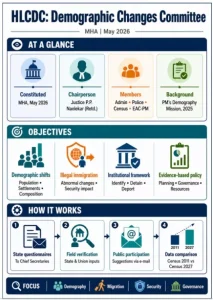
- Constitution: The Ministry of Home Affairs (MHA) constituted the HLCDC in May 2026 to study demographic changes arising from illegal immigration and other abnormal reasons and recommend appropriate policy measures.
- Chairperson: The Committee is headed by Justice Prakash Prabhakar Naolekar (Retd.), former Judge of the Supreme Court.
- Composition: The Committee comprises experts from administration, policing, population studies and governance, including the Census Commissioner, senior retired civil servants and members of the Prime Minister’s Economic Advisory Council (EAC-PM).
- Background: The Committee follows the announcement of a High-Powered Demography Mission by the Prime Minister during the 2025 Independence Day Address.
Objectives of the Committee
- Assess Demographic Changes: Examine changes in population distribution, settlement patterns and demographic composition since the 2011 Census.
- Study Illegal Immigration: Evaluate demographic changes arising from illegal immigration and other abnormal demographic factors affecting national security and governance.
- Recommend Institutional Framework: Suggest a permanent, evidence-based and time-bound mechanism for identifying, detaining and deporting illegal immigrants in accordance with law.
- Support Evidence-Based Policymaking: Generate reliable demographic inputs for planning, governance, security and resource allocation.
Key Features of the Exercise
- State-Level Questionnaires: Detailed questionnaires will be sent to Chief Secretaries seeking information on changes in population, settlements and migration patterns since the 2011 Census.
- Field Verification: The Committee will undertake field visits to validate demographic changes and obtain first-hand information from States and Union Ministries.
- Public Participation: A dedicated e-mail platform will enable citizens to submit suggestions, feedback and relevant information regarding demographic changes.
- Comparison with Census Data: The exercise will compare the 2011 Census with the ongoing Population Census 2027 to understand long-term demographic trends.
| PWOnlyIAS Extra Edge:
Linkage with Census 2027:
- House Listing and Housing Operations (HLO): The first phase of Census 2027 provides updated information on households, settlements and enumeration blocks, offering an important baseline for demographic assessment.
- Updated Population Profile: The final Population Enumeration will provide comprehensive demographic data after a gap of 16 years, enabling more accurate policy planning.
- Improving Development Planning: Updated demographic information supports evidence-based allocation of financial resources, public infrastructure, healthcare, education and social welfare programmes.
Linkage with Electoral Roll Revision:
- Special Intensive Revision (SIR): The Committee will seek data from the Election Commission of India (ECI) regarding names deleted during the Special Intensive Revision (SIR) of electoral rolls.
- Verification of Exclusions: Details regarding deletions and reasons for exclusion will assist in assessing demographic changes and identifying cases requiring further verification.
- Electoral Integrity: Accurate electoral rolls strengthen free and fair elections while ensuring that only eligible citizens participate in the democratic process.
Constitutional and Governance Perspective:
- Article 355: Casts a duty upon the Union to protect every State against external aggression and internal disturbance, providing a constitutional basis for addressing challenges arising from illegal immigration where applicable.
- Article 326: Guarantees universal adult suffrage, making accurate electoral rolls essential for preserving democratic legitimacy.
- Article 21: Any identification, detention or deportation process must adhere to the principles of due process, fairness and protection of life and personal liberty.
- Cooperative Federalism: Since population management, law and order, border security, electoral administration and welfare delivery involve multiple levels of government, successful implementation requires close coordination between the Union, States, the Registrar General of India, the Election Commission of India and local authorities.
|
Significance of the Initiative
- Evidence-Based Governance: Updated demographic information enables informed policymaking on urbanisation, migration, infrastructure, employment and public service delivery.
- National Security: Better understanding of demographic changes can strengthen border management and improve responses to illegal immigration while safeguarding national security.
- Balanced Regional Development: Reliable demographic data supports equitable distribution of financial resources through institutions such as the Finance Commission and improves regional planning.
- Improved Disaster Management: Updated settlement data assists in disaster preparedness, evacuation planning and delivery of emergency relief.
- Strengthening Welfare Delivery: Accurate population estimates improve targeting of beneficiaries under welfare programmes and reduce exclusion and duplication.
Click to Explore UPSC Offline Coaching
Conclusion
India’s demographic profile has undergone significant transformation since 2011. A scientific, transparent and constitutionally compliant assessment of these changes can strengthen development planning, electoral integrity, national security and public service delivery, while ensuring that governance remains evidence-based and inclusive.