Recently, a Privilege Notice was moved by the Opposition against the Prime Minister, alleging that his recent address undermined the dignity of Parliament and the independence of its members.
- The notice pertains to the Prime Minister’s remarks criticising the defeat of the Constitution (131st Amendment) Bill, 2026, which failed to secure the required special majority. The Opposition has argued that such remarks:
- Impute motives to MPs’ voting behaviour, which violates parliamentary conventions.
- Undermine legislative autonomy and dignity of the House.
Best Online Coaching for UPSC
About Privilege Motion
- Definition: A Privilege Motion is a formal notice moved by an MP (or MLA) alleging a breach of privilege or contempt of the House.
- Who Can Move: Any member of the House.
- Procedure: Must relate to a recent incident.
- Notice submitted before 10:00 AM to the Speaker/Chairperson.
- Requires consent of the Presiding Officer.
- Role of Presiding Officer: The Speaker/Chairperson performs initial scrutiny of the motion.
- May decide the matter directly or
- Refer it to the Privileges Committee for detailed examination.
- If admitted (under Rule 222), the member is allowed to present the case before the House.
- Rule 222 of the Rules of Procedure and Conduct of Business in Lok Sabha governs the procedure for raising a question of privilege in the House.
About Parliamentary Privileges
- Definition: Parliamentary privileges are special rights, immunities, and exemptions enjoyed by the two Houses of Parliament, their committees, and their members.
- Scope: The Constitution extends parliamentary privileges to those persons who are entitled to speak and take part in the proceedings of a House of Parliament or any of its committees.
- These include the Attorney General of India and Union Ministers.
- Exclusion: The parliamentary privileges do not extend to the President, who is also an integral part of Parliament.
- Article 361 of the Constitution provides separate privileges and immunities for the President.
- Constitutional Basis: Article 105 of the Constitution expressly mentions two privileges:
- Freedom of Speech in Parliament: It ensures that members can speak without fear of legal consequences, subject to House rules.
- Right of Publication of Proceedings: It allows Parliament to control and regulate publication of its debates and proceedings.
- Statutory Provision: The Code of Civil Procedure, 1908 provides for:
- Freedom from Arrest in Civil Cases
- Freedom from arrest and detention under civil process during:
- The continuance of the meeting of the House or committee
- Forty days before its commencement
- Forty days after its conclusion
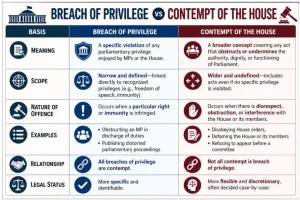 Nature: The Parliament has not enacted any special law to exhaustively codify all parliamentary privileges.
-
- Therefore, privileges remain partly codified and largely based on conventions and precedents.
About Privileges Committee- Investigative Mechanism
- Composition:
- Lok Sabha: 15 members (nominated by Speaker)
- Rajya Sabha: 10 members (headed by Deputy Chairperson)
- Functions:
- Investigates alleged breach, examines evidence, and hears concerned parties.
- Submits a recommendatory report to the House.
- Powers & Outcome:
- Breach of privilege is a punishable offence.
- The final decision rests with the House, which may impose penalties such as reprimand or suspension.
Click to Explore UPSC Offline Coaching
Conclusion
The episode underlines the continuing relevance of parliamentary privileges in preserving institutional dignity and legislative independence. At the same time, it raises important questions about the scope of privilege in a politically charged environment and the need to balance accountability with democratic debate.
 22 Apr 2026