Subject: GS 3: Environment
Context: The Union Government is attempting to finalize the Ecologically Sensitive Area (ESA) notification for the Western Ghats, based largely on recommendations of the K Kasturirangan Committee (2013).
IAS coaching
About the Western Ghats (UPSC Prelims 2005)
- Western Ghats is a 1,500 km-long mountain chain running parallel to India’s western coast.
- Western Ghats are relatively lower in the northern region .
- The elevation of the Western Ghats increases from north to south.
- In the northern regions (Maharashtra and Gujarat), the average height is around 900–1,200 meters. Moving southward, peaks become higher, with elevations exceeding 2,000 meters in Kerala with the highest peak at Anamudi (2,695 m).
- Extends across:
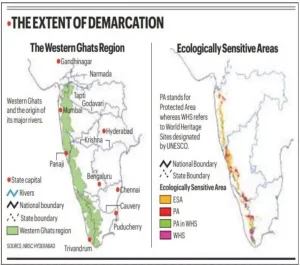 Gujarat
- Maharashtra
- Goa
- Karnataka
- Kerala
- Tamil Nadu
- Recognized as a:
- UNESCO World Heritage Site.
- One of the world’s 8 hottest biodiversity hotspots.
- Agasthyamala Biosphere Reserve is located in the southern Western Ghats.
- Major Rivers Originating in Western Ghats
- Godavari River
- Krishna River
- Cauvery River
- Periyar River
What is an Ecologically Sensitive Area (ESA)?
- An ESA is an area notified under the Environment (Protection) Act, 1986, where certain developmental activities are regulated or prohibited to protect fragile ecosystems.
- Objectives
- Conservation of biodiversity.
- Prevention of environmental degradation.
- Promotion of sustainable development.
- Regulation of polluting activities.
Recommendations of Various Committees on Western Ghats Conservation
- Madhav Gadgil Committee (Western Ghats Ecology Expert Panel, 2011)
- Entire Western Ghats as ESA: The committee recommended declaring the entire Western Ghats region (about 1,29,037 sq km) as an Ecologically Sensitive Area (ESA).
- Three-Tier Ecological Zoning: It proposed categorizing the region into ESZ-I, ESZ-II and ESZ-III based on ecological sensitivity, with ESZ-I receiving the highest level of protection.
- Strict Restrictions on Development: The committee recommended banning mining, quarrying, thermal power plants and large dams in ecologically sensitive zones to ensure ecosystem conservation.
- K. Kasturirangan Committee (High-Level Working Group, 2013)
- Landscape-Based Approach: The committee classified the Western Ghats into 60% Cultural Landscape (human-dominated areas) and 40% Natural Landscape (ecologically sensitive areas).
- Reduced ESA Coverage: It recommended notifying only about 60,000 sq km of the Natural Landscape as ESA instead of the entire Western Ghats region.
- Balanced Conservation Framework: The committee proposed prohibiting mining, quarrying, thermal power plants, red-category industries and large construction projects while allowing sustainable development in inhabited areas.
- MoEFCC Draft ESA Notification (2014)
- Refined ESA Boundary: Based on satellite mapping and ground-truthing, the Ministry proposed 56,825.7 sq km across six states as the Ecologically Sensitive Area.
- Regulation of High-Impact Activities: The draft prohibited new mining, quarrying, thermal power plants and highly polluting industries within the notified ESA.
- Sanjay Kumar Committee (2022–2026)
- Resolution of Mapping Disputes: The committee was constituted to address discrepancies in village-level maps and examine objections raised by state governments.
- Phased State-Wise Implementation: It recommended a flexible approach allowing ESA notification on a state-wise basis rather than waiting for consensus among all six Western Ghats states.
Why Do the Western Ghats Need Protection?
- Biodiversity Hotspot: The Western Ghats are one of the world’s eight hottest biodiversity hotspots, hosting thousands of plant species and numerous endemic flora and fauna such as the Lion-tailed Macaque, Nilgiri Tahr, Purple Frog, and Malabar Giant Squirrel.
- Water Security: The Ghats act as a major watershed by intercepting monsoon winds, recharging groundwater, and giving rise to major rivers like the Godavari, Krishna, Cauvery, and Periyar, supporting over 245 million people.
- Climate Regulation: Dense forests in the Western Ghats help sequester carbon, regulate temperatures, and influence rainfall patterns, contributing significantly to climate stability.
- Disaster Risk Reduction: Healthy ecosystems reduce the risk of landslides, soil erosion, floods, and flash floods, while deforestation and quarrying increase vulnerability to such disasters.
- Ecosystem Services and Livelihoods: The region provides essential ecosystem services such as water supply, pollination, soil conservation, carbon storage, and livelihood support for millions of people.
UPSC Online Preparation
Major Concerns of States Regarding Western Ghats ESA
- Impact on Farmers and Plantation Owners: States fear ESA restrictions may adversely affect agriculture, plantations, and livelihoods dependent on land-use activities.
- Constraints on Infrastructure Development: Restrictions on roads, housing, power projects, and other infrastructure are seen as obstacles to regional development.
- Reduction in Industrial Growth: States argue that limitations on industries could discourage investment and economic expansion.
- Restrictions on Mining and Quarrying: Mining-dependent regions fear loss of employment, revenue, and economic opportunities due to proposed bans.
- Fear of Displacement and Livelihood Loss: Local communities worry that stricter environmental regulations may affect their traditional occupations and settlements.
- Demand for Exclusion of Settlements: States seek removal of villages, plantation areas, and agricultural lands from ESA boundaries.
- Administrative and Boundary Disputes: Disagreements persist over village-level mapping, land records, and the accuracy of satellite-based ESA demarcation.
- Federalism and State Autonomy Concerns: States contend that conservation measures should better reflect local realities and involve greater state participation in decision-making.
Why Does Consensus on Western Ghats ESA Remain Difficult?
- Conservation vs Development Dilemma: The Western Ghats are both an ecological treasure and an important economic region.
- While conservationists advocate strict environmental protection to preserve biodiversity and ecosystem services, states fear that restrictions on mining, industries, infrastructure, and construction activities could hamper economic growth and development.
- Centre–State Differences: The Central Government seeks to implement ESA notifications based on expert committee recommendations, whereas states often demand modifications reflecting local realities.
- Differences over the extent of ESA coverage and permissible activities have led to prolonged disagreements.
- Livelihood Concerns: Millions of people in the Western Ghats depend on agriculture, plantations, forestry, and related activities. Farmers, plantation owners, and local communities fear that ESA regulations may limit economic opportunities, affect land use, and create uncertainty about future livelihoods.
- Ambiguity in ESA Boundaries: Differences between satellite-based mapping and ground realities have generated disputes regarding village boundaries, land records, and settlement areas.
- States have repeatedly sought revisions and exclusions, delaying the finalization of ESA boundaries.
- Inadequate Compensation and Incentives: Conservation imposes opportunity costs on states by restricting certain developmental activities.
- States argue that since the ecological benefits of the Western Ghats extend to the entire country, there should be adequate financial support, grants, and compensation mechanisms to offset conservation-related losses and encourage environmental stewardship.
Way Forward
- Scientific and Transparent ESA Demarcation: A credible ESA framework requires accurate identification of ecologically sensitive areas through a combination of satellite imagery, ground-truthing exercises, biodiversity assessments, and updated land records.
- Transparency in mapping and public disclosure of criteria can reduce disputes and build trust among stakeholders.
- Community-Centric Conservation: Conservation efforts are more effective when local communities are treated as partners rather than obstacles.
- Farmers, tribal communities, plantation workers, and village institutions should be involved in planning and monitoring. Participatory governance can ensure that ecological objectives are achieved without undermining local livelihoods.
- Payment for Ecosystem Services (PES): The Western Ghats provide critical ecosystem services such as water security, carbon sequestration, and climate regulation that benefit regions far beyond the Ghats.
- States and communities that bear the cost of conservation should receive financial incentives, grants, or compensation from the Centre and beneficiaries of these services, encouraging long-term ecological stewardship.
- Promotion of Sustainable Livelihoods: Conservation should be linked with economic opportunities. Sustainable agriculture, organic farming, agroforestry, eco-tourism, and value-added forest products can generate income while reducing ecological pressure.
- Such alternatives can help balance environmental protection with developmental aspirations.
- Strong Monitoring of Mining and Quarrying: Unregulated mining and quarrying are major causes of habitat destruction, landslides, and water pollution in the Western Ghats.
- Strengthening environmental impact assessments, periodic audits, use of technology-based monitoring, and strict enforcement of environmental laws are essential to prevent ecological degradation.
- Cooperative Federalism and Consensus Building: Given that the Western Ghats span six states, conservation cannot succeed without cooperation between the Centre and state governments.
- Regular consultations, dispute-resolution mechanisms, flexibility in implementation, and shared responsibility for conservation can help reconcile ecological priorities with regional development needs.
- Integrated Landscape-Based Planning: Rather than treating conservation and development as separate objectives, policies should adopt a landscape approach that integrates forests, agriculture, settlements, and water resources.
- This can promote sustainable land-use planning while maintaining ecological connectivity.
- Climate-Resilient Development Strategy: With increasing incidents of floods, landslides, and extreme rainfall, development projects in the Western Ghats should incorporate climate resilience measures.
- Environmentally sensitive infrastructure, watershed management, and disaster-risk assessments must become integral to regional planning.
Click to Know UPSC Coaching Centres in India
Conclusion
Protecting the Western Ghats is not merely an environmental imperative but a prerequisite for India’s long-term water, climate, and livelihood security.
 25 Jun 2026