Subject: GS 2: Polity & Governance
Context: Artificial intelligence (AI) is growing very fast. It is changing our daily routines and big industries.
- Because of this fast growth, world leaders need to create a shared set of global rules so that this technology helps everyone fairly and safely.
UPSC Course Fees Online
About Artificial Intelligence (AI)
- Refers: Artificial Intelligence is a branch of Computer Science that aims to create systems capable of Reasoning (using rules to reach conclusions), Learning (acquiring information and rules for using it), and Self-Correction.
- Objective: To drive economic growth, productivity enhancement, and national security, reflecting the view that AI leadership is a determinant of geopolitical power, economic competitiveness, and strategic autonomy.
- Technology Focus: AI technology focuses on building systems that can exhibit various intelligent behaviors, including:
- Machine Learning (ML): A subset of AI, ML enables systems to learn from data and improve over time without being explicitly programmed.
- Natural Language Processing (NLP): Aims to enable machines to understand, interpret, and respond to human language.
- Computer Vision: The ability of machines to interpret and make decisions based on visual inputs, such as images or video.
- Robotics: Combines AI with sensors and actuators to enable machines to interact with and perform tasks in the physical world.
- Deep Learning: A specialized area of ML that uses neural networks with many layers to process large amounts of data, often leading to breakthroughs in areas like speech and image recognition.
Classification of Artificial Intelligence
- Narrow AI (Weak AI): Task-specific systems designed to perform well-defined functions such as facial recognition, speech processing, recommendation engines, or language translation (e.g., Bhashini).
- Represents the current and dominant form of AI in real-world use.
- General AI (Strong AI): A theoretical form of AI capable of understanding, learning, and applying intelligence across any domain, comparable to human cognitive abilities such as reasoning, abstraction, and common sense.
- Does not yet exist; raises profound ethical and governance questions.
- Generative AI: A specialised subset of AI (largely within Narrow AI) that can generate new content—including text, images, audio, video, and code—by learning statistical patterns from large datasets (e.g., ChatGPT, Gemini, DALL·E).
- Economically disruptive due to its impact on creativity, productivity, and labour markets.
|
About AI Development & Its Advancement
AI has become the main engine of the Fifth Industrial Revolution. Experts say its power to change the world is as massive as the invention of the steam engine. It is no longer a thing of the future; it is already changing how countries run and how we live.
- In India, AI development is moving forward very quickly. Under the IndiaAI Mission, the country is building its own technology foundation using these key pieces:
 Computer Power: Over 38,000 GPUs (powerful computer chips) are now available through a government-assisted program, with a target to reach 100,000 GPUs.
- Data and Tools: A digital library called AIKosh now holds more than 9,500 datasets and 273 sector-specific models to help build local AI systems.
- Supercomputers: The National Supercomputing Mission has set up over 40 high-speed supercomputers, including famous ones named AIRAWAT and PARAM Siddhi-AI.
- Startup Ecosystem: Nearly 90 percent of startups in India now use AI as a core part of their business.
The Need for AI
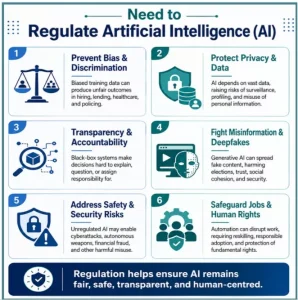
India’s goal is built on making technology open to everyone, large in scale, and fair. This is known as the “AI for All” vision. Instead of letting AI stay in the hands of just a few rich companies or countries, India wants to spread AI tools across vital areas:
- Helping Society: Using AI to boost growth in agriculture, healthcare, education, management, manufacturing, and climate action.
- National Goal: Linking AI growth directly to the vision of Viksit Bharat 2047 (a fully developed India by 2047) to build financial strength, social growth, and self-reliance.
- Global Safety: Setting up basic international rules so that AI benefits can reach every person in the world safely.
AI Market Dimension
- Global AI Market Size: The global AI economy is estimated at ~USD 400–450 billion (2026) and is projected to cross USD 2 – 2.5 trillion by early 2030s, driven by generative AI, cloud computing, and semiconductor demand.
- Growth Rate: AI continues to register high double-digit growth (≈26–30% CAGR), making it one of the fastest-growing technology markets globally.
- Infrastructure Spend: Hyperscaler AI capital expenditure (data centres, advanced chips, cloud infrastructure) is expected to exceed USD 2 trillion cumulatively by 2026, reflecting AI’s infrastructure-intensive nature and entry barriers.
- Indian AI Market Size: India’s AI market is projected to reach ~USD 15–20 billion by 2027, with strong momentum in AI services, platforms, and public-sector use cases.
- Growth Rate: India ranks among the fastest-growing AI markets globally, with an estimated 25 – 35% CAGR, supported by digital public infrastructure and startup activity.
- Talent Advantage: India accounts for ~16% of the global AI talent pool, ranking second worldwide.
- AI workforce demand is expected to approach 1 million professionals by end-2026, underscoring both opportunity and skilling challenges.
- Key Domains of Application: Governance, healthcare, agriculture, defence, manufacturing, education, finance, climate action, and digital public infrastructure.
Sectoral Applications- AI for Social Good:
In 2026, AI is no longer a luxury but a core utility integrated into public service delivery to create tangible societal impact across critical sectors:
- Agriculture- Precision & Resilience: AI converts farming from input-based practices to information-based decision-making, reducing agrarian distress.
- Examples: Tools like Kisan e-Mitra provide a voice-based AI chatbot in 11+ regional languages to simplify access to government schemes.

-
- The National Pest Surveillance System uses computer vision and satellite data to identify 400+ pest species and provide real-time risk warnings for 61+ crops.
- Healthcare- Bridging the “Last Mile”: AI expands healthcare access by compensating for the shortage of specialist doctors and diagnostic infrastructure in rural areas.
- Examples: AI supports early disease detection through automated medical image analysis (X-ray, CT) for TB and cancer, while telemedicine platforms use AI-driven triage to prioritize critical cases in remote districts.
- Language & Inclusion- Removing the “Language Tax”: AI bridges the digital divide by enabling non-English speakers to access services in their own native dialects.
- Examples: The Bhashini platform has crossed 1.2 million downloads, utilizing AI to provide real-time translation and voice services across 36+ Indian languages, making internet services truly inclusive for all.
- Disaster Preparedness- Predictive Safety: AI enhances climate resilience through proactive intervention and high-precision early warning systems.
- Examples: The IMD utilizes AI for extreme weather forecasting, while the development of MausamGPT provides real-time, conversational safety advisories and hyper-local forecasts at the Panchayat level during cyclones and floods.

|
UPSC Coaching Classes
Challenges That Need to Be Addressed
Because AI systems are smart, adapt quickly, and learn on their own, they bring new risks that must be managed:
- Digital Colonialism: Rich countries with massive tech infrastructure could control the whole AI ecosystem. This leaves poorer nations in Asia and Africa behind, turning them into “digital colonies” that just depend on others.
- The Non-Proliferation Trap: Strong nations might use safety rules—like stopping AI-made biological weapons—as an excuse to say that only a few powerful countries or mega-companies should be allowed to build advanced AI.
- Harm to Vulnerable Groups: Children face risks from addictive system designs, and women are often targeted by harmful, fake AI-generated deepfakes.
- Confusing Rules: If every country makes its own separate laws, it creates a messy patchwork that could slow down global innovation.
Global & National Actions & Initiatives
To handle these risks, new organizations and rules are being set up both globally and within India:
- Global Actions:
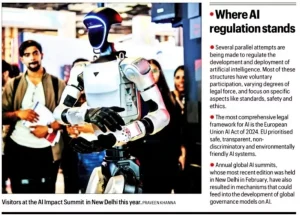 UN Global Dialogue on AI: A program by the United Nations General Assembly that invites every country to help write the rules for AI.
- International Scientific Panel on AI: A global group of 40 experts tasked with tracking the facts of AI science. Professor B Ravindran from IIT Madras is the only Indian expert chosen for this panel.
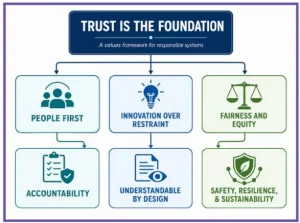
- India’s Action Plan: Launching at the AI Impact Summit 2026, the India AI Governance Guidelines use a practical, law-and-technology approach based on Seven Guiding Sutras:
- Digital Public Infrastructure (DPI): Connecting AI with reliable systems like UPI and DigiLocker to make it easy for the public to use.
- Skills Training: Programs like IndiaAI FutureSkills support 500 PhD students, 5,000 postgraduates, and 8,000 undergraduates. Plus, 570 AI Data Labs are teaching data skills in smaller cities.
- Legal Support: Using the IT Rules (updated in 2026 to fight deepfakes) and the DPDP Act, 2023 to make sure companies handle personal data safely and are held responsible for mistakes.
Way Forward
- Short-Term to Medium-Term Actions:
- New Oversight Groups: Setting up the AI Governance Group (AIGG) to run policy, the Technology & Policy Expert Committee (TPEC) for expert advice, and the IndiaAI Safety Institute to test systems.
- Trusted AI Commons: India will manage this global library. It will share open, free testing tools and data from groups like IIT Madras and Google so any country can test its AI safety.
- Safe Testing Spaces: Creating regulatory sandboxes (controlled testing zones) where companies can try out new AI without breaking laws or causing real-world harm.
- Long-Term Actions:
- Building a national AI incident database to track and learn from AI errors and harms.
- Updating laws to clearly state who is to blame when an AI system causes trouble, while working with other countries to set global standards.
Click to Know UPSC Offline Courses
Conclusion
AI is a tool for the whole world, and it needs a shared solution. By balancing safety with a whole-of-government approach, India is proving that a country does not have to stop growth to stay safe. True progress means building an open system that protects people, helps responsible innovation, and ensures that AI benefits reach every citizen on the path to Viksit Bharat 2047.
 25 Jun 2026