UPSC PYQs

Prelims, Mains & Optional PYQs

UPSC Notes

Comprehensive & Short Notes

Civil Registration System (CRS) Report 2024: Key Findings, Sex Ratio & Significance

2 Jul 2026

Civil Registration System (CRS) Report 2024: Key Findings, Sex Ratio & Significance

Subject: GS 2: Polity & Governance

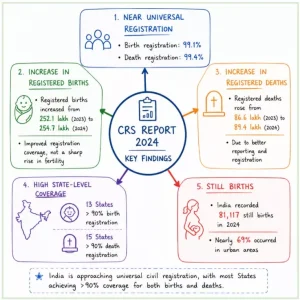
Context: The Civil Registration System (CRS) Report 2024 shows that India has achieved 99.1% birth registration and 99.4% death registration, marking a significant improvement in the completeness of civil registration. 
  • The report also indicates gradual improvement in the Sex Ratio at Birth (SRB) in several States, though regional disparities continue to persist.

UPSC Online Coaching

Key Findings of the CRS Report 2024

  • Near Universal Registration: Birth registration reached 99.1% and death registration 99.4%, indicating that India is approaching universal civil registration.
  • Increase in Registered Births: Registered births increased from 252.1 lakh (2023) to 254.7 lakh (2024), reflecting improved registration coverage rather than a sharp increase in fertility.
  • Increase in Registered Deaths: Registered deaths rose from 86.6 lakh (2023) to 89.4 lakh (2024), largely due to better reporting and registration.
  • Civil Registration SystemHigh State-Level Coverage: Thirteen States achieved more than 90% birth registration, while fifteen States recorded more than 90% death registration.
  • Still Births: India recorded 81,117 still births in 2024, with nearly 69% occurring in urban areas, indicating the need to strengthen maternal and neonatal healthcare.

Sex Ratio at Birth (SRB)

  • The Sex Ratio at Birth measures the number of female live births per 1,000 male live births and serves as an important indicator of gender equity and the prevalence of sex-selective practices.
  • National Average: India’s Sex Ratio at Birth (SRB) stands at 917 females per 1,000 males, showing gradual improvement but remaining below the natural biological range.
  • Top Performing States/UTs: Arunachal Pradesh (1050), Andaman & Nicobar Islands (984), Meghalaya (974), Mizoram (972) and Kerala (970) recorded the highest sex ratios at birth.
  • Lowest Performing States/UTs: Nagaland (865), Lakshadweep (865) and Jharkhand (890) reported the lowest Sex Ratio at Birth.

About the Civil Registration System (CRS)

  • The Civil Registration System (CRS) is India’s continuous and compulsory system for registering births, deaths and still births, while generating vital statistics for governance and policy planning.
  • Legal Basis: It operates under the Registration of Births and Deaths (RBD) Act, 1969, which mandates the registration of all births and deaths across the country.
  • Nodal Authority: It is administered by the Office of the Registrar General & Census Commissioner, India (ORGI) under the Ministry of Home Affairs (MHA), with implementation by State Governments and local registrars.
  • Objectives: It provides legal identity, generates reliable vital statistics (birth rate, death rate, Sex Ratio at Birth, fertility and mortality), and supports evidence-based policymaking and welfare delivery.
  • Recent Reform: The Registration of Births and Deaths (Amendment) Act, 2023 establishes a national digital database to enable seamless updating of records across government databases and improve digital governance.
  • Significance: CRS supports planning in health, education, social welfare, population management and disaster response, while contributing to SDG 3 (Good Health and Well-being), SDG 5 (Gender Equality) and SDG 16.9 (Legal Identity for All).

Significance of Improving Civil Registration

  • Evidence-Based Governance: Reliable registration data supports informed policymaking in healthcare, education, nutrition, social protection and population management.
  • Strengthening Public Health: Accurate birth and death registration improves disease surveillance, mortality assessment and maternal-child health planning.
  • Tracking Demographic Transition: Comprehensive registration provides a clearer understanding of fertility, mortality, age structure and population dynamics.
  • Legal Identity: Birth registration establishes an individual’s legal identity, facilitating access to education, healthcare, social welfare and citizenship-related services.
  • Monitoring Sustainable Development Goals (SDGs): Civil registration data contributes to monitoring SDG 3 (Good Health and Well-being), SDG 5 (Gender Equality) and SDG 16.9 (Legal Identity for All).

Factors Contributing to Improved Registration

  • Digital Governance: Expansion of online registration systems and digitisation has simplified registration procedures and improved accessibility.
  • Administrative Reforms: Simplification of registration forms and greater institutional coordination have enhanced compliance.
  • Improved Institutional Deliveries: Rising institutional births have strengthened timely birth registration through healthcare facilities.
  • Greater Public Awareness: Increased awareness regarding the legal and welfare benefits of registration has improved public participation.

Challenges Highlighted by the Report

  • Persistent Gender Bias: Continued son preference and sex-selective practices in some regions contribute to an imbalanced Sex Ratio at Birth.
  • Regional Disparities: Significant interstate variations indicate uneven implementation of gender-sensitive policies and registration systems.
  • Urban Concentration of Still Births: The disproportionately high share of still births in urban areas calls for improved maternal healthcare, antenatal services and quality obstetric care.
  • Quality of Registration: While coverage has improved, ensuring timeliness, accuracy and completeness of civil registration remains an ongoing challenge.

UPSC Coaching Classes

Government Initiatives Supporting Civil Registration and Gender Balance:

  • Registration of Births and Deaths (RBD) Act, 1969: Makes registration of births and deaths mandatory, providing the statutory framework for the Civil Registration System.
  • Registration of Births and Deaths (Amendment) Act, 2023: Introduced a single digital database for births and deaths to facilitate better governance and public service delivery.
  • Civil Registration System (CRS): Serves as India’s official mechanism for continuous recording of births, deaths and still births.
  • Beti Bachao Beti Padhao (BBBP): Seeks to improve the Child Sex Ratio, promote girls’ education and address gender discrimination.
  • Pre-Conception and Pre-Natal Diagnostic Techniques (PCPNDT) Act, 1994: Prohibits sex selection before or after conception and regulates diagnostic techniques to prevent female foeticide.

Constitutional and Policy Perspective:

  • Article 14: Guarantees equality before law, reinforcing equal rights and opportunities irrespective of gender.
  • Article 15: Prohibits discrimination on the grounds of sex, forming the constitutional basis for gender equality initiatives.
  • Article 21: The Right to Life and Personal Liberty encompasses access to legal identity, healthcare and essential public services, all of which are facilitated by birth registration.
  • SDG 16.9: Calls for providing legal identity for all, including birth registration, by strengthening civil registration systems.

Way Forward

  • Achieve Universal Registration: Strengthen outreach in underserved and remote areas to achieve 100% timely registration of births and deaths.
  • Improve Sex Ratio at Birth: Intensify enforcement of the PCPNDT Act, promote gender-sensitive awareness campaigns and strengthen schemes supporting the girl child.
  • Strengthen Maternal Healthcare: Improve antenatal care, institutional deliveries and neonatal services to reduce still births and maternal mortality.
  • Enhance Digital Integration: Integrate the Civil Registration System with health, education and social welfare databases for seamless service delivery.
  • Promote Data Quality: Improve verification, timely reporting and interoperability of civil registration data for robust evidence-based policymaking.

Click to Know UPSC Offline Courses

Conclusion

India’s near-universal registration of births and deaths marks a major milestone in strengthening population data systems and public administration. However, sustained efforts are needed to improve the Sex Ratio at Birth, eliminate gender bias and ensure that high-quality civil registration translates into better governance, inclusive development and equitable access to public services.

Check Out UPSC CSE Books

Visit PW Store

online store 1

Civil Registration System (CRS) Report 2024: Key Findings, Sex Ratio & Significance

Need help preparing for UPSC or State PSCs?

Connect with our experts to get free counselling & start preparing

Free Counselling for UPSC Aspirants

Connect with our experts and take the right next step.

Expert Guidance
Personalized Strategy
100% Free

Book Your Free Session

NEED ASSISTANCE?

Request a Callback

Our counsellor will connect with you and help you choose the right course and centre.

  • Expert Guidance
  • Course & Fee Information
  • Quick Callback Support

Request a Callback

Books
UPSC PYQs
UPSC Notes
Current Affairs
Quick Revise Now !
AVAILABLE FOR DOWNLOAD SOON
UDAAN PRELIMS WALLAH
Comprehensive coverage with a concise format
Integration of PYQ within the booklet
Designed as per recent trends of Prelims questions
हिंदी में भी उपलब्ध
Quick Revise Now !
UDAAN PRELIMS WALLAH
Comprehensive coverage with a concise format
Integration of PYQ within the booklet
Designed as per recent trends of Prelims questions
हिंदी में भी उपलब्ध

<div class="new-fform">


    </div>

    Subscribe our Newsletter
    Sign up now for our exclusive newsletter and be the first to know about our latest Initiatives, Quality Content, and much more.
    *Promise! We won't spam you.
    Yes! I want to Subscribe.