Recently, astronomers from the University of Hawaii’s Institute for Astronomy discovered a new class of events, Extreme Nuclear Transients (ENTs).
- These flares are more powerful than gamma-ray bursts (GRBs), previously considered the most luminous events since the Big Bang.
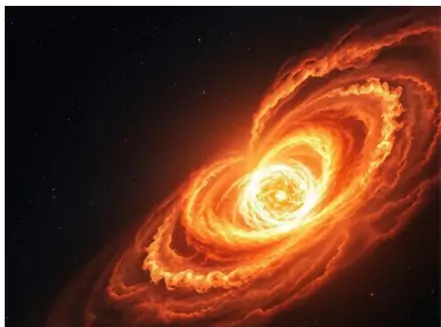
About Extreme Nuclear Transients (ENTs)
- Refers to: Exceptionally bright, long-lived flares from galactic nuclei, distinct from supernovae, GRBs, or standard tidal disruption events (TDEs).
- Nature of Transients: Short-lived astronomical events showing rapid changes in brightness.
Cataclysmic Events in the Universe
The universe, despite its calm appearance, is shaped by violent events such as:
- Collisions of galaxies.
- Explosive supernovae marking the death of massive stars.
- X-ray outbursts from compact objects.
- Black holes devouring stars.
- Gamma-ray bursts (GRBs), once considered the brightest explosions after the Big Bang.
- ENTs now surpass these in both scale and longevity.
|
- Cause: Likely triggered when supermassive black holes (SMBHs) tear apart massive stars (3–10 times the Sun’s mass).
- Process: Stars undergo “spaghettification,” stretched into thin streams by tidal forces, releasing enormous electromagnetic energy.
- Spaghettification is the process of being stretched and shredded by a black hole’s tidal forces. The side closer experiences stronger gravity, pulling it apart into a long, thin stream resembling spaghetti.
- Discovered in: Rare events such as Gaia16aaw, Gaia18cdj, and AT2021lwx.
- Luminosity & Energy: Peak luminosity of 2–7 × 10⁴⁵ erg/s; total energy output of 10⁵²–10⁵³ erg — nearly 10 times greater than previous records.
- Light Curve: Smooth, bright emission lasting for years, unlike supernovae that fade within weeks.
- Characteristics:
-
- Unprecedented Brightness: Over 20–25 times brighter than the most powerful supernovae.
- Extended Timescales: Hundreds of days to peak and gradual fading over years.
- Smooth Evolution: Minimal irregular variability, unlike the stochastic outbursts of Active Galactic Nuclei (AGN).
- Massive Host Galaxies: Found in galaxies with large SMBHs and high star-formation rates.
- Rarity: Estimated frequency of ~10⁻³ per Gpc³ per year, making them extremely rare.
- Global Collaboration: Identified using Gaia space mission, Zwicky Transient Facility (ZTF), and Keck Observatory.
Comparison with Other Events
- Tidal Disruption Events (TDEs): ENTs resemble TDEs but occur in larger host galaxies with more massive black holes.
- Fast X-ray Transients (FXTs): Shorter and less energetic, usually linked to supernovae, not SMBHs.
- Gamma-Ray Bursts (GRBs): Previously considered the brightest, but ENTs release up to ten times more energy.
Significance of Extreme Nuclear Transients (ENTs)
- Scientific Breakthrough: Establishes a new frontier in transient astrophysics.
- Black Hole Physics: Provides direct evidence of SMBHs consuming massive stars.
- Cosmological Tool: Acts as beacons to map galaxies and interstellar matter across vast distances.
What is a Black Hole?
- Black holes are extremely dense regions in space where gravity is so strong that not even light can escape their pull.
- For Example, Cygnus X-1, one of the first discovered stellar black holes, and Sagittarius A*, the supermassive black hole at the center of our Milky Way galaxy.
Types of Black holes Based on Mass
- Stellar-Mass Black Holes: Formed from collapsing massive stars, with masses from a few to hundreds of times that of the Sun.
- Many are in binary systems, pulling gas from companion stars, creating X-rays.
- Supermassive Black Holes: Found at galaxy centers, these range from hundreds of thousands to billions of solar masses, potentially formed in the early universe.
- Intermediate-Mass Black Holes: A theorized “missing link” size range from hundreds to hundreds of thousands of solar masses, hard to detect.
- The recent detection of NGC 4395 Galaxy IMBH is first of its Kind.
- Primordial Black Holes: Hypothetically formed soon after the Big Bang; potentially very small or up to 100,000 solar masses
|
 23 Sep 2025