Recently, the Union Home Ministry has notified amendments to the Immigration and Foreigners Rules, 2025, tightening visa registration deadlines for foreign nationals to enhance national security and streamline border management protocols.
Best Online Coaching for UPSC
Key Changes in Immigration and Foreigners Rules, 2025
- Strict Registration Deadline: Foreigners on a visa of 180 days or less who want to extend their stay must now register any time before their visa expires.
- The previous 14-day grace period after expiry has been removed.
- Emergent Restrictions: For long-term visas with a “180-day stay limit per visit” clause, registration for an extended stay must be done before the 180 days end.
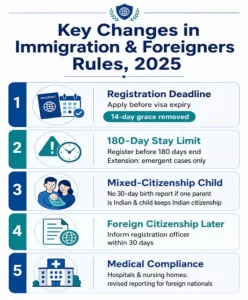 This will now be granted only under emergent circumstances.
- Exemption for Mixed-Citizenship Children: Parents are no longer required to report the birth of a child within 30 days if one parent is an Indian citizen who wishes to retain the child’s Indian citizenship.
- Foreign Citizenship Declaration: If a child born in India chooses to acquire foreign citizenship later, parents must inform the registration officer within 30 days.
- Medical Compliance: The rules mandate revised reporting requirements for all hospitals and nursing homes providing lodging or medical care to foreign nationals.
About Immigration and Foreigners Rules, 2025
- Primary Legal Framework: The Immigration and Foreigners Rules, 2025 serve as the primary legal framework regulating the entry, stay, and exit of foreign nationals in India.
- Administrative Authority: Administered by the Ministry of Home Affairs, these rules implement the statutory provisions of the newly passed Immigration and Foreigners Act.
- Core Objective: The core objective of this framework is to balance tourism and ease of travel with robust internal security.
- Digital Monitoring & Compliance: By digitalizing the monitoring process through online portals, it tracks visa compliance, regulates foreign regional registration, and prevents illegal stay or overstaying.
- National Security Role: These rules provide administrative teeth to actions against individuals who pose a threat to the country.
About Immigration
- Immigration refers to the movement of individuals from their home country to another nation where they are neither natives nor citizens.
- This relocation can be for permanent settlement, naturalization, employment, or temporary work.
- Immigrants and Emigrants: Those who migrate to another country are called immigrants, while from the perspective of their home country, they are referred to as emigrants or outmigrants.
Causes of Immigration
- Economic Factors: People migrate for better jobs, wages, and living standards. Lack of opportunities and poverty push many to seek work abroad.
- Example: Many Indians migrate to the Gulf for higher-paying jobs in construction
- Political Instability & Conflict: Wars, persecution, and oppressive regimes force people to flee. Ethnic, religious, and political discrimination also drive migration.
- Example: Rohingya Muslims migrated from Myanmar to Bangladesh to escape persecution.
- Environmental & Climate Change: Natural disasters and climate change destroy livelihoods. Rising sea levels, droughts, and resource shortages make areas uninhabitable.
- Example: Satabhaya village in Kendrapara district of Odisha faced severe coastal erosion and rising sea levels, forcing residents to migrate as their homes and farmland were lost.
- Globalization & Connectivity: Improved transportation and communication make migration easier. Expanding global job markets attract skilled and unskilled workers.
- Example: IT professionals from India migrate to Silicon Valley.
Impact of Immigration
- Economic Growth: Boosts labor supply, fills skill gaps, and drives entrepreneurship.
- Example: Indian IT professionals contributing to the U.S. tech industry.
- Pressure on Infrastructure: Strains housing, healthcare, and public services in the host country.
- Example: Rapid urbanization in European cities due to refugee influx.
- Remittances & Home Country Development: Supports economies through money sent back home, improving living standards and investments.
- Example: India is the world’s top recipient of remittances, with Indian migrants, especially in the Gulf and the U.S., sending billions annually, boosting household incomes and national GDP.
- Security & Social Challenges: May lead to concerns over crime, assimilation, and national identity.
- Example: Debates over border security in the U.S. and Europe.
|
UPSC Online Courses
Immigration Provisions In India
- Citizenship Act, 1955: Governs the acquisition, renunciation, and termination of Indian citizenship.
- It outlines five ways to become an Indian citizen: birth, descent, registration, naturalization, and incorporation of territory.
- Foreigners Act, 1946:
- Control Over Entry, Stay, and Exit: Regulates the entry, stay, and exit of foreigners in India.
- Powers to Detect and Deport: Empowers the government to detect, detain, and deport illegal immigrants.
- Establishment of Tribunals: The Act empowers the government to establish tribunals with powers similar to civil courts to determine foreigner status.
- 2019 Amendments: Amendments to the Foreigners (Tribunals) Order, 1964 allow district magistrates across all States and UTs to set up tribunals for identifying illegal foreigners.
- Visa Regulations (Under the Passport Act, 1920):
- Defines entry conditions for foreign nationals through visa categories.
- Regulates extensions, restrictions, and violations of visa norms.
- Refugee Policies:
- India is not a signatory to the 1951 Refugee Convention.
- Provides asylum on a case-by-case basis (e.g., Tibetans, Sri Lankan Tamils, Rohingyas).
Key Provisions of the Immigration and Foreigners Rules, 2025
- Mandatory Registration (FRRO Framework): Establishes the Foreigners Regional Registration Office (FRRO) as the nodal authority.
- It mandates that foreign nationals exceeding specified stay thresholds must register digitally to validate their presence.
- Visa Categorization and Compliance: Clearly defines the parameters, operational scope, and duration for various visa classes—including tourist, business, employment, medical, and student visas—while setting strict non-compliance penalties.
- Digitalization of Services (M-Visa & Portals): Integrates all immigration workflows into a designated online portal and mobile application, enabling paperless processing for visa extensions, exit permissions, and address updates.
- Deportation and Stern Enforcement: Empowers civil authorities to identify, detain, and sternly penalize foreign nationals overstaying their visas or engaging in activities inimical to national security.
- Institutional Reporting Mechanisms: Obligates third-party stakeholders—such as hotels, landlords (via Form C), and medical institutions—to electronically report the accommodation of any foreign national within strict timelines.
Click to Know UPSC Coaching Centres in India
PWOnlyIAS Extra Edge:
Role of International Organizations in Immigration
- United Nations High Commissioner for Refugees (UNHCR): UNHCR, the UN Refugee Agency, is a global organization dedicated to people forced to flee their homes because of conflict and persecution.
- Protects and assists refugees, asylum seekers, and stateless people.
- Provides emergency aid, legal support, and resettlement assistance.
- Example: Led relief efforts for Syrian refugees in Turkey, Lebanon, and Jordan.
- International Organization for Migration (IOM)
- Manages migration policies, ensures safe and orderly migration, and combats human trafficking.
- Assists with voluntary repatriation, resettlement, and integration programs.
- Example: Helped Rohingya refugees relocate and provided humanitarian aid in Bangladesh.
Global Practices in Immigration Laws
- United States: In the United States Immigration and Nationality Act (INA), an immigrant is an individual seeking to become a Lawful Permanent Resident in the United States.
- It allows for judicial review of deportation orders.
- European Union: Foreigners have the right to appeal deportation decisions before an independent authority.
- The EU Blue Card allows highly skilled non-EU nationals to work and live in member states.
- Australia: The Migration Strategy includes humanitarian exceptions and due process guarantees.
- Australia’s immigration changes in 2025 aim to strike a balance between economic needs and migration fairness.
|
 4 Jun 2026