Subject: GS 2: Polity & Governance
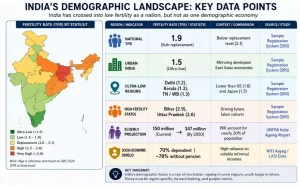
Context: India’s Total Fertility Rate (TFR) has fallen to 1.9 children per woman, below the replacement level of 2.1.
- This marks a major shift from population-growth concerns to challenges of ageing, labour-market imbalance and social security.
UPSC Coaching Classes
Key-Terms:
- Total Fertility Rate (TFR): The average number of children a woman is expected to have during her reproductive years (15–49 years), assuming current age-specific fertility rates remain constant throughout her lifetime.
- Replacement-Level Fertility: A TFR of about 2.1 children per woman, at which a population exactly replaces itself from one generation to the next, without migration.
|
Core Structural Challenges
- Ageing Before Affluence: Unlike Western nations or Japan, India is experiencing ageing before formalisation and prosperity, facing mass demographic graying at a low per-capita income (~$2,800) and a narrow net direct tax base of just 6%.
- India has about 150 million people aged 60 and above. By 2050, that number is projected to rise to 347 million, or nearly one-fifth of the population.
- Informal Labor & Care Gaps: With the vast majority locked in informal work, contribution-based safety nets fail due to highly volatile earnings.
- Concurrently, urbanization and migration dismantle the traditional joint-family system and unpaid female care, shifting the invisible domestic care burden onto a non-existent state safety net.
- The Gendered Burden of Ageing: Women face a compounding crisis. As primary caregivers, their formal labor force participation remains constrained, yet they experience higher rates of old-age widowhood and economic destitution due to longer life expectancies than men.
- Fiscal-Federal and Political-Economy Friction: Divergent demographic speeds risk severe inter-state friction.
- Rapidly ageing, higher-tax-contributing southern states face increasing political and financial anxiety over resource transfers to younger, lower-income northern states.
- Severe Epidemiological Shift: The healthcare system is built for acute care, not longevity.
- According to NITI Aayog’s Senior Care Reforms report, roughly 75% of the elderly suffer from chronic diseases, and nearly 24% face Activities of Daily Living (ADL) limitations, risking an immediate collapse of primary health infrastructure.
Way Forward
- Establish an Inflation-Indexed Pension Floor: Revamp the current, inadequate NSAP subsidy (₹200–₹500) into a legally guaranteed, basic minimum pension floor to insulate informal workers from absolute poverty.
- Pioneer a Silver Economy & Mission Geriatric Care: Transform the ageing crisis into an economic opportunity by funding the silver economy (senior living, assistive tech, elder care services). Pivot public healthcare by embedding geriatric specialization directly into district health planning and primary nursing curriculums.
- Enact Interstate Benefit Portability: Dismantle domicile-based welfare constraints. Richer, ageing states must treat cross-state migrants as vital economic citizens, creating legally portable health and social entitlements that travel with the worker.
- Harvest the Remaining Demographic Dividend: Broaden the fiscal base by aggressively investing in education and high-value skilling in northern states. This ensures internal migration yields high-wage, tax-generating productivity rather than moving workers from rural underemployment into low-wage urban informality.
Click to Know UPSC OnlyIAS Coaching Centres
Conclusion
India’s sub-replacement fertility poses a unique challenge but also an opportunity to build resilient welfare systems through digital infrastructure, telemedicine, and portable social security. The State must increasingly support care, health, and income needs as traditional family support weakens.
 25 Jun 2026