During Cyclone Dana (2025), Bhitarkanika’s mangroves outperformed concrete barriers in absorbing storm surges, showcasing the value of Ecosystem-based Adaptation (EbA) in protecting India’s climate-vulnerable coastline and coastal communities.
UPSC Online Courses
About Mangroves
Mangroves function as highly effective natural coastal barriers because of their unique structural and physiological adaptations that allow them to survive in harsh coastal environments.
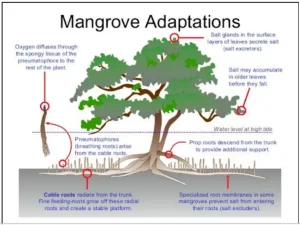
- Refers: Mangroves are specialized halophytes (salt-tolerant woody plants) occupying intertidal zones characterized by high salinity, intense solar radiation, low-oxygen (anoxic) mud, and shifting tidal currents.
- Respiratory Adaptations (Pneumatophores): Because waterlogged coastal silt lacks oxygen, certain mangrove species (such as Avicennia) project lateral roots upward out of the mud.
- These aerial roots feature specialized breathing pores called lenticels to extract oxygen directly from the atmosphere during low tides.
- Mechanical Anchoring (Stilt & Buttress Roots): To withstand high-velocity cyclonic winds and daily tidal waves, species like Rhizophora develop looping stilt roots growing downward from the trunk, while larger trees use wide flying buttress roots at their base to distribute weight across soft silt.
- Salinity Management: Mangroves regulate high osmotic pressure using two distinct physiological mechanisms:
- Exclusion: Filtering out over 90% of physical salt at the root-soil interface via cellular ultrafiltration.
- Exudation: Transporting absorbed salt up into older leaves that are subsequently shed, or actively expelling salt crystals through specialized salt glands on their leaf surfaces.
- Reproductive Strategy (Viviparity): To prevent seeds from rotting or washing away in shifting mudflats, mangroves use viviparous reproduction.
- The seed germinates while still physically attached to the parent tree, developing into a weighted seedling (propagule) that drops into the water to immediately anchor vertically into the silt.
Seawalls
To protect vulnerable coastlines from strong waves, storm surges, and coastal erosion, governments often build artificial coastal defense structures such as seawalls.
- Seawalls are hard concrete or stone structures built parallel to the coastline to protect coastal areas from waves, storm surges, and coastal erosion.
- They act as physical barriers between the sea and human settlements.
- Limitations: Expensive, require regular maintenance, and may increase erosion in nearby coastal areas by reflecting wave energy.
Groynes
To control beach erosion caused by the movement of sand along the coast, engineers often use structures known as groynes.
- Groynes are narrow structures built perpendicular to the shoreline to trap sand and reduce beach erosion caused by longshore currents.
- They help maintain beach width and stabilize coastlines.
- Limitations: Can reduce sand supply to nearby beaches, increasing erosion in adjacent areas.
Embankments
In low-lying coastal and riverine regions, embankments are widely used to reduce flooding and seawater intrusion.
- Embankments are raised barriers made of soil, rock, or concrete constructed along rivers or coastlines to prevent flooding and seawater intrusion.
- Commonly used in low-lying coastal and delta regions.
- Limitations: Can weaken over time, breach during extreme floods or cyclones, and require continuous maintenance.
|
Geographical Distribution
- Global Layout: Asia hosts the largest total mangrove area globally. Over 40% of the world’s mangrove ecosystem is highly concentrated across just four nations- Indonesia (19%), Brazil (9%), Nigeria (7%), and Mexico (6%).
- National Metrics: India’s total mangrove cover stands at 4,992 square kilometres, accounting for roughly 0.15% of the country’s total geographical area.
- Spatial Stratification: India’s mangrove distribution is highly skewed, with the East Coast (Bay of Bengal) supporting significantly larger, more contiguous patches than the West Coast due to massive river delta systems.
- The Sundarbans (West Bengal): Spanning a transboundary area across India and Bangladesh, this forms the world’s largest single contiguous patch of mangrove forest and was the first mangrove ecosystem brought under scientific management plans.
- Bhitarkanika (Odisha): Fed by the Brahmani, Baitarani, and Dhamra rivers, it forms India’s second-largest mangrove ecosystem.
Key National Mangrove Initiatives
- MISHTI Scheme (Mangrove Initiative for Shoreline Habitats & Tangible Incomes): Launched in the Union Budget 2023-24.
- The scheme focuses on mangrove plantation, coastal ecosystem restoration, and creating livelihood opportunities for coastal communities through convergence of schemes like MGNREGA and Compensatory Afforestation Fund Management and Planning Authority (CAMPA).
- National Coastal Mission under NAPCC: The National Coastal Mission under the National Action Plan on Climate Change promotes mangrove conservation, coastal resilience, and climate adaptation to address risks from cyclones, sea-level rise, and coastal erosion.
- Integrated Coastal Zone Management (ICZM) Programme: Supported by the World Bank, the programme works on mangrove restoration, biodiversity conservation, pollution control, and sustainable coastal resource management in vulnerable coastal states.
- National Mangrove and Coral Reef Committee: Established by the Government of India to guide policies for the protection, restoration, and scientific management of mangrove and coral reef ecosystems.
- CAMPA Fund Utilization: Funds under the Compensatory Afforestation Fund Management and Planning Authority (CAMPA) are increasingly used for mangrove afforestation, habitat improvement, and coastal ecosystem regeneration.
- State-Level Mangrove Protection Measures: Coastal states such as West Bengal, Odisha, Gujarat, and Maharashtra have developed dedicated mangrove conservation authorities, eco-sensitive zoning, and community-led restoration projects.
About Ecosystem-based Adaptation (EbA)
- Refers: EbA is a nature-centric climate strategy that uses biodiversity and ecosystem services to help communities adapt to the adverse impacts of climate change.
- Harnessed Habitats: Unlike traditional engineered “grey” infrastructure, EbA harnesses natural habitats like mangroves, seagrass meadows, and coral reefs to act as dynamic, self-sustaining buffers.
|
UPSC Online Classes
Key Features of Mangroves as Climate Shields: (UPSC CSE Mains 2019)
- Wave Protection: The dense and tangled aerial roots of mangroves reduce the strength of incoming waves and lower the damage caused by storm surges.
- Natural Land Building: Mangroves trap sediments and organic matter within their roots, helping coastlines gradually rise and adjust to sea-level rise.
- Strong Coastal Protection: Scientific studies identify India as a major coastal EbA hotspot, where mangroves protect large coastal populations from climate disasters.
- High Carbon Storage: Mangroves are powerful blue carbon sinks, storing very large amounts of carbon dioxide in their waterlogged soils, often more than tropical rainforests.
- Long-Lasting & Cost-Effective: Unlike concrete seawalls that weaken and need frequent repairs, mangrove ecosystems naturally regenerate and become stronger over time if protected properly.
Hard (Grey) vs. Ecosystem (Green) Infrastructure:
- Shifting Coastal Damage: Hard concrete structures often redirect wave energy instead of absorbing it, increasing erosion and damage in nearby unprotected coastal areas, as seen along parts of the Kerala coast.
- Successful Community Restoration: In the Sundarbans, over 18,000 women restored around 4,600 hectares of mangroves, reducing the impact of Cyclones Amphan and Yaas while also improving livelihoods through honey collection and crab farming.
|
Challenges Associated with India’s Coastal Adaptation Policy
- Hidden Climate Benefits: Many climate adaptation projects are included within general forestry or development schemes, so their specific climate benefits are rarely measured separately.
- Weak Institutional Coordination: Coastal management suffers from divided responsibilities and weak monitoring, leading to greater focus on visible concrete infrastructure instead of nature-based solutions.
- Poor Climate Positioning: Major schemes like MISHTI (Mangrove Initiative for Shoreline Habitats & Tangible Incomes) are mainly treated as conservation programs rather than important climate adaptation strategies.
- Higher Spending on Grey Infrastructure: Coastal states spent nearly ₹2,641 crore on hard engineered coastal protection over the last decade, while the budget of the National Coastal Mission declined sharply from ₹195 crore (2022–23) to ₹50 crore (2024–25).
Way Forward
- Clear National EbA Framework: Create clear legal definitions and classification systems for ecosystem-based adaptation (EbA) to improve identification, monitoring, and funding of nature-based climate solutions.
- Integrate Nature into Coastal Planning: Shift from isolated restoration efforts to a national coastal strategy that includes mangrove and seagrass restoration within disaster management and coastal planning laws.
- Increase Funding for Green Infrastructure: Redirect public spending from high-maintenance seawalls toward strengthening the National Coastal Mission and other nature-based protection measures.
- Promote Community-Led Restoration: Expand the successful Sundarbans model by financially supporting self-help groups and women’s cooperatives in local mangrove restoration.
- Improve Climate Monitoring: Build strong data-based monitoring systems to measure ecosystem protection benefits and strengthen India’s role in global climate finance mechanisms.
Click to Know UPSC Coaching Centres in India
Conclusion
India’s heavy reliance on rigid, concrete seawalls provides temporary relief but ultimately shifts and worsens long-term erosion risks along its fragile coastline. The proven success of mangrove systems during intense cyclones demonstrates that investing in natural capital is both economically sound and socially equitable.
 9 Jun 2026