Subject: GS 2: Polity & Governance
Context: Despite improvements in institutional deliveries, women’s empowerment, and maternal health programmes, NFHS-6 (2023–24) records a decline in exclusive breastfeeding (EBF), highlighting persistent gaps in postnatal support, maternity protection, and workplace support.
IAS coaching
Exclusive Breastfeeding (EBF)- Importance and NFHS-6 Findings
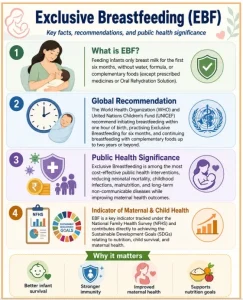
- Exclusive Breastfeeding (EBF) refers to feeding infants only breast milk for the first six months, without any additional food or drink (except prescribed medicines or oral rehydration solution), as recommended by the World Health Organization (WHO) and the United Nations Children’s Fund (UNICEF).
- Health Benefits: EBF provides complete nutrition, strengthens immunity against infections, promotes cognitive development, reduces infant mortality and malnutrition, while lowering mothers’ risk of breast and ovarian cancers.
- NFHS-6 Findings: Although institutional deliveries increased to 90.6% and early initiation of breastfeeding improved from 41.8% to 50.1%, Exclusive Breastfeeding declined from 63.7% (NFHS-5) to 55.8% (NFHS-6).
- State-wise Variation: Sharp declines were recorded in Uttar Pradesh, Haryana, Delhi, Rajasthan, and Madhya Pradesh, whereas Kerala, Gujarat, and West Bengal reported improvements.
- Emerging Concern: The decline is observed across both urban and rural India, with a steeper fall in rural areas, indicating systemic challenges beyond healthcare access.
Why is Exclusive Breastfeeding Declining Despite Better Maternal Healthcare?
- Informal Employment: A majority of women work in the informal sector, forcing them to resume work soon after childbirth due to economic compulsions, thereby interrupting exclusive breastfeeding.
- Limited Maternity Protection: While the Maternity Benefit Act, 1961 (amended in 2017) provides 26 weeks of paid maternity leave, its benefits largely remain confined to the organised sector.
- Rising Caesarean Deliveries: Caesarean Section (C-Section) deliveries have increased from 21.5% to 27.2%, often delaying breastfeeding initiation and increasing dependence on supplementary feeding without adequate lactation support.
- Weak Postnatal Support: Inadequate breastfeeding counselling, shortage of trained lactation consultants, poor family support, and delayed follow-up after discharge reduce breastfeeding success.
- Socio-economic Changes: Urbanisation, migration, nuclear families, aggressive marketing of infant formula, and traditional pre-lacteal feeding practices continue to undermine Exclusive Breastfeeding.
Government Initiatives Promoting Breastfeeding and Maternal Care
- Integrated Child Development Services (ICDS) (1975): Delivers supplementary nutrition, immunisation support, health check-ups, growth monitoring, preschool education, and nutrition counselling for mothers and children through Anganwadi Centres.
- Infant Milk Substitutes, Feeding Bottles and Infant Foods (Regulation of Production, Supply and Distribution) Act (IMS Act), 1992 (amended in 2003): One of the world’s strongest legislations regulating the promotion, advertisement, and marketing of infant formula and feeding bottles to protect and promote exclusive breastfeeding.
- Pradhan Mantri Matru Vandana Yojana (PMMVY) (2017): Provides conditional cash maternity benefits to partially compensate for wage loss during pregnancy and support maternal nutrition, rest, and breastfeeding.
- Comprehensive Lactation Management Centres (CLMCs) & Lactation Management Units (LMUs) (2017 onwards): Established under the Mother’s Absolute Affection (MAA) Programme to provide breastfeeding counselling and pasteurised donor human milk for premature, low-birth-weight, and critically ill newborns when mothers’ own milk is unavailable.
- POSHAN Abhiyaan (National Nutrition Mission) (2018): Promotes maternal, infant, and young child nutrition through behaviour change communication, digital monitoring, community mobilisation, and convergence of nutrition-related interventions across sectors.
Click to Know UPSC Coaching Centres in India
Implications of the Decline in Exclusive Breastfeeding
- Adverse Child Health Outcomes: Increases the risk of malnutrition, diarrhoeal diseases, pneumonia, childhood infections, and infant mortality, while weakening immunity and healthy growth.
- Poor Maternal Health: Early discontinuation reduces protection against breast cancer, ovarian cancer, postpartum haemorrhage, and limits birth spacing through lactational amenorrhoea.
- Increased Healthcare Expenditure: Higher incidence of preventable illnesses raises household medical expenses and burdens the public healthcare system.
- Nutritional and Human Capital Loss: Contributes to stunting, wasting, cognitive impairment, and poor learning outcomes, affecting human capital formation and productivity.
- Economic Burden: Increases spending on infant formula, reduces workforce productivity, and raises healthcare costs and future economic losses.
- Social and Gender Implications: Reflects inadequate maternity support, workplace protection, and childcare systems, affecting women’s health, employment continuity, and child welfare.
- Environmental Impact: Greater reliance on infant formula increases plastic waste, energy consumption, and greenhouse gas emissions, making breastfeeding the more sustainable option.
- Threat to SDG Achievement: May hinder progress towards SDG 2 (Zero Hunger), SDG 3 (Good Health and Well-being), SDG 5 (Gender Equality), and SDG 10 (Reduced Inequalities).
 6 Jul 2026