India’s transition towards a facilitation-driven business ecosystem through digital governance, regulatory simplification, and trust-based administration, significantly improving the Ease of Doing Business.
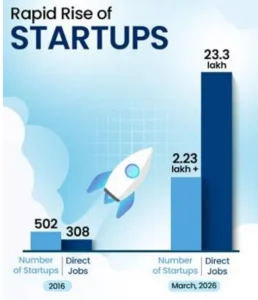
- In 2016, only 502 startups were recognised, creating 308 direct jobs. However, by March 2026, over 2.23 lakh startups have been recognised, generating 23.3 lakh direct jobs.
Best Online Coaching for UPSC
What is Ease of Doing Business (EoDB)?
- Ease of Doing Business (EoDB) refers to the extent to which the regulatory, administrative, and legal environment of a country facilitates the establishment, operation, and expansion of businesses with minimum cost, time, and procedural hurdles.
- It measures how easily entrepreneurs and firms can:
- Start a business,
- Obtain permits and licenses,
- Access credit,
- Register property,
- Pay taxes,
- Enforce contracts,
- Conduct trade, and
- Resolve insolvency.
Indicators of India’s Improving Business Environment (UPSC CSE 2016)
- World Bank Doing Business Report: India’s rank improved from 142 (2014) to 63 (2019), reflecting substantial progress in regulatory simplification and business facilitation.
- The World Bank’s Doing Business report was officially discontinued in September 2021 following an internal investigation that revealed data irregularities and ethical breaches.
- It has been fully replaced by a new flagship project called Business Ready (B-Ready)
- IMD World Competitiveness Ranking 2025: India’s ranking improved from 43rd (2021) to 41st (2025), indicating stronger governance, business efficiency, and infrastructure development.
- World Bank GovTech Maturity Index: India consistently remained in Group A (2020, 2022, 2025), demonstrating advanced digital governance and innovative public service delivery systems.
- UN E-Government Survey: India secured high scores in the Online Services Index, Telecommunication Infrastructure Index, and Human Capital Index, highlighting robust digital public infrastructure and citizen-centric governance.
Key Reforms Undertaken
- Startup India: Launched in January 2016, the Startup India initiative aims to support entrepreneurs and build a robust startup ecosystem.
- It seeks to transform India into a nation of job creators rather than job seekers. Support measures include the Seed Fund, Fund of Funds, investor connect portal, and a credit guarantee scheme.
- Simplified Business Registration: Platforms such as SPICe+ and Udyam Registration have enabled paperless, integrated, and time-bound business incorporation processes.
- MCA21: MCA Version 3 was launched in FY 2021-22 and integrates advanced features like e-Scrutiny, e-adjudication and e-consultation. It also includes Compliance Management System and MCA Lab.
 From 2021 to 2025, a total of approximately 3.84 crore filings were made. Of these 3.33 crore filings were approved through Straight Through Process.
- Udyam Registration Portal: Udyam Registration Portal was introduced in July 2020. It offers a free, paperless, and self-declaration-based system for MSMEs (Micro, Small and Medium Enterprises).
- MSME registrations on the Udyam Portal increased from 10.02 thousand in October 2020 to over 858 thousand by 5 June 2026.
- PARIVESH (Pro-Active and Responsive Facilitation by Interactive, Virtuous, and Environmental Single Window Hub) 2.0: It aims to streamline Environment clearance (EC), Forest clearance (FC), Wildlife (WL) and Coastal Regulation Zone (CRZ) clearances.
- As a result, the average time for environmental clearance approval reduced to 64 days in 2025-26, against the stipulated timeline of 105 days.
- GeM (Government e-Marketplace): GeM was introduced in 2016 to digitise and make public procurement more streamlined and inclusive.
- GeM has achieved a cumulative Gross Merchandise Value (GMV) of ₹18.4 lakh crore, including crossing ₹5 lakh crore GMV in the financial year 2025–26.
- Digital India Land Records Modernization Programme (DILRMP): DILRMP was launched in 2016 to modernize the management of land records and minimize the scope of land/property disputes.
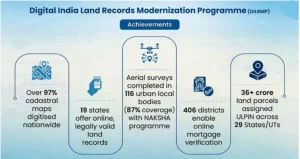
Achievements
- Higher Investor Confidence: Policy stability, regulatory simplification, and improved ease of doing business have strengthened investor trust in the Indian economy.
- India received over USD 1 trillion in cumulative FDI inflows (2000–2025).
- Annual FDI inflows increased from around USD 36 billion in 2013-14 to over USD 80 billion in recent years.
- India continues to remain among the top global destinations for greenfield investments.
- Growth of Startups and MSMEs: Improved access to finance, simplified registration processes, and supportive policies have accelerated entrepreneurial growth.
- Recognised startups increased from 502 in 2016 to over 2.23 lakh by March 2026.
- Startups generated 23.3 lakh direct jobs.
- MSME registrations on the Udyam Portal increased from 10,000 (2020) to over 8.58 lakh registrations annually by 2026.
- Nearly 48% of recognised startups have at least one woman director or partner.
- Expansion of Digital Economy: The widespread adoption of Digital Public Infrastructure (DPI) has enhanced efficiency, transparency, and financial inclusion.
- UPI transactions increased from 2 crore transactions in FY 2016-17 to over 24,162 crore transactions in FY 2025-26.
- UPI transaction value rose from ₹0.07 lakh crore to around ₹314 lakh crore during the same period.
- UPI is used by 540 million+ individuals and 100 million merchants.
- Enhanced Tax Compliance and Formalisation
- GST taxpayers increased from around 60 lakh in 2017 to over 1.64 crore in 2026.
- The GST Network processed over ₹107.64 lakh crore in payments by April 2026.
- E-Way Bill generation increased from 15.74 crore (2018-19) to 188.27 crore (2025-26).
- Improved Logistics and Market Connectivity: Infrastructure and logistics reforms have reduced transaction costs and improved supply-chain efficiency.
- India’s rank in the World Bank Logistics Performance Index improved from 54th (2014) to 38th (2023).
- GeM achieved a cumulative Gross Merchandise Value (GMV) of ₹18.4 lakh crore.
- ONDC has expanded to 616+ cities with over 7.64 lakh sellers on the network.
UPSC Online Classes
Challenges
- Inter-State Regulatory Variations: Uneven implementation of reforms across states creates compliance uncertainty, as businesses face differing procedures for land approvals, labour regulations, and local clearances despite national-level reforms.
- Contract Enforcement Issues: Judicial delays and case pendency increase transaction costs and reduce investor confidence; over 5 crore cases remain pending across Indian courts, affecting timely dispute resolution.
- Land Acquisition Bottlenecks: Complex acquisition procedures and ownership disputes continue to delay industrial and infrastructure projects, increasing project costs and implementation timelines.
- Infrastructure Gaps: High logistics costs and inadequate connectivity in rural and backward regions reduce competitiveness; logistics costs in India remain around 13–14% of GDP, higher than many developed economies.
- Digital Readiness of MSMEs: Limited digital literacy and technological adoption among micro and small enterprises constrain effective utilization of GST, e-invoicing, ONDC, and other digital compliance platforms.
- Access to Timely Credit: Despite policy interventions, many MSMEs face financing constraints due to limited collateral, high perceived risks, and dependence on informal credit channels.
- Regulatory Overlaps: Multiple approvals from different authorities often result in duplication, compliance burden, and delays, particularly in sectors such as construction, manufacturing, and mining.
Way Forward
- Strengthen Cooperative Federalism: Greater harmonisation of state-level regulations can create a more uniform and predictable business environment.
- Accelerate Judicial Reforms: Dedicated commercial courts and faster dispute resolution mechanisms can improve contract enforcement.
- Deepen Digital Governance: Expanding integrated digital platforms can further reduce compliance burden and administrative delays.
- Enhance Logistics Efficiency: Investments in multimodal transport and supply-chain infrastructure can reduce transaction costs and improve competitiveness.
- Promote Trust-Based Regulation: Further decriminalisation of minor offences and rationalisation of compliances can foster a more business-friendly ecosystem.
Click to Know UPSC OnlyIAS Coaching Centres
Conclusion
India’s Ease of Doing Business reforms reflect a paradigm shift from regulatory control to facilitative governance. Sustained efforts in digitalisation, compliance reduction, and institutional reforms will be crucial in transforming India into a globally competitive investment destination and realizing the vision of Viksit Bharat 2047.
 8 Jun 2026